Agentforce Pricing in 2026: Flex Credits vs Per-User
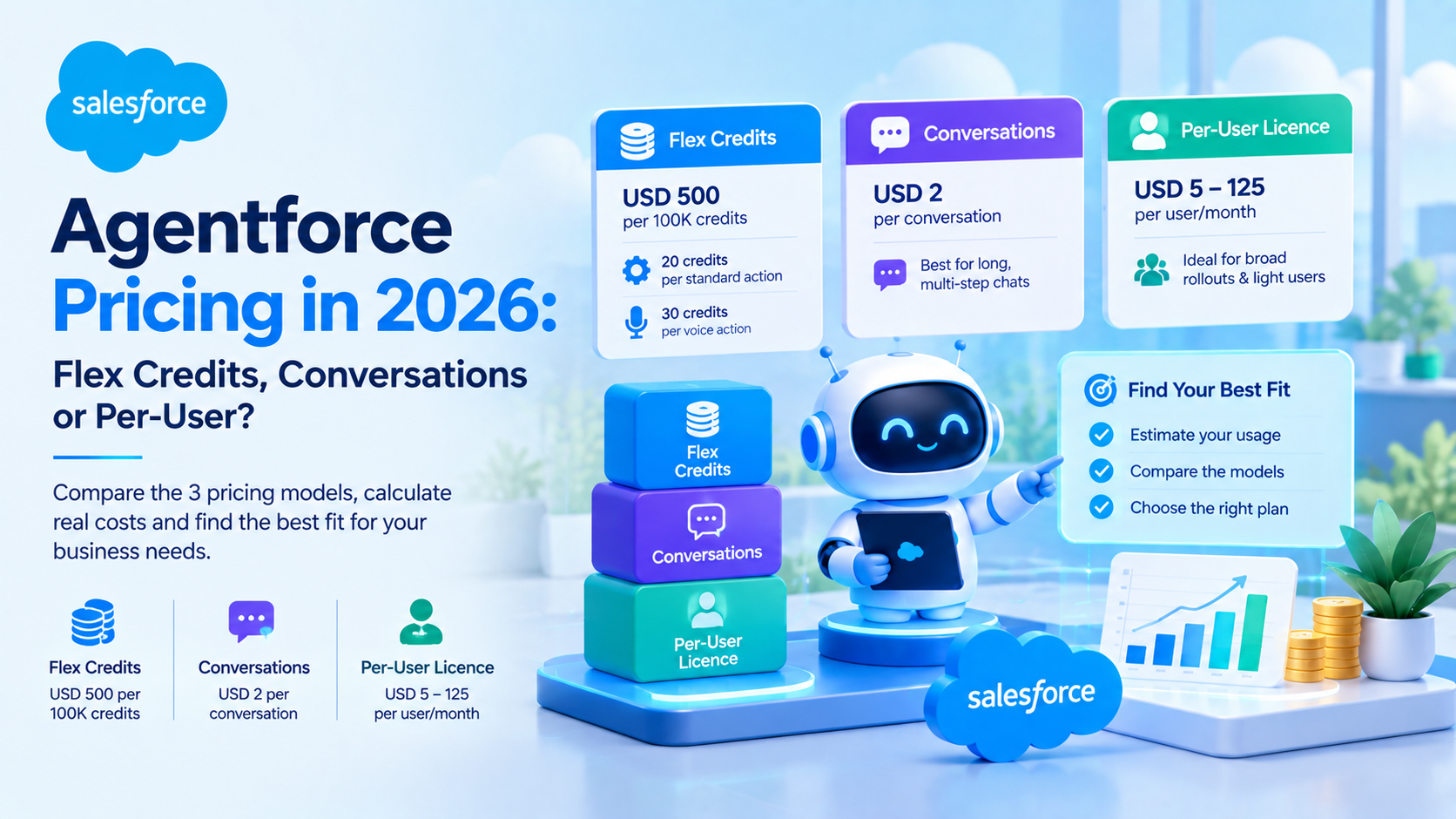
Agentforce pricing in 2026 runs on three models: Flex Credits at USD 500 per 100,000 credits, where a standard agent action consumes 20 credits and a voice action 30; per-conversation pricing at USD 2 per customer conversation; and per-user licensing from USD 5 per user per month up to USD 125 for the unmetered add-on. Which is cheapest depends entirely on actions per conversation.
How does Agentforce pricing work in 2026?
Agentforce is priced on consumption rather than seats by default, which is a genuine break from how Salesforce has historically charged. The unit is an action, meaning a discrete thing the agent does: updating a record, answering a product question, summarising a case, or running a flow or prompt template.
Salesforce's published Agentforce pricing sets out the following:
| Model | Price | Best fit |
|---|---|---|
| Flex Credits | USD 500 per 100,000 credits | Variable or unpredictable volume, internal and external agents |
| Conversations | USD 2 per conversation | Customer-facing agents with long, multi-step conversations |
| Agentforce User Licence | USD 5 per user per month (Flex Credits still required) | Broad rollout where most users are light consumers |
| Agentforce add-on | USD 125 per user per month | Heavy internal use by a defined team, unmetered |
| Agentforce Industries add-on | USD 150 per user per month | Industry cloud users needing sector-specific AI |
| Agentforce 1 Editions | From USD 550 per user per month, including 1M Flex Credits and 2.5M Data Cloud Credits per org per year | Full platform consolidation with AI built in |
Three buying models sit on top of those prices: Pre-Purchase, where you pay upfront for a credit block; Pre-Commit, monthly billing against a baseline commitment; and PayGo, monthly billing for actual usage with no commitment.
What is a Flex Credit, and what does one action actually cost?
A Flex Credit is the consumption unit. At USD 500 per 100,000 credits, one credit costs USD 0.005, and Salesforce states that Agentforce actions consume 20 Flex Credits while Agentforce Voice actions consume 30.
Working that through:
- One standard agent action: 20 credits, so USD 0.10
- One voice action: 30 credits, so USD 0.15
- A block of 100,000 credits buys 5,000 standard actions
- USD 1,000 per month of credit spend supports roughly 10,000 actions, or about 450 per working day
Hold onto the per-action cost, because it makes everything else tractable. An agent that resolves a typical enquiry in six actions costs about USD 0.60 per enquiry, and comparing that with the loaded cost of the same enquiry handled by a service agent usually settles the business case in one direction or the other within a few minutes.
One caveat before those figures go anywhere formal. Salesforce publishes credit consumption per action, the 20 and the 30, but the dollar-per-action numbers above are derived from the credit block price rather than quoted directly, and third-party analyses have circulated conflicting per-action figures. Confirm the rate in your own quote before it reaches a board paper.
Unused credits generally expire at the end of the subscription term rather than rolling over, which is the main argument against a large Pre-Purchase block in year one.
Where is the break-even between Flex Credits and per-conversation pricing?
A conversation costs USD 2. At USD 0.10 per action, USD 2 buys 20 actions. So:
- Under 20 actions per average conversation, Flex Credits are cheaper.
- Consistently over 20 actions, per-conversation pricing caps your exposure and wins.
Most well-scoped customer service agents, handling order status, appointment booking, returns initiation or policy questions, resolve in five to twelve actions. Those belong on Flex Credits.
Agents running long diagnostic conversations, multi-system troubleshooting, or repeated retrieval across large knowledge bases can exceed 20 actions per conversation, and per-conversation pricing becomes the safer commercial structure. In our experience the second category is also where action counts are hardest to predict, which is a second reason to prefer the capped model there.
Against the per-user models, the arithmetic runs the same way. The Agentforce add-on at USD 125 per user per month with unmetered internal usage breaks even against Flex Credits at 1,250 actions per user per month, or roughly 57 actions per user per working day. A sales rep asking an agent to summarise accounts and draft follow-ups a few times a day will not come close. A support team using an agent on every case might. Measure before you commit.
Why we start clients on PayGo even when it costs more per action
PayGo carries the highest effective rate of the three buying models, and the discount for committing upfront is real money. The obvious move is to estimate consumption, take the Pre-Purchase block, and bank the saving. Salesforce account teams will encourage exactly that, and on paper it is the cheaper option.
We advise against it for a first agent, and the reason is not caution for its own sake. Nobody can forecast credit consumption accurately before running an agent on real traffic. The estimate is built on sandbox action counts and an assumed containment rate, and both of those numbers move substantially in the first two months of production.
They usually move downward, because tuning instructions and subagent scope reduces actions per conversation. A Pre-Purchase block sized on pilot numbers therefore buys headroom you no longer need, and since unused credits expire at term end rather than rolling over, the saving evaporates.
The case where the commitment wins is a second or third agent in an org already running production traffic, where you have twelve weeks of real consumption data and the forecast is an extrapolation rather than a guess. That is the point to negotiate a Pre-Commit baseline, not before.
How do you estimate your Agentforce bill in five steps?
- Pick one use case and count the actions. Build the agent in a sandbox, run 20 representative conversations, and record actions consumed per conversation. The entire estimate rests on this number and it cannot be guessed.
- Multiply by real volume. Take actual monthly case volume for that use case, not the total across the business. Apply a containment assumption, meaning the share of conversations the agent resolves without escalating, and be conservative: 40 to 60 per cent is a realistic band for a first agent.
- Add testing consumption. Salesforce's Agentforce Testing Center notes that running tests consumes requests and credits and can modify CRM data, so tests belong in a sandbox. Batch regression runs during development are a real line item.
- Price all three models against the same volume. Compute monthly cost under Flex Credits, per-conversation and the relevant per-user option. The ranking often surprises people, and it changes as containment improves.
- Add the Data Cloud dependency. Agentforce grounds answers in your data, retrieval typically runs through Data Cloud, and Data Cloud is metered separately on its own credit model. An estimate that omits it is incomplete.
Re-run the whole thing after 60 days in production, because the number that mattered most in step 1 will have changed.
What drives Agentforce costs up unexpectedly?
Four patterns account for most of the overruns we see when reviewing agent builds.
Over-broad topic scope. An agent whose subagents, the components formerly called topics and renamed from April 2026, overlap will reason across more of them per turn and consume more actions to reach the same answer. Tight, mutually exclusive scoping is a cost control as much as a quality one.
Chatty retrieval. Grounding an agent on a large, poorly filtered knowledge set means more retrieval per turn. Narrowing the knowledge source to what the agent genuinely needs reduces both cost and hallucination rate.
Unmanaged testing. Automated regression suites running on every commit consume credits steadily. Worth doing, worth budgeting.
Low containment left unmeasured. This is the one that should worry a buyer most, because it is a structural property of consumption pricing rather than a configuration mistake. Agentforce bills for the attempt, not the outcome. An agent that handles 30 per cent of conversations and escalates the rest charges you for every failed attempt and then you pay a human to resolve it anyway.
At low containment the model is a duplicate cost, not an investment, and the billing gives you no signal that this is happening. Containment has to be instrumented deliberately and reviewed monthly, because nothing in the pricing will tell you.
The related limitation is worth stating plainly: an agent grounded in incomplete or contradictory data does not fail loudly. It produces confident wrong answers at USD 0.10 an attempt, and the cost of that lands on your service team rather than your Salesforce bill.
Is Agentforce adoption real, or still mostly pilots?
The revenue trend suggests it has moved past pilots. In its first quarter fiscal 2027 results announced on 27 May 2026, Salesforce reported Agentforce annual recurring revenue of USD 1.2 billion, up 205 per cent year on year, with combined Agentforce and Data 360 ARR reaching nearly USD 3.4 billion on total quarterly revenue of USD 11.1 billion.
For a buyer that matters in two practical ways. The product is receiving sustained investment and shipping meaningfully each release, so a build today will not be orphaned.
It also means Salesforce commercial teams have strong incentives to bundle Agentforce into renewals. When an Agentforce 1 edition appears in a renewal quote at USD 550 per user per month, price it against your measured action volume rather than accepting it as the default. We have seen that quote arrive for orgs with no agent in production and no action count to test it against.
Frequently Asked Questions
What counts as one Agentforce action?
Salesforce defines an action as a specific function an agent executes on the platform: updating a record, summarising a case, answering a product enquiry, or running a custom prompt or flow. A single conversation typically involves several actions. Standard actions consume 20 Flex Credits and voice actions consume 30.
Can we try Agentforce without buying credits?
Yes, to a degree. Salesforce Foundations includes Agentforce Builder, Prompt Builder, Agent Script and related tooling at no cost, and Enterprise Edition orgs and above have historically received an allocation of free Flex Credits through Foundations. That is enough to build and test an agent, not to run production traffic. Confirm the current allocation with your account team.
Do unused Flex Credits roll over?
Generally no. Unused credits expire at the end of the subscription term, which makes large upfront Pre-Purchase blocks risky before you have production consumption data. Starting on PayGo or a modest Pre-Commit baseline, then raising the commitment once actual usage is known, usually costs less overall.
Is the Agentforce add-on at USD 125 per user worth it over Flex Credits?
Only for genuinely heavy internal users. The break-even is around 1,250 actions per user per month, roughly 57 per working day. Support teams using an agent on every case can reach that; sales teams using one for occasional summaries and drafts rarely do. Measure a month of real usage before switching models.
Do we need Data Cloud to run Agentforce?
In practice, yes, for any agent that must answer from your own data. Agentforce grounds responses in unified data and retrieval usually runs via Data Cloud, which is metered on a separate credit model. Budget both, and treat data readiness as a prerequisite rather than a parallel workstream.
Get an action count before you get a quote
The Agentforce quotes we are asked to review usually share one problem: nobody has measured actions per conversation for the use case being priced, so every model in the quote is being compared against a guess. Build one agent in a sandbox, run 20 real conversations through it, and you will have the only number that matters. If you would rather have that measured independently of the vendor, get in touch or read about our Salesforce consulting services.
Have Questions or Need Assistance?
Our team of Salesforce experts is ready to help you implement the solutions discussed in this article.
Contact Us Today