Agentforce vs Copilot Studio: What an Agent Costs
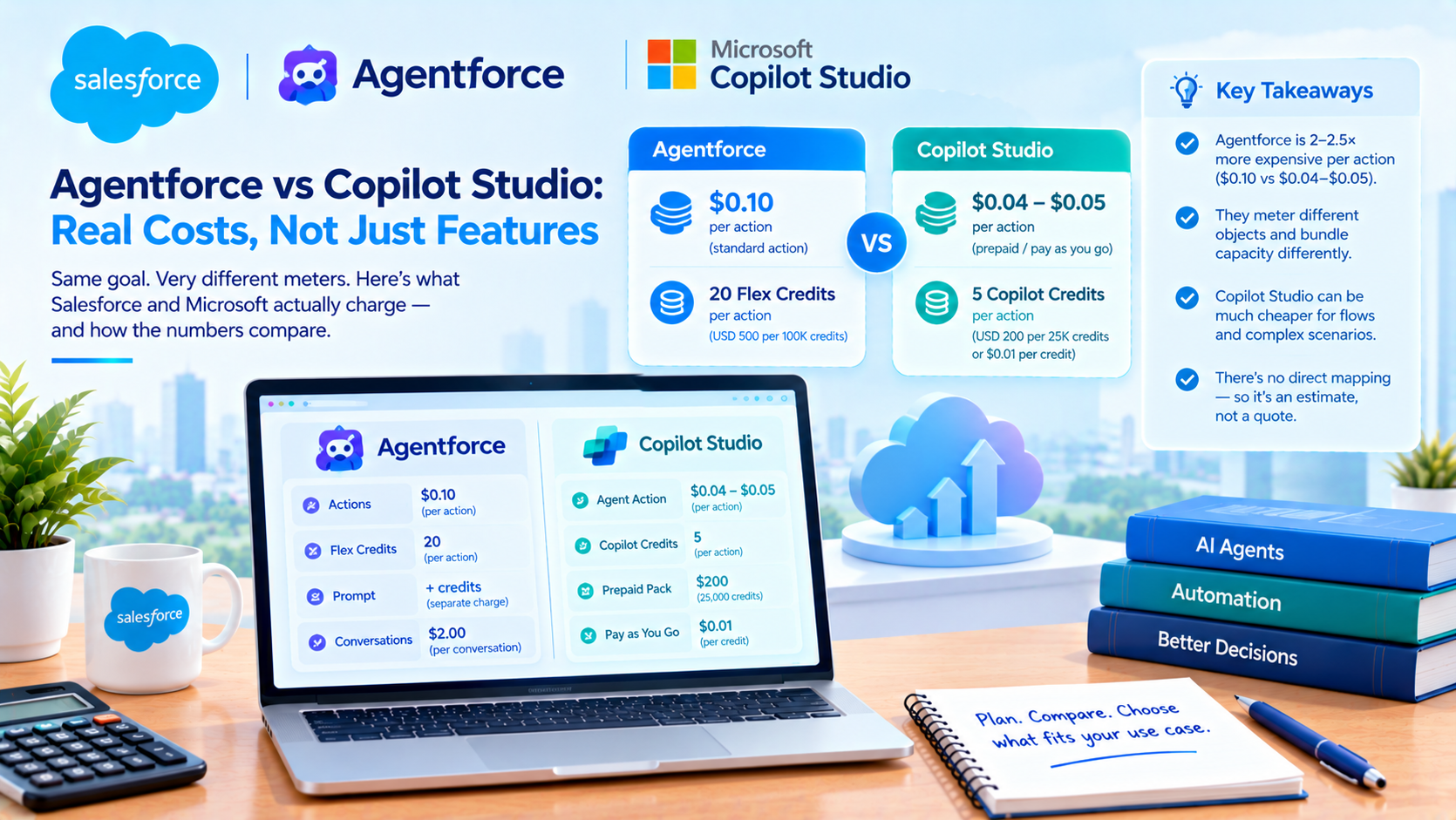
On published rates, one standard Agentforce action costs USD 0.10 and one Copilot Studio agent action costs USD 0.04 on prepaid capacity or USD 0.05 pay as you go. Agentforce charges 20 Flex Credits per action at USD 500 per 100,000 credits. Copilot Studio charges 5 Copilot Credits per agent action, at USD 200 per 25,000-credit pack or USD 0.01 per credit on demand. So Agentforce is two to two and a half times the price per action.
That is the only clean like-for-like number in this comparison, and it is not the number that should decide it. The two platforms meter different objects, bundle capacity differently, and behave completely differently when you run out. One bills you. The other switches your agents off.
Everything below was verified directly on Salesforce's and Microsoft's own pages on 19 October 2026. Both vendors state their pricing is subject to change, and both have changed it this year.
How does each platform meter an agent?
Agentforce meters in Flex Credits, with the dollar rate on the Agentforce pricing page and the multipliers on a separately published rate card dated 31 August 2026. Credits are "fungible across Actions, Prompts, Translations, and Voice Actions".
| Agentforce usage type | Production credits | Sandbox credits |
|---|---|---|
| Standard or custom action | 20 | 16 |
| Standard or custom voice action | 30 | 24 |
| Basic prompt | 2 | 2 |
| Standard prompt | 4 | 4 |
| Advanced prompt | 16 | 16 |
| Help agent resolution | 400 | 0 |
| Slackbot standard action | 40 | not published |
| Headless 360 platform interaction | TBA | TBA |
Two details from that card change the arithmetic. Prompts are charged in addition to actions, not instead of them, and the sandbox discount is 0.8 on actions only: prompts cost the same in a sandbox as in production. Also note the last row. One of the products Salesforce folded into its reported Agentforce revenue metric this year has no published credit rate at all.
Copilot Studio meters in Copilot Credits, and the unit was renamed this year. Microsoft's capacity management documentation now states: "Copilot Credits are the unit that measures agent usage." Anything you read that prices Copilot Studio in "messages" or "message packs" is describing a retired model.
| Copilot Studio feature | Copilot Credits | Charged to a Microsoft 365 Copilot licensed user |
|---|---|---|
| Classic answer | 1 | No charge |
| Generative answer | 2 | No charge |
| Agent action | 5 | No charge |
| Tenant graph grounding | 10 | No charge |
| Agent flow actions, per 100 actions | 13 | No charge |
| Content processing tools, per page | 8 | No charge |
| GenAI Voice, per minute | 35 | No charge |
Look at the agent flow row twice. Microsoft charges 13 credits per hundred agent flow actions, which is 0.13 credits per step, against 5 credits for an agent action. The same work, architected as a flow rather than as discrete agent actions, is roughly 38 times cheaper on Microsoft's meter. There is no published mapping between a Salesforce action and a Microsoft agent flow action, so this is the largest single reason any cross-platform cost model is an estimate rather than a quote.
The dollar rates, from Microsoft's licensing guidance: prepaid capacity pack USD 200 per pack per month billed annually for 25,000 credits, pay as you go "$0.01/Copilot Credit" billed in arrears, Copilot Studio user licence USD 0, and Microsoft 365 Copilot at "$30 per user/month".
What does a 10,000-interaction agent cost per month?
Here is the arithmetic, with the assumptions stated plainly because they are ours and not published by either vendor.
Our assumptions, which you should replace with your own: 10,000 customer interactions per month, three actions per interaction, one model-generated answer per interaction, production only, no voice, and no grounding or data platform charges counted.
| Scenario | Monthly, at published rates | Annual |
|---|---|---|
| Copilot Studio, prepaid packs | 1,360 to 1,400 | ~16,500 |
| Copilot Studio, pay as you go | 1,700 | 20,400 |
| Copilot Studio, prepaid plus tenant graph grounding | 2,160 | ~25,900 |
| Agentforce, Flex Credits, actions only | 3,000 | 36,000 |
| Agentforce, Flex Credits plus one standard prompt per interaction | 3,200 | 38,400 |
| Agentforce, Conversations | 20,000 | 240,000 |
All figures USD. The credit rates and dollar rates are published and verified. The activity assumptions are ours.
The working: 10,000 interactions at three actions each is 30,000 actions, at 20 credits each is 600,000 credits, at USD 0.005 per credit is USD 3,000. On the Microsoft side, one generative answer at 2 credits plus three agent actions at 5 credits each is 17 credits per interaction, 170,000 credits a month, which is USD 1,700 at the pay as you go rate or about USD 1,360 at the prepaid unit rate. This is the same way Salesforce's own worked examples on its pricing page count credits, and the page attaches two disclaimers to those examples that we will repeat: "The credit usage example provided is for illustrative purposes only" and "This example does not include other costs like Data 360 credits or other consumption services."
The Conversations row deserves its own point, because it is the most useful piece of arithmetic in the whole comparison. Conversations are USD 2 each. A standard action is USD 0.10. So the break-even is 20 standard actions per conversation. Below 20 actions, Flex Credits are cheaper. Above 20, Conversations are. At three actions per interaction, Conversations costs 6.7 times more.
And this is a one-way door. Salesforce's FAQ is unambiguous: "No. Flex Credits and Conversations will not be supported in the same org." You pick one model for the whole org, which means a simple deflection agent and a complex multi-step service agent have to share a billing model that suits one of them.
Where this comparison stops being like for like, and you should assume all of these apply to you:
- Bundled capacity differs structurally. A Salesforce Max edition seat at USD 550 per user per month includes 2.75 million Flex Credits per org per year, which covers about 38% of the 600,000 credits a month above. Copilot Studio capacity is bought separately from any Microsoft 365 Copilot licence, and the Copilot Studio user licence itself is USD 0. There is no published way to net a seat allowance off a meter.
- Turns per interaction are unpublished on both sides. Microsoft bills per answer, Salesforce bills per action plus per prompt, and neither publishes an answers-per-conversation figure.
- Grounding is metered incommensurably. Microsoft charges a flat 10 credits for tenant graph grounding. Salesforce meters grounding through Data 360 per million rows or per megabyte across four volume tiers. Converting rows processed into interactions needs your data model, not a formula.
- Voice units are different objects. 30 credits per voice action against 35 credits per voice minute, with no published actions-per-minute figure. Worse, the Salesforce rate card notes that some customers are billed in Agentforce Voice Minutes instead, a usage type for which no rate is published at all.
- Microsoft publishes no sandbox or non-production rate. Salesforce publishes 0.8. Any dev and test cost comparison is guesswork.
- Salesforce's own pages disagree at the same price point. The Agentforce pricing page gives Agentforce 1 Editions "2.5M Flex Credits per org per year" from USD 550 per user per month, while the Core, Advanced and Max editions announced in September 2026 put 2.75 million credits in Max at the same USD 550. Two published figures, one price. Ask which SKU your quote actually names.
What happens when you run out of capacity?
This is the contrast that matters more than the per-action price, and both halves of it are the vendors' own words.
Salesforce: "There is no overage penalty. If you exceed your entitlement, your rate is your contracted rate billed monthly in arrears." Over-commitment is the expensive mistake, not under-commitment, because "Unused Flex Credits do not roll over into subsequent subscription terms."
Microsoft: "Enforcement is triggered when a tenant reaches 125% of their prepaid capacity." At that point, "Custom agents are disabled. Disabling an agent doesn't interrupt an ongoing conversation. All subsequent attempts to invoke the agent are rejected until capacity is increased or reset." End users see one of two messages, and Microsoft publishes both: "There is a billing issue." and "This agent is currently unavailable. It has reached its usage limit." The licensing guidance is blunter: "Technical enforcement (including service denial) will result for usage that is over the purchased capacity." Agent flows behave slightly differently, blocking new runs rather than disabling the agent, and "Enforcement resets monthly when prepaid Copilot Credits are renewed."
So one platform turns a demand spike into an invoice and the other turns it into an outage. If you are putting a customer-facing agent on Copilot Studio, the Copilot Credit forecast is an availability control, not a finance exercise, and it belongs in the same runbook as your other capacity alarms. Salesforce's equivalent risk is a bill nobody saw coming, which is why its own page tells you to set Digital Wallet alerts.
There is one more Microsoft constraint behind the pricing that is easy to miss: generative AI throughput is coupled to how much capacity you own. At 1 to 10 prepaid packs the published quota is 50 requests per minute and 1,000 per hour; at 51 to 150 packs it is 100 per minute and 2,000 per hour. The 10,000-interaction workload above sits at around seven packs, which puts it in the 1,000 requests per hour band. That is a real ceiling for a bursty service workload, and buying capacity you do not need for credits may be the only published way to raise it. Salesforce publishes no comparable coupling.
Can each platform reach the other's data?
Not symmetrically, and this is where the architecture decision usually gets made.
Microsoft into Salesforce is mature and fully documented. The Salesforce connector for Copilot Studio publishes create, update, delete and upsert operations, Bulk API job operations, read operations including "Execute a SOQL query" and "Execute SOSL search query", and record-change triggers for created and modified records. Published throttling is 900 API calls per connection per 60 seconds with a maximum of 50 concurrent requests. Two caveats carry real weight: the connector class for Copilot Studio is Premium, and it is unavailable in US Government (GCC), GCC High, DoD and China (21Vianet). Separately, Copilot Studio can take Salesforce Knowledge as a knowledge source with "No limit on number of articles or article size", synced every four to six hours.
Salesforce into Microsoft is a chat surface plus a beta ingestion path. Agentforce can be surfaced inside Teams through the Salesforce IT Service and IT Desk apps, which is a presentation channel rather than data access: that setup says nothing about reading Microsoft 365 mail, calendar or files. The data path is Agentforce Coworker, and its limits page is explicit that its figures are enforced, prefacing them with "Hard limits are enforced by the platform and can't be adjusted":
| Agentforce Coworker source | Published hard limit |
|---|---|
| SharePoint, total file volume per site | 10 to 15 GB |
| SharePoint, files per site per ingestion | 5,000 |
| SharePoint, file size | PDFs 100 MB, other files 4 MB |
| SharePoint, incremental ingestion frequency | 1 hour |
| Search agent AI answer | 100 requests per minute |
Agentforce Coworker is labelled Beta on every page of its guide. And that 4 MB cap on non-PDF files covers Office documents, which is most of a real SharePoint estate. Compare Copilot Studio, which handles SharePoint files up to 200 MB when a Microsoft 365 Copilot licence is present in the tenant, and up to 512 MB per individual file.
We found no documented first-party path for an Agentforce agent to read or write Outlook mail or calendar data. That is an absence of evidence rather than proof none exists, and we did not exhaustively check every activity-capture and middleware route, but it is not documented where you would expect to find it.
On MCP, both directions exist and only one is generally available. Microsoft announced "the general availability of MCP integration in Copilot Studio" in May 2025, with SSE transport remaining in public preview and MCP requiring generative orchestration. On the Salesforce side, Hosted MCP Servers can expose agent-backed and prompt-backed tools, with the Einstein Trust Layer applied and the authenticated user's sharing rules and field-level security respected, and one documented restriction worth planning around: only agents built with the new Agent Script Builder can be exposed as MCP tools. The more capable Headless 360 MCP Server is still, as of today, "a Beta Service, available starting in July 2026", under Beta Services Terms. Its four tools cover discovery, description and dispatch across GET, POST, PUT, DELETE and PATCH, and Salesforce's own guidance is to require approval in the MCP client before any tool that changes configuration or deletes data, and to test in a sandbox first.
Which limits are enforced, and which are advice?
Salesforce labels this distinction. Microsoft does not, and that asymmetry is itself a finding.
From Salesforce's Agentforce Considerations article:
| Agentforce limit | Published wording | Status |
|---|---|---|
| 100 agents per org | "You can have up to 100 agents and, within that 100, you can have one version of the default Agentforce agent" | Enforced |
| 10 actions per subagent, 10 subagents per agent | "For best performance, we recommend assigning no more than 10 actions to a subagent, and 10 subagents to an agent" | Recommendation |
| Action timeout 60 seconds | "Agent actions time out after 60 seconds" | Enforced |
| Reasoning timeout 30 seconds | "Reasoning engine requests time out after 30 seconds" | Enforced |
| Output truncation 65,000 characters | "Agent action outputs over 65,000 characters are truncated" | Enforced |
The 10 and 10 figures get quoted as caps constantly, including by people selling Agentforce work. They are a performance recommendation. The enforced number in that neighbourhood is 100 agents per org, and the Agent API adds a separate enforced "120-second timeout. When a call times out, you receive an HTTP 500 response."
Microsoft's quotas and limits page, by contrast, labels nothing as hard, default or advisory. It says only that "You can configure Copilot Studio default quotas and adjust them for your custom agents on a case-by-case basis." The two exceptions we could identify are the model response stream timeout of five minutes, which "isn't configurable per agent or environment", and a Teams service limit of 10 sessions per user every 24 hours which the page does call enforced. Everything else on that page is a number with no stated enforcement status: 500 knowledge sources per agent, 1,000 topics, 100 skills, a maximum of 2 Dataverse knowledge sources per agent, 25 SharePoint site URLs per agent, SharePoint list queries returning only the first 2,048 rows, and a connector payload of 5 MB in public cloud against 450 KB in GCC.
For an architect, that means the Salesforce side can be designed against with confidence and the Microsoft side needs a support conversation to confirm which numbers move.
Where does each one lose?
Both vendors document their own weaknesses, which is more useful than any comparison blog, including this one.
Agentforce, in Salesforce's words: "Agents aren't available for Government Cloud." "Agents have limited API support." "Bringing your own model isn't supported." "Agent conversations aren't personalized based on past sessions", which is to say no cross-session memory. "In general, agents support one intent per utterance, so users can't make requests that span multiple intents." "Deactivating an agent interrupts any ongoing user conversations." Subagent and action instructions, including input and output instructions, are supported in English only, and providing them in another language may cause the reasoning engine to underperform. And from the Einstein Trust Layer documentation, a line worth reading to anyone pitching full autonomy: "We recommend that a human check each model response before sharing them with end users for the majority of use cases", followed by "You're ultimately responsible for any LLM-generated response you share with your customers."
Copilot Studio, in Microsoft's words: "Generative orchestration only supports English", and since MCP requires generative orchestration, MCP is English-only by composition. On autonomous agents, Microsoft documents a security characteristic that deserves more attention than it gets: "Currently, agents with event triggers use only the maker's credentials for authentication. Tools called by an agent in response to a trigger must also use the maker's credentials", with a pre-publish warning that this "might allow users of an agent without their own authorization the ability to access data and systems they shouldn't." Microsoft also documents that autonomy degrades when the model needs clarification: "For event-triggered or other autonomous executions, a generated tool call might fail when required input isn't available because no user is present to answer a follow-up question." The orchestration layer carries a 10-turn working context, and Computer-Using Agent usage is explicitly excluded from the Microsoft Copilot licence inclusion.
That inclusion is the single biggest commercial asymmetry in this comparison, and its scope is narrow in a way the headline hides. Employee-facing use of Copilot Studio agents is included in the Microsoft Copilot licence "when the user of the agent is licensed with Microsoft Copilot, and the agent operates using the authenticated Microsoft Copilot USL user's identity", subject to a fair use limit for which no number is published. Read the scope: Business to Employee. An agent handling 10,000 external customer interactions is outside it, so the USD 30 licence does nothing for that bill. An internal employee agent whose users are all licensed can see most of the Copilot Studio meter go to zero. That reading is ours, drawn from Microsoft's scope wording, and it is the thing to check first if your use case is internal.
How good is the evidence that either works at scale?
Thinner than either vendor's marketing implies, and asymmetric.
Salesforce discloses absolute figures because they are reported to the SEC. Its Q2 FY27 press release, for the quarter ended 31 July 2026, states "Agentforce ARR exceeded $1.5 billion, up over 240% Y/Y" and "Agentforce and Data 360 annual recurring revenue ("ARR") reached nearly $3.9 billion, up over 210% Y/Y", plus "7.0 billion Agentic Work Units ("AWUs") delivered to date across Agentforce and Slack, with 3.2 billion in Q2".
Ignore those percentages, and Salesforce's own disclosure explains why: "Effective Q2 FY27, Agentforce ARR includes our AI offerings, Slackbot and Headless 360." The definition of the numerator expanded in the quarter being celebrated, so the growth rate is not like for like. Use the absolute USD 1.5 billion and USD 3.9 billion. And note the wrinkle: Headless 360, now inside a reported revenue metric, is itself still a Beta Service with a credit rate published as "TBA".
On the Microsoft side we could not verify a single Copilot Studio seat, agent or organisation count on a Microsoft primary source. The widely circulated figures for custom agents built and organisations using Copilot Studio appear only on aggregator sites, so we are not repeating them. The one Microsoft-published usage figure we could verify is from October 2024 and is not Copilot Studio specific.
We also searched for an independent head-to-head evaluation of the two platforms and found none. What exists is vendor material and comparison listicles. Neither platform has published evidence that supports a "proven at scale" claim, and anyone telling you otherwise is quoting a marketing page.
How should you actually choose?
The honest version is that the per-action price is the least important input.
| If this is true of your use case | The platform that fits |
|---|---|
| Agent serves employees who already hold Microsoft 365 Copilot licences | Copilot Studio, where that usage is included subject to an unpublished fair use limit |
| Agent serves external customers at volume | Compare on real action counts. Copilot Studio is cheaper per action, Agentforce bundles credits with seats you may already own |
| Agent acts mostly on CRM records, with CRM sharing rules governing access | Agentforce, which runs natively inside the security model |
| Agent acts mostly on SharePoint, Teams and Office content | Copilot Studio, given Agentforce Coworker's beta status and 4 MB non-PDF cap |
| An outage is worse than an unexpected invoice | Agentforce, which bills overage in arrears rather than disabling agents at 125% |
| You run in Government Cloud | Neither as published. Agentforce states "Agents aren't available for Government Cloud" and the Microsoft Salesforce connector is unavailable in GCC, GCC High and DoD |
A workable evaluation sequence:
- Count the real work. Actions per interaction and interactions per month, measured from your current case or ticket volumes, not estimated.
- Classify the audience as employee or customer. That single answer moves the Microsoft cost by an order of magnitude.
- Price both meters at your own counts, using published rates only, and mark every assumption you had to supply.
- For Agentforce, calculate your actions per conversation against the 20-action break-even before choosing Flex Credits or Conversations, because the org gets one model.
- For Copilot Studio, model the requests-per-hour quota at the pack count your credits imply, not at the quota you would like.
- Decide which failure you can live with: a bill you did not forecast, or agents disabled at 125% of capacity.
- Build one agent on each platform against the same real workload if the decision is close. Both have free or near-free entry points, and two weeks of real traffic will tell you more than any pricing model.
Frequently Asked Questions
Is Agentforce more expensive than Microsoft Copilot Studio?
Per action, yes. A standard Agentforce action is 20 Flex Credits at USD 500 per 100,000 credits, so USD 0.10. A Copilot Studio agent action is 5 Copilot Credits at USD 0.008 prepaid or USD 0.01 pay as you go, so USD 0.04 to USD 0.05. Total cost depends on bundled credits, grounding and whether your users hold Microsoft 365 Copilot licences.
What happens if you exceed your Agentforce Flex Credits?
Nothing is disabled. Salesforce states "There is no overage penalty. If you exceed your entitlement, your rate is your contracted rate billed monthly in arrears." The greater risk is over-commitment, because "Unused Flex Credits do not roll over into subsequent subscription terms." Salesforce recommends Digital Wallet alerts to catch consumption before the invoice does.
What happens if you exceed your Copilot Studio capacity?
Microsoft grants a grace band, then enforces. "Enforcement is triggered when a tenant reaches 125% of their prepaid capacity", at which point "Custom agents are disabled" and further invocations are rejected until capacity is increased or reset. Agent flows block new runs instead. Enforcement resets monthly when prepaid credits renew, so treat the forecast as an availability control.
Can a Copilot Studio agent update Salesforce records?
Yes. The Salesforce connector publishes create, update, delete and upsert operations plus SOQL and SOSL queries and record-change triggers. Two constraints matter: its class for Copilot Studio is Premium, so licensing applies, and it is unavailable in US Government (GCC), GCC High, DoD and China (21Vianet).
Can Agentforce read SharePoint and Teams data?
Partly, and the data path is beta. Agentforce Coworker ingests SharePoint content under enforced hard limits of 10 to 15 GB per site, 5,000 files per ingestion, and 100 MB for PDFs but only 4 MB for other file types. Teams integration is a chat surface rather than data access, and we found no documented first-party path to Outlook mail or calendar.
Are 10 actions per subagent and 10 subagents per agent hard limits?
No. Salesforce's wording is "For best performance, we recommend assigning no more than 10 actions to a subagent, and 10 subagents to an agent." That is a performance recommendation. The enforced figures nearby are 100 agents per org, a 60-second action timeout, a 30-second reasoning timeout and 65,000-character output truncation.
Where to start
If both vendors are telling you their agent platform is the obvious choice because you already own the other half of their stack, the question that settles it is not price per action. It is whether your agent's users are employees or customers, and whether an agent being switched off at 125% of capacity is survivable in your service model. Those two answers eliminate one platform in most of the evaluations we have run. Send us your interaction volumes and audience split and we will price both meters against your actual numbers, or read more about how we approach Agentforce work first.
Have Questions or Need Assistance?
Our team of Salesforce experts is ready to help you implement the solutions discussed in this article.
Contact Us Today