How Much Does Salesforce Health Cloud Cost in 2026?
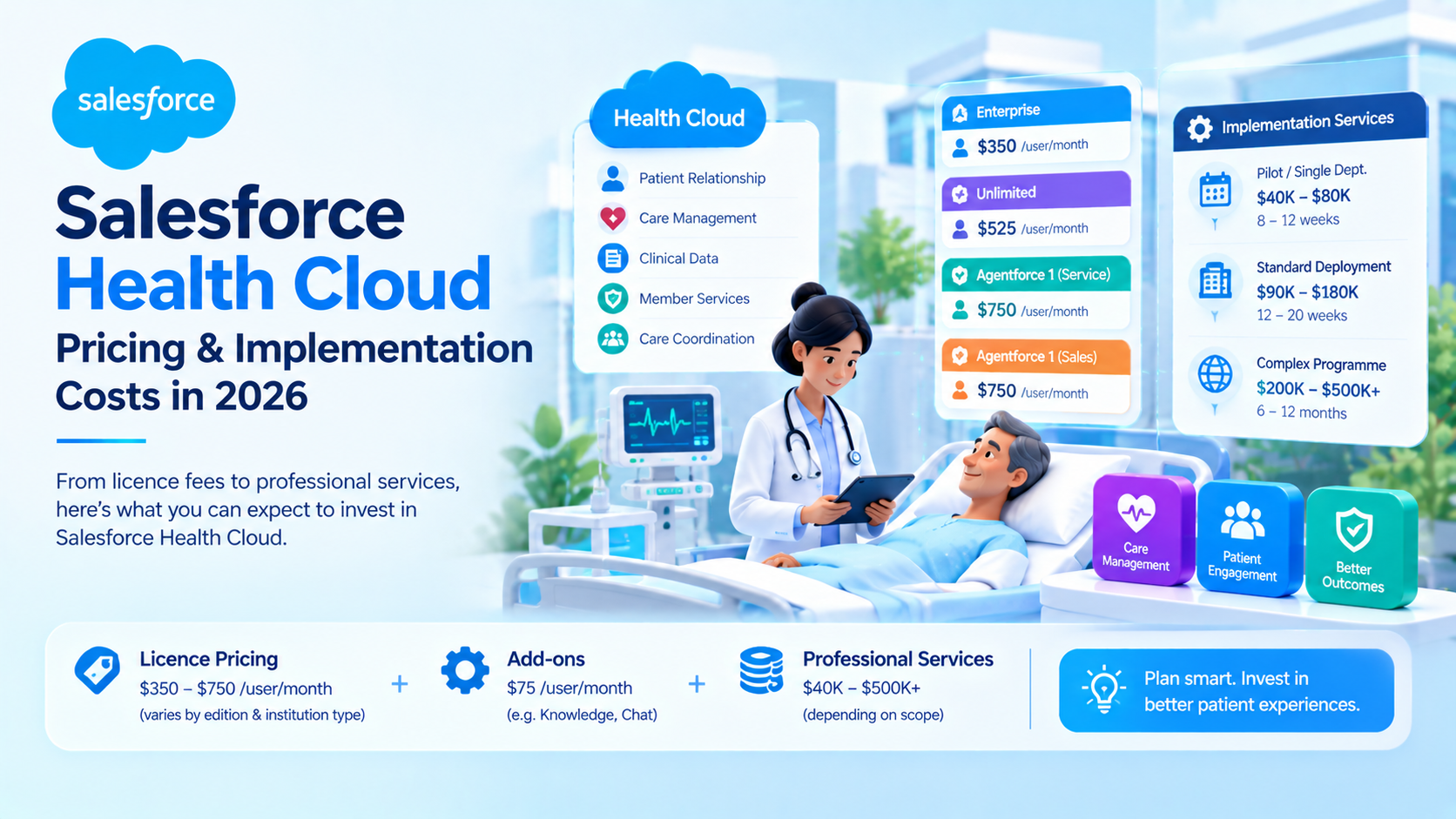
Salesforce Health Cloud is licensed from USD 350 per user per month on Enterprise Edition, USD 525 on Unlimited, and USD 750 on either Agentforce 1 edition, all billed annually. A typical first implementation adds USD 40,000 to USD 250,000 in professional services and takes 12 to 20 weeks, driven mostly by EHR integration and data migration scope.
Those are list prices, and very few organisations pay exactly them. What you spend depends on your volume discount, on how many staff genuinely need a full licence rather than a portal login, and on how much of the clinical workflow you are rebuilding rather than reproducing.
What Health Cloud is, and the one thing it will not replace
Health Cloud is Salesforce's industry edition for healthcare providers, payers, medtech manufacturers and life sciences organisations. It adds a clinical and insurance data model, with objects such as Patient, Care Plan, Clinical Encounter, Care Request and Member Plan, on top of the standard Salesforce platform. Prebuilt care management, utilisation management and patient intake components come with it, along with OmniStudio and FlexCards.
Buyers fall into three groups. Provider organisations use Health Cloud as a patient relationship and care coordination layer that sits beside the EHR rather than in place of it. Payers use it for member services, claims enquiries and utilisation management. Life sciences and medtech firms use it for patient support programmes, HCP engagement and device account management.
Health Cloud is not an electronic health record. It does not replace Epic, Cerner or athenahealth, and it is not where clinicians document care.
That distinction is commercial, not just architectural. The business cases we have watched collapse at finance review collapsed because they counted a clinical system saving that was never going to arrive. If your cost model has a line for retiring an EHR, remove it before the CFO finds it.
What does a Health Cloud licence cost in 2026?
Salesforce publishes four Health Cloud editions. All are billed annually, and every figure below is a list price in USD per user per month, taken from the official Health Cloud pricing page.
| Edition | Price (USD/user/month, billed annually) | What is included |
|---|---|---|
| Health Cloud Enterprise | $350 | Clinical and insurance data models, integrated care management, OmniStudio, FlexCards |
| Health Cloud Unlimited | $525 | Everything in Enterprise, plus more storage and automation, predictive and generative AI, Premier Success Plan, full sandbox |
| Health Cloud Agentforce 1 for Service | $750 | Everything in Unlimited, plus Agentforce for Health Cloud, Flex Credits, Data Cloud, Slack, Analytics, Customer Community Plus, Tableau Next |
| Health Cloud Agentforce 1 for Sales | $750 | Everything in Unlimited, plus Agentforce for Health Cloud, Flex Credits, Data Cloud, Slack, Analytics, Sales Performance Management, Tableau Next |
Common add-ons are priced separately: Knowledge (Read-Write) at USD 75 per user per month, and Chat or Facebook Messenger at USD 75 per user per month each on Enterprise.
Do two things before you count seats. Work out who genuinely needs a full Health Cloud licence, because referring physicians, patients and most portal users are served through Experience Cloud licences at a fraction of USD 350. Clients consistently overcount this on the first pass, sometimes by a third of the headcount they originally quoted us.
Then model your agent usage before choosing an edition. The Agentforce 1 editions bundle Flex Credits and Data Cloud, which lands cheaper than buying Agentforce as an add-on once conversation volume is real, and noticeably more expensive if you are only running a pilot.
What implementation adds on top of the licences
Professional services are the line that varies most and the one buyers underestimate. As a planning range for a first rollout:
| Scope | Typical services cost (USD) | Typical duration |
|---|---|---|
| Pilot or single-department rollout, no EHR write-back | 40,000 – 80,000 | 8 – 12 weeks |
| Standard provider or payer deployment, one EHR integration, data migration | 90,000 – 180,000 | 12 – 20 weeks |
| Multi-entity or multi-country programme, several source systems, custom care journeys | 200,000 – 500,000+ | 6 – 12 months |
Five things drive most of the spread between a USD 60,000 project and a USD 300,000 one: integration depth, the number of source systems, source data quality, regulatory scope, and how much is custom-built rather than configured.
Integration depth dominates the rest. A one-way nightly feed of demographics is straightforward work. Real-time bidirectional exchange with an EHR, the pattern Salesforce is now productising through its EHR Read-Write agent and partnerships with athenahealth and others in the Agentforce Health announcement, costs several times more and carries clinical governance overhead that has nothing to do with Salesforce.
Then budget the items that never appear in a licence quote: sandbox and storage overages, MuleSoft or another integration platform if you do not already own one, Salesforce Shield if your security review demands platform encryption and event monitoring, and 15 to 20 per cent of the initial build cost each year for enhancement and release management.
Why a first Health Cloud build takes 12 to 20 weeks
- Discovery and clinical process mapping (2–3 weeks). Document care pathways, referral flows and service desk journeys as they actually run, not as the policy manual describes them.
- Security and compliance groundwork (1–2 weeks, in parallel). Execute the Business Associate Agreement with Salesforce, agree what protected health information will and will not enter the org, and design the sharing model before anyone builds an object.
- Data model and org design (2–3 weeks). Decide what maps to the standard Health Cloud model and what genuinely needs custom objects.
- Integration build (3–6 weeks). EHR connectivity is the long pole. Read-only is far quicker than bidirectional write-back, which needs clinical sign-off as well as engineering.
- Configuration and automation (3–5 weeks). Care plans, intake flows, reporting, and Agentforce agents where they earn their place.
- Data migration and validation (2–4 weeks). Duplicate management rules need to be agreed before the load, not after.
- UAT, training and go-live (2–4 weeks). Clinical users need training on their own workflow, not a generic Salesforce tour.
Steps 4 and 6 are where schedules slip, and the cause is usually external. If your EHR vendor charges for interface work or runs a queue for integration requests, find that out in week one rather than week ten.
When Service Cloud with a custom data model beats Health Cloud
Health Cloud is not automatically the right answer for a healthcare organisation, and we have argued clients out of it.
For a specialist clinic group with about 30 users, a single scheduling system and no plan to integrate an EHR beyond a nightly demographics feed, we compared Health Cloud Enterprise against Service Cloud Enterprise with a small set of custom objects for episodes and referrals. Health Cloud lost on that engagement. The licence gap was substantial per user per month, and the clinic used perhaps a fifth of the clinical data model. Care plans, utilisation management and the payer objects were all sitting there unused, and unused objects still have to be governed, secured and explained to auditors.
What Health Cloud would have bought them was a data model already shaped like the one they would eventually need, plus the Agentforce Health agents when they were ready for them. That is a genuine advantage and it is why the same comparison flips the other way for larger organisations.
The dividing line, in our experience, is whether care coordination crosses teams, systems or legal entities. When it does, rebuilding the Health Cloud model in custom objects costs more than the licence ever would. When it does not, you are paying for a clinical model you will not use.
What Health Cloud handles badly
Two weaknesses come up on nearly every project, and neither appears in a demo.
Reporting on the clinical model is harder than buyers expect. The Health Cloud schema spreads patient context across several related objects, which is correct for a care coordination system and awkward for the standard report builder. Teams that want a single view of longitudinal patient activity usually end up in CRM Analytics or an external warehouse, and that is a budget line nobody planned for.
OmniStudio is the second. It is powerful for guided intake and assessment flows, and it is a distinct skill set with its own deployment behaviour. If your admin team is comfortable with Flow and nothing else, either train them properly or expect to keep a partner on retainer for anything OmniStudio touches.
Does Salesforce Health Cloud meet HIPAA requirements?
Health Cloud can be used in a HIPAA-compliant manner, but compliance is a shared responsibility rather than a product feature. Salesforce will sign a Business Associate Agreement covering the in-scope services. You remain responsible for how the org is configured: field-level security, sharing rules, login policies, audit trails, and what data ends up in fields never designed to hold protected health information.
Organisations with stricter security postures usually add Salesforce Shield for platform encryption, event monitoring and field audit trail. Treat that as a line item from the outset. Encrypting fields that are already in production use is disruptive and slow.
What ROI should a healthcare organisation actually expect?
Be sceptical of headline ROI figures, including the vendor's own. Salesforce publishes a customer case study citing 459 per cent ROI and USD 1.5 million in savings at MIMIT Health, and notes that one in three patients postpone doctor visits because of wait times or cost. Both figures come from a vendor-published case study. Treat them as an illustration of what is possible, not a forecast for your organisation.
The returns that reliably show up are narrower and easier to defend: reduced call handling time in patient contact centres, fewer abandoned referrals, faster prior authorisation turnaround, and a measurable drop in no-shows once reminders and rescheduling are automated. Pick two, baseline them before go-live, and you will have a business case that survives procurement within two quarters.
How to test a Health Cloud implementation partner
- Ask for healthcare-specific references rather than general Salesforce references. The data model is different enough that generic experience does not transfer cleanly.
- Ask who has integrated with your specific EHR. "We can integrate with anything" is not the same claim as "we shipped an Epic integration into production last year".
- Insist on a fixed-scope discovery phase before any fixed-price build. Anyone quoting a full implementation price before mapping your care pathways is guessing.
- Agree the handover model up front: documentation standards, admin training, and who owns the org after go-live.
Aptivus Solutions runs discovery-first engagements for that reason, and you can see what our Salesforce consulting covers before committing to a build.
Frequently Asked Questions
Is Salesforce Health Cloud worth it for a small clinic?
For a single clinic under roughly 20 users, Health Cloud at USD 350 per user per month is usually hard to justify. Sales Cloud or Service Cloud Enterprise with a light custom data model delivers most of the patient engagement value for far less. Health Cloud earns its price when care coordination spans multiple teams, systems or legal entities.
Does Health Cloud replace our EHR?
No. Health Cloud is an engagement and coordination layer, not a system of record for clinical documentation. It sits alongside Epic, Cerner, athenahealth or Meditech and synchronises with them. A business case that assumes EHR replacement will not survive contact with your clinical governance committee.
Can we start on Health Cloud Enterprise and upgrade later?
Yes. Moving from Enterprise at USD 350 to Unlimited at USD 525, or to an Agentforce 1 edition at USD 750, is a commercial change rather than a re-implementation. The usual trigger is Agentforce usage, or hitting the sandbox and storage allowances that the higher editions raise.
How much does Agentforce add to a Health Cloud deployment?
If you buy Health Cloud Agentforce 1 for Service or Sales at USD 750 per user per month, Flex Credits and Data Cloud are bundled. Buying Agentforce as an add-on to a lower edition is cheaper at low usage but crosses over quickly once agents handle meaningful volume. Model expected conversation volume before choosing.
What is the fastest realistic go-live for Health Cloud?
Eight to ten weeks, for a single department, with read-only EHR integration and a clean data migration. Anything faster usually means the integration or the migration has been deferred to a later phase. Deferring is a legitimate choice, but it should be a decision made openly rather than something the business discovers at go-live.
Sizing this before you sign
The expensive mistake here is pricing the licences accurately and the EHR integration by guesswork, then finding out in week ten that your clinical systems vendor has a queue and a day rate. Before you sign anything, get a written answer from that vendor on interface cost and lead time.
If you want a second opinion on the numbers, get in touch.
Have Questions or Need Assistance?
Our team of Salesforce experts is ready to help you implement the solutions discussed in this article.
Contact Us Today