Salesforce Automotive Cloud Pricing and Real Costs
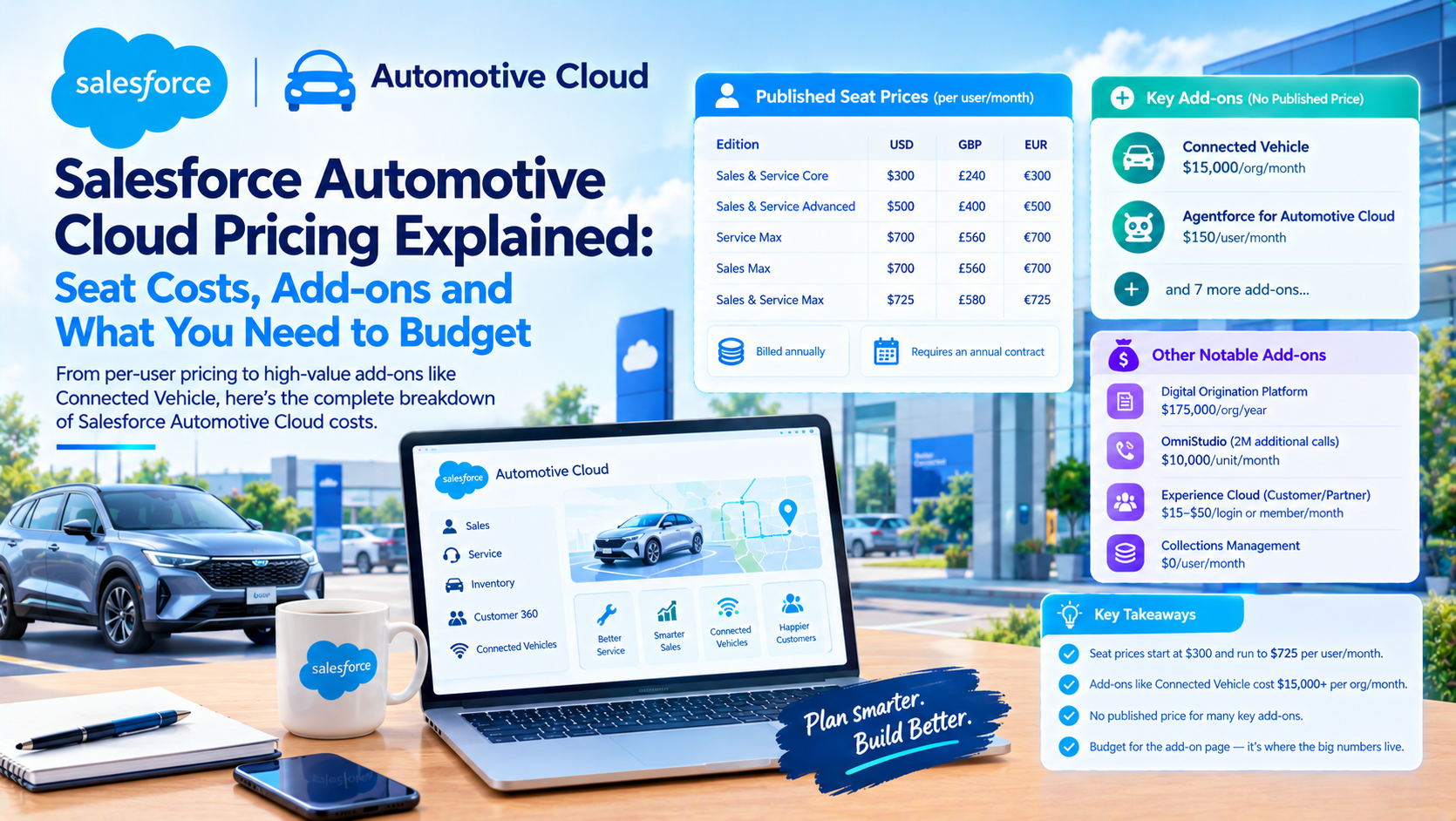
Salesforce Automotive Cloud list prices start at USD 300 per user per month for Sales & Service Core and run to USD 725 for Sales & Service Max, all billed annually. The capability most buyers assume they are purchasing, connected vehicle data, is not in any tier: it is a separate add-on at USD 15,000 per org per month. Budget the add-on page before the pricing page.
That is the whole commercial shape of this product in three sentences, and it is unusual enough to be worth the rest of the article. Salesforce publishes a complete per-seat ladder for Automotive Cloud, which almost nobody else in automotive software does. It then publishes a second page, linked from the first, where the six-figure annual line items live.
We have scoped Salesforce programmes for dealer groups, captive finance arms and one OEM aftersales function. The pattern in every one of them was the same: the seat cost was the number the buyer arrived with, and the add-ons plus the integration to the dealer management system were the numbers that decided the business case.
What does Salesforce Automotive Cloud cost per user?
Five tiers, verified directly on the Automotive Cloud pricing page on 26 October 2026. Every figure on that page carries the qualifier "(Billed annually)" and the page states "These editions require an annual contract."
| Tier | USD per user per month (published list price, verified 26 Oct 2026) | Flex Credits | Data storage |
|---|---|---|---|
| Automotive Cloud Sales & Service Core | 300 | 500K per org per year | 20MB per user |
| Automotive Cloud Sales & Service Advanced | 500 | 1M per org per year | 1GB per user |
| Automotive Cloud Service Max | 700 | 2.75M per org per year | 1GB per user |
| Automotive Cloud Sales Max | 700 | 2.75M per org per year | 1GB per user |
| Automotive Cloud Sales & Service Max | 725 | 2.75M per org per year | 1GB per user |
A footnote adds: "*Data 360 includes 1TB storage entitlement in the org".
Two things about that ladder are worth noticing before you model anything.
First, Automotive is the most expensive vertical ladder Salesforce currently publishes. The core clouds repriced to Core 195, Advanced 395 and Max 550 on 3 September 2026. Energy & Utilities runs Core 250 and Max 650 to 700 with no Advanced tier at all. Automotive sits above both at every rung, and Core at 300 is 54% above the core-cloud Core.
Second, the top tier is the one you are least likely to see. On the regional pages we checked, Sales & Service Max at 725 appears in the feature comparison table rather than as a pricing card. A buyer skimming the cards sees four tiers and a 700 ceiling.
The currency behaviour is worth one line, because it costs European buyers real money. The page offers six currencies, and the non-USD figures are fixed multiples rather than conversions: GBP is 0.80 of USD, AUD is 1.40, JPY is 120, SEK is 10, and EUR is set numerically equal to USD. At any realistic exchange rate a euro buyer pays a premium against the dollar list price. The seven regional pages we fetched (US, UK, EU, AU, IN, CA, AP) agree exactly on every figure, which is a pleasant change from MuleSoft and Net Zero Cloud, where the regional pages contradict each other outright.
Why the add-on page costs more than the pricing page
Salesforce publishes a second page, Automotive Cloud add-on features and pricing, carrying nine priced add-ons. These figures are published list prices, verified directly on 26 October 2026. The footnote on that page reads "*Total cost billed annually."
| Add-on | Published list price (verified 26 Oct 2026) |
|---|---|
| Connected Vehicle | $15,000/org/month |
| Digital Origination Platform | $175,000/org/year |
| Agentforce for Automotive Cloud | $150/user/month |
| Channel Revenue Management | $30,000/org/yr |
| OmniStudio, Additional Calls (2M) | $10,000/unit/month ($120,000/yr) |
| Asset Service Lifecycle Management | $75 user/month |
| Experience Cloud for Automotive (Customer Community Plus) | $15/login/month or $35/member/month |
| Experience Cloud for Automotive (Partner Community) | $20/login/month or $50/member/month |
| Collections Management | $0/user/month (with Automotive Cloud) |
Connected Vehicle at $15,000 per org per month is $180,000 a year, by our arithmetic on the published monthly figure. That is the line that reframes the whole budget. An OEM that reads "Automotive Cloud" and pictures vehicle telemetry flowing into service cases is picturing the add-on, not the tier.
Digital Origination Platform at $175,000 per org per year is the equivalent surprise for a captive finance arm. Loan and lease origination is not inside the seat price.
Agentforce for Automotive Cloud at $150 per user per month is a 50% uplift on Core. It is also, notably, a priced SKU with no published maturity designation. We looked for a GA, beta or pilot label on the Agentforce automotive pages and found none, while the marketing page carries the standard disclaimer that "Solutions may not be currently available, delivered on time or at all." Ask which release the capability you are being shown actually ships in, and get the answer in the order form.
Collections Management at $0 per user per month with Automotive Cloud is genuinely free and worth claiming.
A separate group of add-ons is named on the main pricing page with no figure at all: Automotive Cloud Intelligence, MuleSoft Direct for Automotive Cloud, Rebate Management, Loyalty Management, Security Center, Data Detect, Salesforce Backup & Recovery and Salesforce Archive among them. Automotive Cloud Intelligence and MuleSoft Direct do not appear on the add-ons page either, so no public price exists for them that we could find. Unpriced does not mean cheap. It means the number arrives with the quote.
The 20MB storage line is the sharpest number on the Core tier
Core includes 20MB of data storage per user. Advanced and all three Max tiers include 1GB per user. That is a 50x step for a 67% price increase.
At 250 seats, Core gives the entire org 5GB of data storage. Advanced gives 250GB. Salesforce charges roughly 2KB per record as an approximation, with named exceptions, so 5GB is on the order of 2.5 million records for a business whose central entities are vehicles, service events, finance agreements and warranty claims. A dealer group with 300,000 vehicles in its parc, each carrying service history, will reach that during the migration rather than after it.
Salesforce publishes no list price at all for additional data storage. We checked the platform add-ons page again this month and there is no storage line item on it, which means the price of growing out of Core is set in your negotiation rather than on a page.
So the Core to Advanced decision is frequently not a feature decision. In our experience it is a storage decision dressed as a feature decision, and it is better to make it deliberately at contract stage than to discover it in year two when the cost of the fix is a renegotiation rather than a line on the original order form.
What the data model actually contains, and what the DMS keeps
This is where an automotive programme succeeds or overruns, and the documentation answers it clearly if you read the object list rather than the brochure.
Automotive Cloud has a genuinely native vehicle model. The Automotive Cloud standard objects page documents 99 objects, and the vehicle specifications mapping confirms that Vehicle carries VehicleIdentificationNumber, VehicleRegistrationNumber, ChassisNumber, EngineNumber, residual and market value fields, and an IsTelematicsServiceActive flag. VehicleDefinition carries the specification attributes: body type, drivetrain, emission standard, fuel type, transmission, torque, wheelbase.
That matters because the comparable finding in Energy & Utilities went the other way. There is no native Meter object in that vertical. Here, VIN is a first-class field on a first-class object, and the finance and recovery models are deep: 13 objects covering financial accounts, balances, statements and transactions, 10 covering repossession, four covering credit bureau activity, 12 covering warranty and claims.
Now the gap. We searched the 99-object list for a repair order and there is none. No RepairOrder, no VehicleRepairOrder, no Dealer object (a dealer is an Account, a dealer location is a ServiceTerritory), and no object that stores telematics signal values as opposed to telemetry definitions and actions.
Salesforce is explicit about where the repair order lives. The STAR integrations overview lists exactly five standardised Business Object Documents, and the page describes their job as to "bring data into Automotive Cloud from any external system":
- Customer Information
- Repair Order
- Sales Lead
- Vehicle Inventory
- Vehicle Specifications
Three of those five, repair orders, vehicle inventory and vehicle specifications, are the operational core of a dealership. Salesforce documents them as things you bring in. The Repair Order BOD page says the integration "retrieves repair order data from external systems" and names no Salesforce object as the landing target.
Read precisely, that is not a product deficiency. It is a scope boundary, and it is the most useful thing in the documentation: Automotive Cloud owns the customer, the vehicle identity, the finance agreement and the warranty claim. The DMS keeps the repair order and the inventory.
The practical consequence is that the interface to the dealer management system is the variance driver in every estimate, exactly as the billing system interface is in utilities. How many service and inventory journeys your DMS answers synchronously decides whether the programme is six months or eighteen.
One caveat we will not overstate. Connected vehicle ingestion is documented, but the published reference architecture runs the pipeline through AWS IoT FleetWise, IoT Core, S3 and EventBridge, with Salesforce receiving event notifications. No Salesforce page we found states that Salesforce cannot store telemetry values. What we can say is that the documented architecture puts ingestion and event history outside Salesforce, and that the Connected Vehicle add-on costs $180,000 a year on top of that pipeline.
Two generations of edition naming are live at the same time
Salesforce's commercial surface and its developer documentation currently describe this product's licensing differently.
The pricing page sells Core, Advanced and Max. The Automotive Cloud standard objects page, current for Winter '27 and API 68.0, carries the line "Available in: Enterprise, Unlimited, and Developer Editions."
Neither page reconciles the two, and no sentence anywhere tells a buyer which platform edition the $300 figure assumes. We found this same pattern in Energy & Utilities, where four generations of naming were live at once, and the fix is the same:
- Get the legacy subscription name written into the order form alongside the new tier name.
- Get the entitlement table attached to the order form, not referenced by it.
- Ask specifically which edition gates each capability your design depends on.
There is one further gap specific to Automotive. Salesforce publishes an Additional Contractual Limitations annexe for Communications, Energy & Utilities, CME, Insurance, Health and Media & Entertainment. We could not find one for Automotive. Those annexes are where contractual volume caps live, the kind that read "B2C Order Management (5,000 Orders/year)". We found no document saying Automotive has no caps. We found no document. For a buyer that means the ceilings which are public for five sibling verticals are, here, visible only in your own order form, and the question belongs in writing to your account executive.
Per user or per rooftop: the buying-model question nobody models
The structural difference between Salesforce and the incumbent automotive platforms is not price. It is the meter.
Salesforce charges per user per month. Cost scales with headcount and is indifferent to how many rooftops or vehicles you run.
CDK Global charges per dealer per month for its packaged integrations. Its Partner Program Pricing Guide prices every line "(Per Dealer/Month)": a Service Appointment Writeback Package at $285 for the first application and $100 for each additional one, Front Office Writeback at $285, F&I Menu at $230, Vehicle Merchandising at $110, Customer Writeback at $65, a Base Extract-Only Fee of $28. That document carries a 2022 copyright and no issue date, so treat the figures as indicative of the model rather than current, but the model itself is the point.
Nobody in this category meters per vehicle, despite the vehicle being the unit of value in every one of these businesses. We looked specifically.
| Vendor | Publishes a price on its own site? | Metering unit |
|---|---|---|
| Salesforce Automotive Cloud | Yes, full public ladder | Per user per month |
| CDK Global | Partner and integration pricing only, dated 2022 | Per dealer per month |
| Reynolds and Reynolds | No | Not published |
| Cox Automotive (Dealertrack, VinSolutions) | No | Not published |
| Tekion | No | Not published |
| Keyloop | No | Not published |
| SAP | No automotive-specific price found | Not published |
| Oracle | No automotive-specific price found | Not published |
That an entire category publishes nothing is itself the finding, and it cuts both ways. Salesforce's transparency is real and worth crediting. It also means Salesforce is the only vendor whose number you can model before you talk to anyone, which can make it look expensive next to competitors whose number you simply do not have yet.
The arithmetic that follows from the meter is the one to run in week one. A 400-person OEM aftersales function with twelve locations pays Salesforce for 400 seats. A 40-person dealer group with twelve rooftops pays for 40. Per-user pricing favours businesses with few staff relative to their physical or vehicle footprint, and punishes the reverse. Add the per-org add-ons, which do not scale with seats at all, and a small-headcount buyer with Connected Vehicle can end up paying more in add-ons than in licences.
What 500K Flex Credits actually buys at Core
Flex Credits are consumed per action, and the multipliers come from the Flex Credits rate card. A standard Agentforce action costs 20 credits in production and 16 in sandbox. Prompts are charged in addition to actions, not instead of them.
So, our arithmetic on published multipliers rather than a Salesforce figure: 500,000 credits at 20 credits per standard action is 25,000 agent actions per org per year on Core, roughly 68 a day across the entire business. Max's 2.75M gives 137,500 actions a year, about 377 a day.
For a contact centre fielding service bookings those are small numbers, and the allocation is per org per year rather than per user, so it does not grow as you add seats. Beyond the entitlement, Salesforce's published position is that "There is no overage penalty. If you exceed your entitlement, your rate is your contracted rate billed monthly in arrears", and unused credits do not roll over. Over-committing is the more expensive error.
What an automotive implementation actually takes
These are Aptivus estimates based on comparable industry cloud programmes, not Salesforce figures and not quotes. Use them as a planning baseline to test real proposals against.
| Scope (our estimate, not a published figure) | Typical elapsed time |
|---|---|
| Customer and vehicle 360 with read-only DMS service history | 12 to 18 weeks |
| Plus case management, service scheduling and dealer territory model | 20 to 30 weeks |
| Plus finance account, origination or warranty claims handling | 30 to 44 weeks |
| Plus connected vehicle event handling and telemetry-triggered journeys | A further 14 to 24 weeks |
The variance driver is the DMS interface, specifically how many service, inventory and repair-order journeys your dealer management system can answer synchronously. A platform that only supports nightly extracts turns a real-time service console into a batch reporting exercise, and that discovery belongs in week two, not month six.
The failure mode we see most often is scoping the vehicle model and the customer model well, then underestimating dealer onboarding. Every rooftop has its own data hygiene, its own process variation and its own view of who owns the customer. Technology does not resolve that, and neither does a steering committee.
Frequently Asked Questions
Does Salesforce Automotive Cloud include Sales Cloud and Service Cloud?
The tier names say Sales, Service or both, and the Sales & Service tiers price the combination. Salesforce states for some industry clouds that the combined edition includes the corresponding core cloud editions. We could not find that sentence stated for the Automotive Service-only or Sales-only tiers, so confirm the inclusion in writing rather than assuming it from the tier name.
Is connected vehicle data included in any Automotive Cloud tier?
No. Connected Vehicle is a separate add-on published at $15,000 per org per month, which is $180,000 a year. It is not gated by tier, so a Core customer and a Max customer buy it on the same terms. Budget it separately and confirm which telemetry sources are in scope, since the published reference architecture routes ingestion through AWS rather than storing signals in Salesforce.
Is there a native repair order object in Automotive Cloud?
No. The 99-object standard list contains no repair order object. Salesforce publishes Repair Order as one of five STAR Business Object Documents for bringing data in from external systems, and its documentation says the integration "retrieves repair order data from external systems". Plan for the repair order to stay in your DMS and for Salesforce to read it.
What does Agentforce for Automotive Cloud cost?
$150 per user per month on the published add-ons page, which is a 50% uplift on the Core seat price. The published Flex Credit allocations are separate from that licence. We found no GA, beta or pilot designation on any Agentforce automotive page, so ask which capabilities are shipping today and which are roadmap before you price them into a business case.
How much data storage comes with Automotive Cloud?
Core includes 20MB per user, every higher tier includes 1GB per user, and a footnote adds 1TB of Data 360 storage in the org. Salesforce publishes no list price for additional data storage anywhere we could find, so exceeding your allocation is a negotiation rather than a rate card. For vehicle-centric data models this is the line that most often forces the Core to Advanced upgrade.
Does Salesforce publish contractual volume caps for Automotive Cloud?
Not that we could find. Salesforce publishes Additional Contractual Limitations annexes for Communications, Energy & Utilities, CME, Insurance, Health and Media & Entertainment, and we found no equivalent for Automotive. That is an absence of a document rather than a documented absence of caps, so ask your account executive to confirm any volume entitlements in the order form.
Where to start
If you are evaluating Automotive Cloud, the two questions that decide the business case are what your dealer management system can answer synchronously, and whether connected vehicle data is in scope at $180,000 a year on top of the seats. Both are answerable in a two-week assessment, well before anyone writes a statement of work. We run that assessment as a fixed-scope piece of work: DMS interface inventory, object model fit against your vehicle and customer data, and a cost model that puts the add-ons and the storage step in the same table as the seat price. If that is the stage you are at, get in touch or look at what we do.
Have Questions or Need Assistance?
Our team of Salesforce experts is ready to help you implement the solutions discussed in this article.
Contact Us Today