Salesforce Core vs Advanced vs Max: Which Edition to Buy
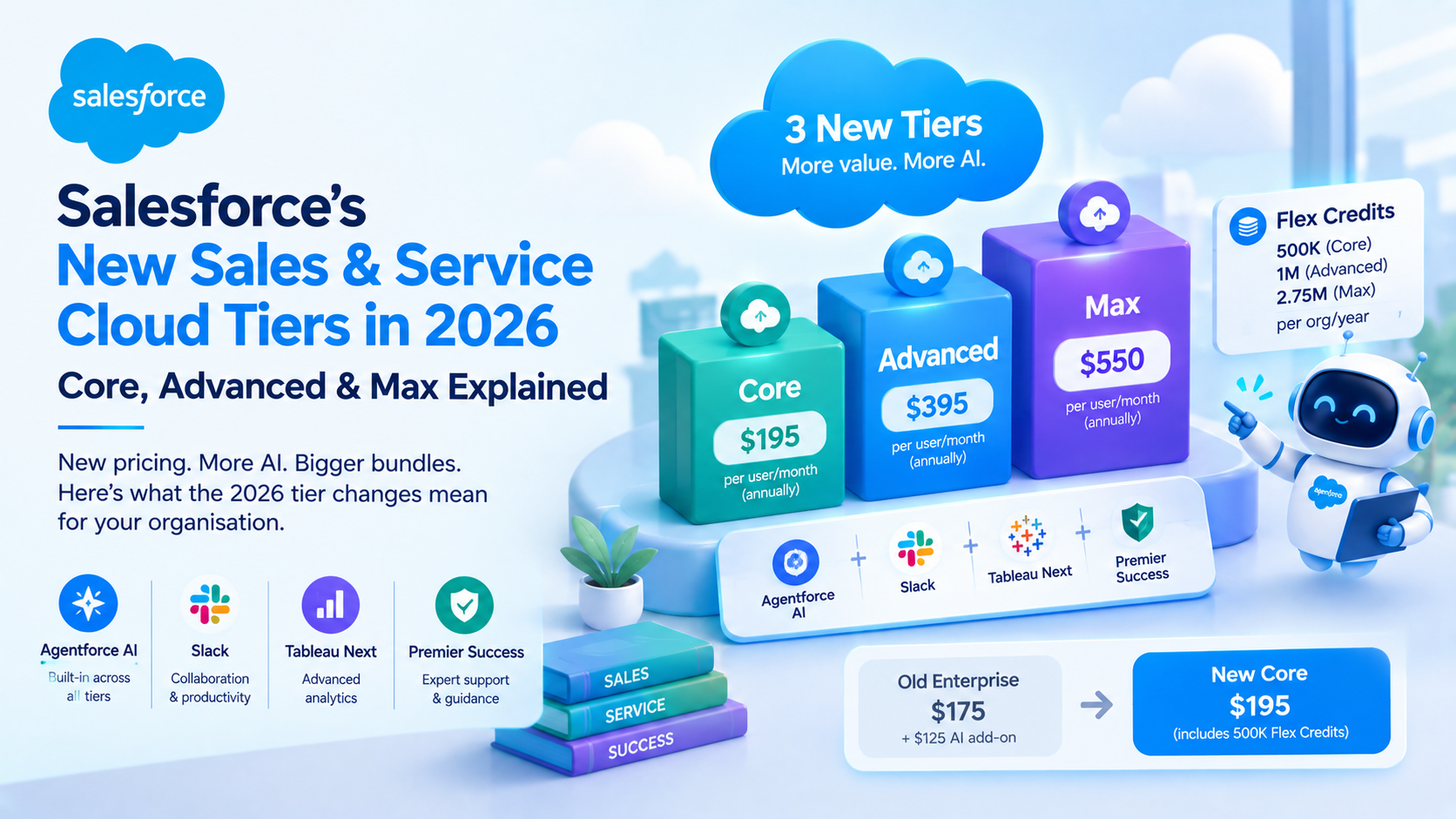
Salesforce now sells Sales and Service Cloud in three main tiers: Core at USD 195 per user per month, Advanced at USD 395, and Max at USD 550, all billed annually. They were announced on 3 September 2026 and replace Enterprise, Unlimited and Agentforce 1 for new purchases. Core costs 11% more than the Enterprise edition it succeeds, and bundles Agentforce, Slack, Tableau Next and Premier Success into the licence.
That is the whole change in one paragraph, but the paragraph hides the part that matters to your budget. The old ladder let you buy a cheap CRM licence and add AI later if you wanted it. The new ladder does not. If you are renewing in the next twelve months, or buying Salesforce for the first time, the decision you are making is no longer "how much CRM do I need" but "how much AI capacity am I willing to pre-purchase".
We have spent the last week repricing live client proposals against the new tiers. This post is what we found.
What are the Core, Advanced and Max editions?
Core, Advanced and Max are the three upper tiers of Salesforce's Sales and Service Cloud line as of September 2026. Every one of them includes Agentforce AI, Slack, Tableau Next analytics, enterprise security features and a Premier Success Plan. They differ on Flex Credits, on which security and workforce products are bundled, and on price.
The three lower tiers are unchanged. Free Suite is still USD 0, Starter Suite is still USD 25 per user per month, and Pro Suite is still USD 100.
| Tier | List price, USD per user/month, billed annually | Flex Credits per org/year | Replaces |
|---|---|---|---|
| Free Suite | 0 | none | unchanged |
| Starter Suite | 25 | none | unchanged |
| Pro Suite | 100 | none | unchanged |
| Core | 195 | 500,000 | Enterprise (was 175) |
| Advanced | 395 | 1,000,000 | Unlimited (was 350) |
| Max | 550 | 2,750,000 | Agentforce 1 (was 550) |
Source: the Salesforce Sales pricing page and Service pricing page, both checked 8 September 2026. Prior prices are the list prices we recorded on 31 August 2026, one week before the change.
Salesforce's own announcement frames the change as bundling rather than a price rise, and says Core delivers 70% more value than legacy Enterprise, Advanced more than 50% more than legacy Unlimited, and Max 60% more than Agentforce 1 at the same price. Those are vendor value claims, not measurements, and you should treat them the way you would treat any vendor's own arithmetic about its own bundle.
One thing is genuinely not confirmed. Salesforce Ben's coverage notes that Salesforce has not formally said Enterprise and Unlimited are withdrawn, only that the new editions exist and that legacy pricing is unchanged at renewal. In quotes we have seen since 3 September, new business is being quoted on the new tiers. If you are told Enterprise is still available to you, get it in writing on the order form rather than in an email.
How much more will your renewal actually cost?
For an existing Enterprise or Unlimited customer, the immediate answer is nothing. Salesforce has said legacy edition pricing does not change at renewal, and existing Agentforce 1 customers can move to Max at no additional cost.
For a new buyer the increase is 11.4% on the Enterprise rung and 12.9% on the Unlimited rung.
On a 150-seat deal that is the difference between USD 315,000 and USD 351,000 a year, so USD 36,000. On 400 seats it is USD 96,000 a year.
The number that changes the conclusion, though, is what the old ladder cost once you added AI. Salesforce introduced Agentforce add-ons at USD 125 per user per month in June 2025. An Enterprise seat at 175 plus that add-on came to 300 per user per month. Core is 195 with 500,000 Flex Credits included.
So for a buyer who wanted Agentforce, the new packaging is cheaper on paper. For a buyer who did not want Agentforce, it is a 11.4% rise for capacity they will not use. Which of those two you are depends entirely on whether you have an agent use case you can actually name, and most of the organisations we talk to cannot name one yet.
The two products are also not equivalent. The 2025 add-on was sold as unmetered generative AI and Agentforce for employees. Core's 500,000 Flex Credits are metered. Do not treat them as the same thing in a business case.
Why 500,000 Flex Credits is smaller than it sounds
This is the part that catches people, and it is the single most useful piece of arithmetic in this post.
Flex Credits are allocated per org per year, not per user. A standard Agentforce action consumes 20 credits, and a voice action consumes 30. So 500,000 credits on Core is 25,000 standard agent actions per year for the entire organisation.
Spread across 200 users that is 125 actions per user per year, or roughly one action every second working day. Spread across 400 users it is one action every fourth working day.
That is fine if your agent handles a narrow, high-value task such as qualifying inbound enquiries. It is nowhere near enough if you intended to put a service agent in front of every case. A contact centre handling 2,000 cases a month would burn 480,000 credits a year at one action per case, and real cases take more than one action.
Advanced doubles the allocation to 1,000,000 and Max takes it to 2,750,000, which is why Max exists. If your plan is agent-first service, model the credit consumption before you pick a tier, not after. Additional Flex Credits are purchasable, and we have not yet seen a published list price for overage, so you are negotiating that blind.
Which edition actually gates the thing you need?
Salesforce has not yet published separate allocation pages for Core, Advanced and Max. The documented allocations still sit under the Professional, Enterprise and Unlimited names, and in our reading the new tiers inherit them. Verify this on your order form before you sign, because it is the least settled part of the change.
With that caveat, here is what genuinely stops working at each rung. These are the constraints we see bite on real projects, taken from Salesforce's Professional Edition allocations, Enterprise Edition allocations and Unlimited Edition allocations pages, checked 8 September 2026. Every figure below is a documented allocation rather than an estimate of ours.
| Constraint | Pro Suite (Professional) | Core (Enterprise lineage) | Advanced (Unlimited lineage) |
|---|---|---|---|
| Custom objects | 50 | 200 | 2,000 |
| Custom fields per object | 100 | 500 | 800 |
| Active flows and processes | 5 | no low cap documented | 2,000 active, 4,000 total |
| Custom profiles | 3 | 1,500 per user licence type | 1,500 per user licence type |
| Permission sets | 10 | 1,000 created | 1,000 created |
| Active validation rules per object | 20 | 100 | 500 |
| Developer sandboxes | 10 | 25 | 100 |
| Partial Copy sandbox | not available | 1 | 1 |
| Full sandbox | not available | not included | 1 |
| API calls per user per day | add-on required | 1,000 | 5,000 |
The row that ends most Pro Suite conversations is the third one down. Salesforce's Professional Edition allocations page documents a limit of five active flows and processes. Not five per object, five in total. Any business with a lead assignment flow, a case escalation flow, an approval flow and two field-update flows has already spent its allocation.
The second row that ends conversations is Full sandbox. If you need a production-scale copy for performance testing or for training users on real data volumes, that is on the Advanced rung, not Core. Buying Core and then discovering you need a Full sandbox means either an add-on purchase or an uncomfortable conversation six months in.
API access deserves a specific correction, because we have seen it argued badly. API access does not require Core. Pro Suite and below can buy the Web Services API as an add-on at USD 25 per user per month, and Core and above include it. So Pro Suite plus API is USD 125 against Core at USD 195. The honest argument for Core is objects, flows, profiles and sandboxes, not API gating.
When is Pro Suite still the right answer?
For a team under about 25 users running a recognisable sales process with light customisation, Pro Suite at USD 100 remains good value, and we still recommend it. The gap to Core is now USD 95 per user per month rather than USD 75, which makes the case for staying on Pro Suite slightly stronger than it was in August.
The trade-off we walk clients through looks like this. Staying on Pro Suite saves USD 95 per user per month, so USD 22,800 a year on 20 seats. What you give up is the flow allocation, Partial Copy sandbox, and any Agentforce capacity at all.
We have taken the Pro Suite side of that trade twice this year for clients with simple processes and no AI roadmap, and both are still on it. We have also seen it go wrong once, at a client whose process complexity grew faster than expected and who hit the five-flow limit in month seven. The migration to Enterprise cost them about three weeks of rework, mostly rebuilding automation that had been crammed into fewer flows than it should have been.
That is the real risk of choosing the lower rung: not the licence cost, but the design compromises you make to live inside the limits, and the cost of unpicking them later.
How to price your own renewal in five steps
- Count your named agent use cases. Not aspirations, use cases with an owner and a defined trigger. If the count is zero, Core's credit allocation is not worth paying for and you should push hard to stay on legacy Enterprise pricing.
- Model credit consumption at 20 credits per action, 30 per voice action. Multiply by expected annual volume. Compare against 500,000 for Core, 1,000,000 for Advanced, 2,750,000 for Max.
- Check the four gating limits: active flows, custom objects, Full sandbox, and API calls per user per day. One hard requirement in that list settles the tier on its own.
- Price the legacy path in parallel. Ask for a renewal quote on your existing edition as well as the new tier. Salesforce has said legacy pricing is unchanged, so make them show you both numbers side by side.
- Get the allocation table on the order form. Because Core, Advanced and Max do not yet have published allocation pages, the order form is your only durable record of what you bought.
Where we would push back on the sales conversation
Two things are worth resisting.
The first is buying Advanced for the Flex Credits alone. If credits are the only reason to move up, ask what a credit top-up costs on Core instead. Bundled capacity you cannot consume is not a discount.
The second is accepting the value-uplift framing without testing it. Core includes Slack, Tableau Next and Premier Success. If you already pay for Slack separately, that is a genuine saving and you should net it off. If your team has never opened Tableau, counting Tableau Next as value is fiction. Work out the uplift for your own stack rather than accepting the published percentage.
Our own position, and it is a position rather than a fact: for most mid-market organisations without a live agent programme, Core is the right tier and the extra USD 20 per user per month over legacy Enterprise is a reasonable price for the Slack and analytics bundling. Advanced is worth it only for Full sandbox, Security Center, or a credit requirement you have actually modelled.
Frequently Asked Questions
Are Salesforce Enterprise and Unlimited editions discontinued?
Salesforce has not formally announced their withdrawal. What it has said is that Core, Advanced and Max are available now and that legacy edition pricing is unchanged at renewal for existing customers. New business quotes we have seen since 3 September 2026 use the new tiers. If you want to buy Enterprise as a new customer, ask for it explicitly and confirm on the order form.
How much did Salesforce prices go up in September 2026?
For new purchases, the Enterprise rung moved from USD 175 to USD 195 per user per month, a rise of 11.4%, and the Unlimited rung moved from USD 350 to USD 395, a rise of 12.9%. Max is USD 550, the same as the Agentforce 1 edition it replaces. Existing customers on legacy editions keep their current pricing at renewal.
What are Flex Credits and how many do I need?
Flex Credits meter Agentforce usage, allocated per organisation per year rather than per user. A standard agent action consumes 20 credits and a voice action 30. Core's 500,000 credits equal 25,000 standard actions annually across the whole org. Estimate your annual action volume before choosing a tier, because credit capacity is the main difference between Core, Advanced and Max.
Does Salesforce API access require the Core edition?
No. Core and above include the Web Services API, but Pro Suite and lower editions can purchase it as an add-on at USD 25 per user per month. Pro Suite plus the API add-on totals USD 125 per user per month against Core at USD 195. Choose Core for custom object headroom, unlimited flows, sandboxes and profiles, not for API access alone.
Which edition includes a Full sandbox?
A Full sandbox, meaning a production-scale copy with your real data volumes, sits on the Unlimited lineage that Advanced now occupies. Core, on the Enterprise lineage, includes 25 Developer sandboxes and one Partial Copy sandbox with 5 GB of data storage. If you need full-volume performance testing or realistic user training environments, budget for Advanced or for a Full sandbox add-on.
When does the new pricing apply to industry clouds?
Salesforce has said industry edition pricing under the new structure arrives later in autumn 2026. Financial Services Cloud, Health Cloud and the other industry products were still on their previous ladders when we checked on 8 September 2026. If you are buying an industry cloud this quarter, ask your account executive which structure your quote uses before you compare it to anything.
What to do before your next renewal date
The specific trap in this change is a renewal quote that moves you onto Core or Advanced without anyone modelling whether you will consume the Flex Credits you are now paying for. Pull your renewal date, count your named agent use cases, and if the count is low, ask for both a legacy-edition quote and a new-tier quote in the same conversation. If you want a second pair of eyes on the arithmetic, get in touch and we will price both paths against your seat count and your actual automation footprint. Our Salesforce advisory and implementation services cover licensing reviews as well as build work.
Have Questions or Need Assistance?
Our team of Salesforce experts is ready to help you implement the solutions discussed in this article.
Contact Us Today