Salesforce CPQ End of Sale: Should You Migrate Yet?
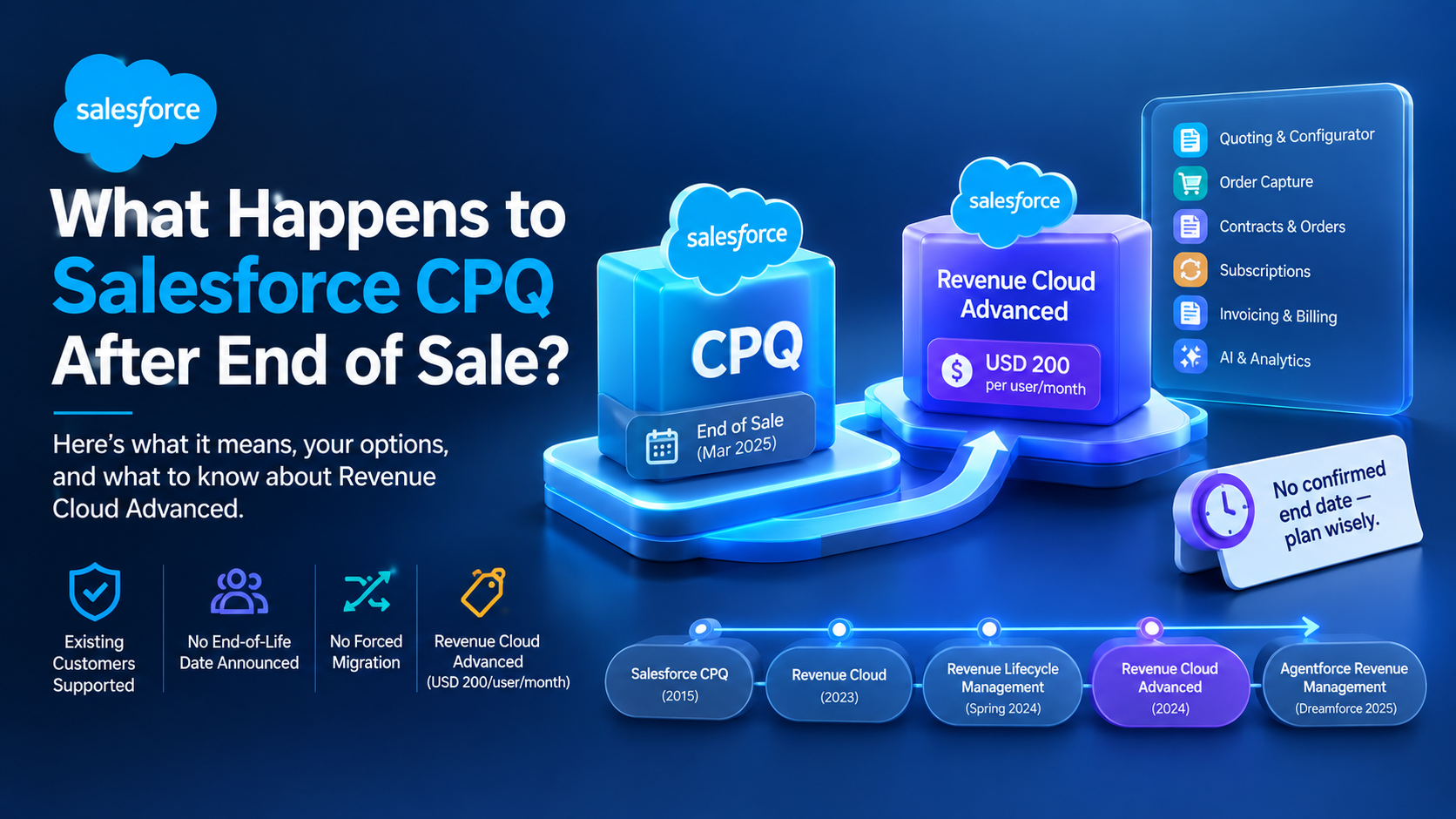
Salesforce CPQ went end of sale in March 2025, which means new customers cannot buy it while existing customers keep full support, can add licences and can renew. Salesforce has announced no end-of-life date and states there is no forced migration. Revenue Cloud Advanced lists at USD 200 per user per month against CPQ's now-unpublished price, and the widely repeated 2029 to 2030 end-of-life date is analyst inference rather than a Salesforce commitment.
If you take one thing from this post, take that last clause. Nobody at Salesforce has told anybody when CPQ stops working, and a migration business case built on an invented deadline will not survive contact with a finance director who reads the source.
What does end of sale actually mean for existing Salesforce CPQ customers?
Salesforce publishes a page titled, in its own words, "Salesforce CPQ Not End of Life: What End of Sales Means". The wording on that page is unusually direct for vendor communication, so here it is verbatim:
"Salesforce CPQ is end of sale, not end of life. Existing customers can continue using Salesforce CPQ, buy additional users, renew licenses, and receive support."
And:
"Salesforce has not announced an end-of-life date for CPQ."
And:
"There is no forced migration from Salesforce CPQ to Agentforce Revenue Management."
Salesforce describes CPQ as moving into a maintenance phase, where existing customers get support and critical fixes while new product innovation goes to Revenue Cloud Advanced. Salesforce Ben's coverage of the announcement records the same commitment covering CPQ and Salesforce Billing together.
Note what is absent. There is no stated number of years. No minimum support window. The commitment is open-ended, which cuts both ways: nothing is ending next year, and nothing is guaranteed for five years either.
On dates, no source we could find gives a day-level end-of-sale date, including Salesforce's own page. Multiple specialist sources converge on March 2025, so March 2025 is what we write. If you see a specific date quoted with confidence, ask where it came from.
The 2029 to 2030 end-of-life figure circulating in migration content traces back to phrasing like "industry analysts expect it around 2029 to 2030 based on typical enterprise software lifecycle patterns". That is inference from generic software lifecycles, not guidance. We have seen it quoted back to us in a client steering committee as though it were Salesforce policy, which is how a reasonable inference becomes an expensive assumption.
Why the product has three different names on Salesforce's own website
Before any pricing conversation, sort out what you are actually buying, because Salesforce is running three naming generations simultaneously.
The lineage: Salesforce CPQ from the 2015 SteelBrick acquisition, then Revenue Cloud, then a brief spell as Revenue Lifecycle Management in spring 2024, then Revenue Cloud Advanced for the rebuilt product, then Agentforce Revenue Management as the top-level brand from Dreamforce 2025.
Today all of the following are live: Salesforce Help writes "Revenue Management (formerly Revenue Cloud)", the pricing page sells editions called Revenue Cloud Growth and Revenue Cloud Advanced, and the URL path still reads /sales/revenue-lifecycle-management/.
There is a second naming collision worth flagging, and it is new. On 3 September 2026 Salesforce announced Core, Advanced and Max editions at USD 195, USD 395 and USD 550 per user per month for Agentforce Sales, Service and Industries. So "Advanced" now means two different products at two different prices. Revenue Cloud Advanced is USD 200. Agentforce Advanced is USD 395. On a quote, insist the SKU name is written in full.
Revenue Cloud itself has not moved to the new edition structure. We checked the pricing page on 14 September 2026, eleven days after the announcement, and it still shows Growth, Advanced and Billing.
What does Revenue Cloud Advanced cost, and where does the sticker price mislead?
These are published list prices, verified 14 September 2026 on the Revenue Cloud pricing page, billed annually.
| Edition | Published list, USD per user per month | Included |
|---|---|---|
| Revenue Cloud Growth | 150 | Quoting and configurator, order capture, subscriptions |
| Revenue Cloud Advanced | 200 | Everything in Growth, plus contracts and orders, consumption and invoicing, AI and analytics |
| Revenue Cloud Billing | Quote only | Usage rating and digital wallet, invoicing engine, document production, accounting subledger |
Salesforce CPQ carries no published price anywhere on those pages, which is consistent with end of sale.
Three things are not in that USD 200, and all three land later in the programme.
Add-ons sold separately. Dynamic Revenue Orchestration, Invoice Management and External User Support are all listed as available for purchase rather than included. Dynamic Revenue Orchestration in particular gets heavy billing in Revenue Cloud marketing and is not part of the Advanced licence.
Premier Success at 30% of net licence fees. Standard is included. On a 200-seat Advanced deployment, Premier is roughly USD 144,000 a year on top of roughly USD 480,000 of licence.
Revenue Events credits, which expire annually. This is the part almost nobody models. Salesforce publishes a Revenue Events rate card, updated June 2026, showing credit multipliers by usage type.
| Usage type | Internal multiplier | External multiplier |
|---|---|---|
| Pricing, configuration, create quotes, create orders, manage contracts | 0 | 1 |
| Orchestrate orders | 10 | 10 |
| Manage invoices | 10 | 10 |
Core internal quoting consumes no credits. Orchestration and invoicing consume at ten times the rate, external transactions consume where internal ones do not, and the rate card states that credits "must be used before the Order End Date" with "no rollover permitted".
Salesforce does not publish a dollar figure per Revenue Event. That comes on the order form. So the honest position is that the per-user licence is knowable from public sources and the consumption component is not, and any total cost of ownership model you build before you have that rate card in hand has a hole in it. Say so in the business case rather than filling the hole with an estimate.
Is Revenue Cloud Advanced actually better for large quotes?
This is the most common technical reason clients give for wanting to move, so it deserves a straight answer rather than a marketing one.
CPQ's large-quote problem is real and well documented. Coforge's technical write-up on large quote design puts the practical ceiling at 200 to 300 quote lines, describes hand-tuning a large quote threshold as "purely hit and trial", and notes it "might behave differently in production and sandbox". Teams living with this recognise Apex CPQ Time Limit Exceeded on sight.
Revenue Cloud Advanced raises the ceiling. It does not remove it. The documented limits as of September 2026 include 1,000 quote line items per quote, 1,000 order products per order, and 5,000 total records per quote.
And there is a limit inside that limit which is easy to miss: amendments and renewals created in the user interface are capped at 300 lines, while the API-based lifecycle supports 1,000. If your renewals team works in the interface on 500-line contracts, the platform ceiling you actually hit is 300, not 1,000.
Other structural limits that catch CPQ migrators: bundle hierarchy is capped at 3 levels with 5 child nodes per parent, the configurator has a 10-second execution window, and usage and consumption does not support bundled products. Deep CPQ bundles do not survive that hierarchy constraint without redesign.
Winter '27 previews 15,000-line quotes. Preview is not general availability, and we would not build a business case on a preview feature. If 1,000-line quotes solve your problem, the ceiling is available now. If you need 15,000, wait for the GA announcement rather than the release-notes headline.
Why the migration is a re-implementation, and what does not carry across
Salesforce's own CPQ migration page names no automated tool. It offers four strategies, lift and shift, selective transformation, full rationalisation, and new business unit, and frames the goal as "a stronger revenue model, not a screen-by-screen rebuild". Salesforce Help documents migration tools and accelerators for data while stating that "tools don't replace human design decisions".
For data, tooling exists. For logic, it does not. The object and logic mapping below is compiled from specialist migration documentation.
| Salesforce CPQ | Revenue Cloud equivalent | What is required |
|---|---|---|
SBQQ__Quote__c | Standard Quote plus Context Services | Transform |
SBQQ__QuoteLine__c | Transaction line item | Remap and revalidate |
SBQQ__ProductOption__c | Product Catalog Management attribute | Redesign |
SBQQ__ProductRule__c | Constraint rule | Manual rebuild |
SBQQ__Subscription__c | Asset lifecycle object | Transform and revalidate |
| Price rules | Pricing procedures | Manual translation |
| Quote Calculator Plugin JavaScript | Business rules engine | Rewrite declaratively |
| Twin fields | Context definitions, attributes and tags | Reconfigure |
| Quote templates | Document Builder | Rebuild |
Custom Apex on SBQQ__ objects | None | Rewrite or retire |
The Quote Calculator Plugin row is the one that reprices most programmes. Teams with years of accumulated JavaScript pricing logic are not migrating it; they are rewriting that logic declaratively, which means first recovering the business rules that the JavaScript encodes. In our experience that archaeology takes longer than the rebuild, because the person who wrote the plugin left in 2021 and the rules were never documented anywhere else.
Twin fields deserve a specific mention too. In CPQ, a field on the quote line with a matching API name on the order product synchronised automatically. Revenue Cloud replaces that convention with explicit context definitions and entity mappings, configured rather than inferred. It is a better design and it is not a migration; every twin-field relationship has to be re-expressed by hand.
On the object model itself, be careful with the claim that Revenue Cloud simply reuses standard Quote and Order objects. It runs on native core platform objects rather than a managed package, which is the genuinely important architectural difference, and it introduces its own transaction layer alongside the standard objects. The defensible statement is that the managed-package schema is gone, not that your existing Quote automations carry over.
The API surface is different too, and better. Revenue Cloud exposes REST business APIs such as POST /commerce/quotes/actions/place and POST /connect/revenue-management/assets/actions/amend, in place of CPQ's Apex and managed-package calls. If your quoting is integrated with an ERP or a partner portal, this is the part of the migration with a genuine upside.
Can you run CPQ and Revenue Cloud at the same time?
Yes, and there is a catch that shapes every phased plan.
Salesforce documents coexistence explicitly: Revenue Management and Salesforce CPQ can both be provisioned in one org, which requires the Revenue Cloud Advanced licence. During coexistence, CPQ retains quotes, document generation, advanced approvals, asset generation and order management.
The catch is in the same documentation: billing in Revenue Management is disabled while both are provisioned. So the phased approach that looks most attractive, new business units on Revenue Cloud while legacy runs on CPQ, cannot use Revenue Cloud Billing until CPQ is gone. If billing modernisation is the reason for the programme, coexistence does not get you there incrementally.
Should you migrate now or wait?
Here is where we disagree with most of the content on this topic, which is written by firms selling migrations.
There is no deadline. Salesforce has said so in writing. That removes urgency as a reason and leaves capability as the only honest one.
Move now if you are selling across multiple channels, running complex renewals and amendments, or planning e-commerce or Agentforce integration on the revenue side. The architecture decision has to precede the channel investment, because building new channels on CPQ means building them twice.
Move now if your CPQ org is already at the 200 to 300 line performance wall and your quotes are growing. That pain is real and Revenue Cloud's 1,000-line ceiling is a genuine improvement, subject to the 300-line interface amendment cap noted above.
Wait if you are a straightforward inside-sales operation with stable products, no channel expansion planned, and a CPQ org that works. Rebuilding working pricing logic to land in the same place, at a higher licence cost, is not a project. It is an expense with a slide deck.
One number from Salesforce's own end-of-sale page belongs in this decision: roughly 15% of Revenue Cloud Advanced customers came from CPQ. The overwhelming majority are net-new. That tells you the migration path is less travelled than the marketing implies, and that your implementation partner's CPQ migration experience is worth interrogating specifically rather than taking their Revenue Cloud experience as a proxy.
What a CPQ to Revenue Cloud migration realistically costs
Everything in this section is a third-party estimate. Salesforce publishes no migration cost or duration figures, and neither do we pretend to. Treat these as a planning baseline to test real quotes against, not as prices.
| Phase | Duration (specialist estimate, not a Salesforce figure) |
|---|---|
| Discovery and scoping | 4–8 weeks |
| Data migration and transformation | 6–12 weeks |
| Integration rebuilds | 4–10 weeks |
| User acceptance testing | 4–8 weeks |
| Cutover and hypercare | 2–4 weeks |
| Total | 6–18 months depending on catalogue complexity, integration count and active contract volume |
On cost, the same specialist source puts systems integrator fees between USD 150,000 for a limited mid-market scope and USD 2 million or more at enterprise scale, with post-go-live stabilisation adding 10% to 15% of the initial scope, and estimates Revenue Cloud licensing at 30% to 80% higher than legacy CPQ licensing. That licensing delta is an estimate too, and it is the figure we would most want to test against your own renewal quote, because your CPQ pricing is contracted and nobody else's benchmark describes it.
Our own view on where the estimates are most likely to be wrong: the discovery phase is understated for any org with Quote Calculator Plugin logic, and the integration rebuild is understated for any org where the ERP integration was built against the SBQQ__ schema. Both are rewrite work dressed as migration work in most plans we are asked to review.
Frequently Asked Questions
When does Salesforce CPQ stop working?
Salesforce has announced no end-of-life date for CPQ. Its own page states that CPQ is end of sale, not end of life, and that existing customers keep support, can add licences and can renew. The 2029 to 2030 dates circulating online are analyst inference from typical enterprise software lifecycles, not a Salesforce commitment.
Can I still buy Salesforce CPQ in 2026?
Not as a new customer. End of sale took effect in March 2025 and CPQ no longer carries a published price. Existing CPQ customers can continue to add users and renew licences. If a partner offers to sell you CPQ as a new implementation in 2026, ask specifically how they intend to license it.
How much does Revenue Cloud Advanced cost?
Revenue Cloud Advanced lists at USD 200 per user per month billed annually, and Revenue Cloud Growth at USD 150. Revenue Cloud Billing is quote-only. Not included: Dynamic Revenue Orchestration, Invoice Management, External User Support, Premier Success at 30% of net licence fees, and consumption-based Revenue Events credits that expire annually.
Does Salesforce provide a tool to migrate from CPQ to Revenue Cloud?
For data, yes, with accelerators documented in Salesforce Help and a partner accelerator on AppExchange. For logic, no. Product rules, price rules, Quote Calculator Plugin JavaScript, quote templates and custom Apex on SBQQ__ objects all require a manual rebuild. Salesforce's own migration page offers strategies rather than tooling.
Can Salesforce CPQ and Revenue Cloud run in the same org?
Yes. Salesforce supports coexistence in an org provisioned for both, which requires a Revenue Cloud Advanced licence. The constraint is that billing in Revenue Management is disabled while both are provisioned, so a phased migration cannot use Revenue Cloud Billing until CPQ is removed from the org.
Will Revenue Cloud handle quotes with thousands of lines?
Today the documented limit is 1,000 quote line items per quote and 5,000 total records per quote, with user interface amendments and renewals capped at 300 lines against 1,000 through the API. Winter '27 previews 15,000-line quotes, but preview is not general availability and should not anchor a business case.
If CPQ still works and you are being told to move
The decision that costs most here is a migration started on a deadline that does not exist, into a licence that is materially more expensive, to rebuild pricing logic that already works. Salesforce has removed the deadline in writing, which means the only defensible trigger is a capability you need and cannot get from CPQ: multi-channel selling, modern billing, or quotes above CPQ's 200 to 300 line wall.
Before you commission anything, get your Quote Calculator Plugin code read by somebody who can tell you what business rules it actually encodes. That document determines the true size of the programme, and every plan we review that lacks it is understated. If you want us to do that reading, send us the plugin and your product rule inventory, and our Salesforce advisory and implementation team will come back with a scope rather than a sales cycle.
Have Questions or Need Assistance?
Our team of Salesforce experts is ready to help you implement the solutions discussed in this article.
Contact Us Today