Salesforce Education Cloud Pricing: What Universities Pay
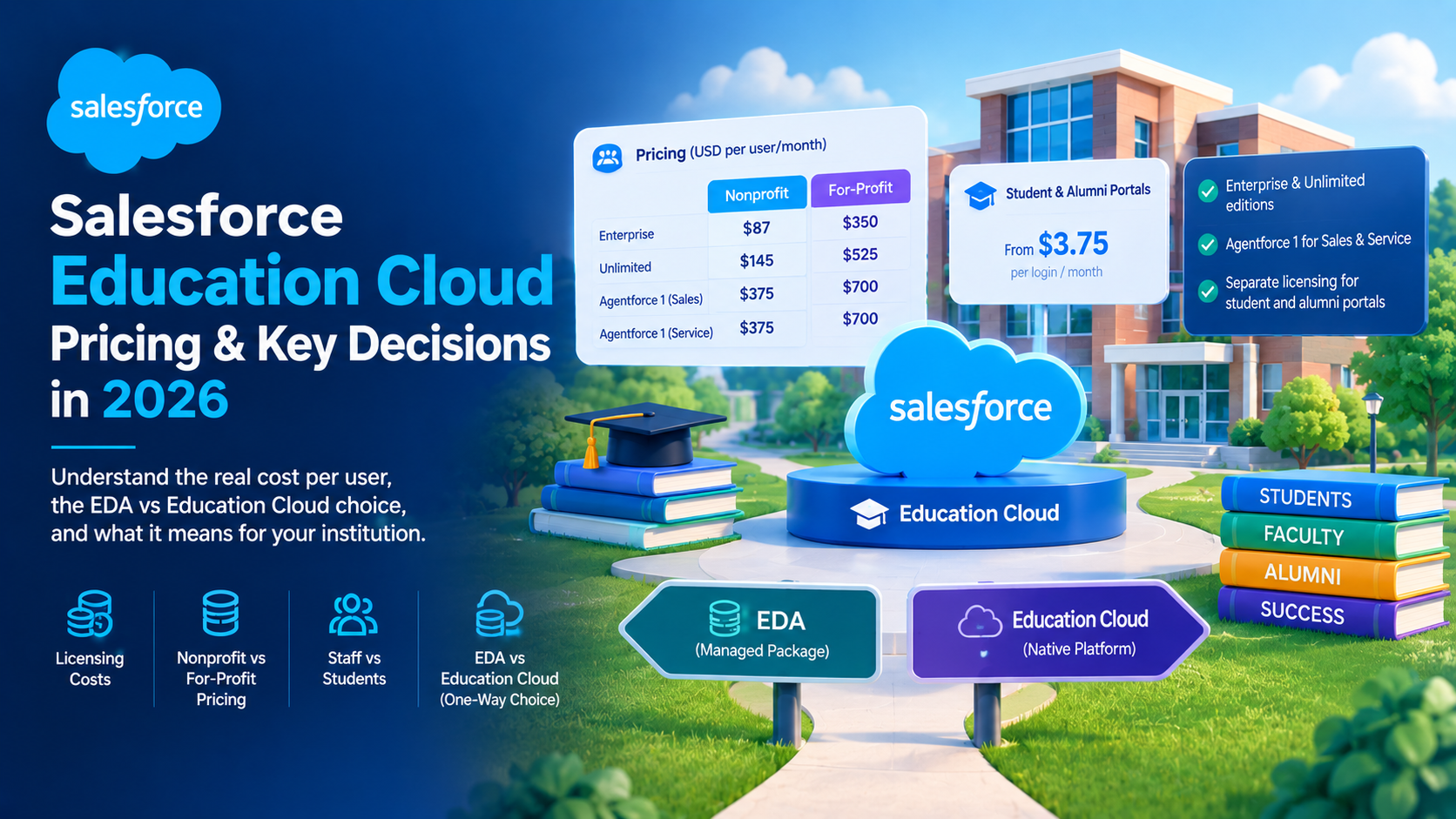
Salesforce Education Cloud lists at USD 87 per user per month on Enterprise and USD 145 on Unlimited for nonprofit institutions, and USD 350 and USD 525 for the same editions at a for-profit institution. Student and alumni portals are licensed separately, from USD 3.75 per login per month. Those licence figures are the smaller half of the budget. The larger half is the data model decision you make in month one, and it is not reversible.
That is the honest shape of an Education Cloud budget, and it is worth stating up front because most of the content ranking for this question is quoting a price ladder Salesforce replaced, or describing a product architecture Salesforce abandoned.
What does Salesforce Education Cloud actually cost per user in 2026?
Salesforce publishes two separate price ladders for education, and the gap between them is roughly fourfold. The nonprofit ladder on the Education Cloud pricing page applies to institutions that qualify as not-for-profit. For-profit institutions price from a separate For-Profit EDU pricing guide PDF.
Both ladders are per user per month, billed annually, and both were verified on 14 September 2026.
| Edition | Nonprofit institution (published list) | For-profit institution (published list) |
|---|---|---|
| Education Cloud Enterprise | USD 87 | USD 350 |
| Education Cloud Unlimited | USD 145 | USD 525 |
| Agentforce 1 for Sales | USD 375 | USD 700 |
| Agentforce 1 for Service | USD 375 | USD 700 |
Two things about this table matter more than the numbers themselves.
First, "per user" means staff. Admissions officers, advisers, registrars, advancement teams. It does not mean students. A 30,000-student university with 400 staff touching the CRM is buying 400 licences, not 30,400. Clients consistently get this the right way round, but they then get the second part wrong.
Second, there is no published student-FTE or org-level price for Education Cloud. We looked for one specifically, on the HTML page, in the for-profit PDF, and on Salesforce's AWS Marketplace listing, which simply says "request a private offer". If your institution has been quoted on an FTE basis, that is a negotiated offer rather than a list price, and you have no published benchmark to test it against. Ask what the per-user equivalent works out to before you sign, because that is the number you can compare to the next quote.
Why the Core, Advanced and Max editions are missing from education pricing
On 3 September 2026 Salesforce announced three replacement editions: Core at USD 195, Advanced at USD 395 and Max at USD 550 per user per month, bundling Agentforce, Slack, Tableau Next and Premier Success. The announcement named Agentforce Sales, Agentforce Service and Agentforce Industries, and listed Financial Services, Healthcare and Public Sector as the verticals covered.
Education was not named. Eleven days later, on 14 September 2026, the Education Cloud pricing page still shows Enterprise, Unlimited and Agentforce 1. So does the nonprofit pricing page.
We are not going to tell you what that means, because Salesforce has not said. What we will tell you is what to do about it. If you are signing a three-year Education Cloud agreement this quarter, you are signing into an edition naming structure that Salesforce is actively replacing on its commercial products. Get a clause on the order form covering what happens to your pricing if your edition is renamed or restructured mid-term. We have started asking for this on every education and nonprofit deal since the September announcement, and the worst answer we have had so far is "we will come back to you", which is still better than finding out at renewal.
EDA or the Education Cloud data model: the decision you cannot undo
Here is the single most consequential thing on this page, and the thing most search results still get wrong.
Education Cloud does not run on EDA. Salesforce says so plainly on its own Education Cloud page: "Education Cloud does not run on the Education Data Architecture (EDA). Instead, it has its own Education Data foundation." The modern product is built on native platform objects. EDA is a managed package with a different account model.
The two are mutually exclusive. You cannot install Education Cloud into an org running EDA. Strata Information Group, an independent higher education consultancy, confirms this in its Education Cloud FAQ, updated May 2026.
The account model is where it bites. EDA uses administrative and household accounts. Education Cloud uses Person Accounts. Person Accounts change how sharing, reporting, duplicate management and every piece of automation you have written behaves. Turning them on is a one-way door at org level.
So the choice in front of an institution already running EDA is not an upgrade. It is a re-implementation into a new org, with a data migration and a rebuild of every automation and report that assumed the old model.
What we recommend, and what the alternative costs
We recommend Education Cloud for new builds without hesitation. The data model is where Salesforce is shipping, the release train carries it three times a year, and EDA has the look of a product in maintenance.
For an institution with a mature EDA org, the alternative is to stay, and it is a legitimate choice rather than a delaying tactic. Salesforce has published no EDA end-of-support date. We looked for one specifically and there is none. SIG's position is that there is "no driving need to leave" if current functionality meets the institution's needs. Cloud for Good, which does this migration work commercially, says Salesforce "has no plans to retire EDA" while still recommending the move.
Where staying loses is new capability. Everything Salesforce is building for education, including the Agentforce capabilities in recruitment and student success, targets the Education Cloud data model. An EDA org keeps working and stops gaining. If your roadmap for the next three years is "keep the lights on and improve reporting", staying is defensible arithmetic. If it includes AI-assisted advising or a modern admissions funnel, you are buying a migration eventually, and migrations do not get cheaper as the org gets older.
One thing to watch when you research this yourself: a great deal of well-ranked content, including Salesforce Ben's own Education Cloud guide as last updated in November 2024, still describes Education Cloud as built on EDA and refers to modules called Admissions Connect and Student Success Hub. That was true once. It is not true now, and a procurement business case built on it will describe the wrong product.
How much do student and alumni portals add to the bill?
This is where education budgets actually break, and almost nobody models it before the quote arrives.
Experience Cloud for Education is priced separately from Education Cloud licences. Verified 14 September 2026 on the Experience Cloud for Education pricing page:
| Licence type | Published list price |
|---|---|
| Login Edition, learners and alumni | USD 3.75 per login per month |
| Member Edition, learners and alumni | USD 8.75 per member per month |
| Login Edition, partners | USD 5.00 per login per month |
| Member Edition, partners | USD 12.50 per member per month |
Put 20,000 students on Member Edition and you are at USD 175,000 per month at list, which is USD 2.1 million a year before a single discount is negotiated. That number is usually where the conversation about "a student portal" turns into a conversation about scope.
Login Edition looks like the escape hatch, and Salesforce pitches it at users with three or fewer logins a month. The break-even against Member Edition sits at roughly four logins. The problem is that student portal usage is violently seasonal. Registration week, results day and financial aid deadlines produce login spikes that blow through the threshold, and the annual average that looked comfortable in the model does not describe any individual month.
Model portal licensing on peak-month logins rather than the annual mean. If the peak month puts you above four logins for a meaningful share of the population, Member Edition is cheaper and far easier to forecast.
Two further constraints from Salesforce Ben's Experience Cloud licence guide that cost real money later: each community licence type carries a limit of 10 custom objects, and downgrading between licence types is close to impossible without renaming accounts and reassigning records. Pick the licence type with the data model you will have in three years, not the one you have at go-live.
Does the Power of Us discount apply to universities?
Partly, and the detail is less settled than the marketing suggests.
The Power of Us programme is live, names educational institutions as eligible, and reports more than 56,000 participating organisations as of its August 2026 page update. The headline offer is 10 free licences plus discounts on additional licences. Per the nonprofit pricing page, those 10 free licences are Nonprofit Cloud or Sales and Service Cloud.
What we could not verify, and what you should therefore ask your account executive directly:
- The discount percentage on licences beyond the free 10. It is not published anywhere we could reach.
- Whether the free 10 can be Education Cloud licences at all. The published offer names Nonprofit Cloud and Sales and Service Cloud only.
- Whether a public or state university qualifies in its own right or must apply through its 501(c)(3) foundation. The eligibility PDF is blocked to crawlers and the old Salesforce Foundation eligibility pages now redirect to the corporate impact site.
We would rather tell you those three things are open than invent a percentage. Get all three answered in writing before you build a business case on the discount.
What does a university implementation actually involve, and how long does it take?
Salesforce structures Education Cloud into five functional areas: recruitment and admissions, academic operations, student success, student financials, and advancement and alumni relations. The Next-Gen SIS line is explicitly phased, with academic operations and student financials shipped and tuition, billing, payments and refunds described as coming without published dates.
There is no Salesforce-published phasing methodology for education. We looked. In its absence, here is the sequence we use, and the reasoning behind it.
- Recruitment and admissions first. It has the cleanest boundary, the least dependency on the student information system, and the fastest visible result. Enquiry capture, application tracking and communications can go live without touching the SIS record of truth.
- Advancement second, if the institution has a fundraising mandate. It is effectively a separate constituency model and can run in parallel with minimal contention.
- Student success third. Advising, case management and early alerts. This is the first phase that genuinely needs SIS data flowing in, so budget the integration work here rather than pretending it belongs to phase one.
- Academic operations and student financials last. These are the phases that come closest to replacing SIS functionality, and they carry the most institutional politics per unit of technical effort.
- Portals at the point where they carry real transactions, not as a phase-one showcase. A portal that only displays data the student can already see elsewhere earns nothing and costs per login.
On timelines, the most useful published evidence is not a vendor case study. Penn State publishes its enterprise CRM programme timeline openly. It records a 14-week strategy engagement in autumn 2022 before any build, an advancement CRM phase that remains open, a learner-lifecycle Education Cloud phase running roughly 12 months from spring 2024, and a further phase extending to enrolment services through 2025 and into 2026.
That is approximately four years from strategy to partial enterprise coverage at a large public university, published by the institution rather than the vendor. It is the number we point at when someone brings us a vendor deck promising enterprise-wide go-live in one academic year. Individual modules do go live in 12 to 20 weeks. The enterprise does not.
Where Education Cloud implementations go wrong
Four failure modes, in the order we encounter them.
Large data volume arrives earlier than anyone plans for. Salesforce Architects put the data skew threshold at 10,000 child records per parent. A campus admissions funnel crosses that comfortably; Salesforce's own Indiana University story cites around 430,000 opportunity records on a single campus. Symptoms are record locking errors during bulk loads, report timeouts and sharing recalculations that stall. Plan bucket accounts and an archiving policy at design time, because retrofitting them after three admissions cycles means reprocessing millions of records.
The SIS question gets deferred. Salesforce's own EDA documentation says the platform "likely can't replace your LMS or SIS", while the Next-Gen SIS page positions Salesforce as the replacement for legacy SIS products. Both statements are live on Salesforce properties today. We could not find credible published guidance on integrating with Banner, PeopleSoft or Workday Student, and we are not going to cite the content-farm pages that dominate those search results. Decide explicitly whether Salesforce is integrating with your SIS or replacing it, write the answer down, and make every subsequent phase consistent with it.
Person Accounts get switched on before anyone has modelled the reporting. It is a one-way door, and the reporting and sharing consequences land on teams who were not in the design workshop.
Portal licensing is estimated from average usage. Covered above, and it is the single most common cause of a budget that doubles between business case and order form.
What the published numbers on outcomes actually support
Be careful with outcome claims in this sector, including ours.
The independent figures worth citing are sector benchmarks rather than CRM results. The National Student Clearinghouse reported first-year persistence at 76.5% and retention at 68.2% for the Fall 2022 cohort, a ten-year high. NACAC's analysis of IPEDS data puts average admissions yield at 30% for Fall 2022, 33% private and 25% public. Those give you a denominator for a business case.
The CRM outcome numbers in circulation are vendor-published. Salesforce's Indiana University story reports a 7% increase in the ratio of admitted applicants to enrolled students, alongside consolidation of more than 400 email tool instances into one. Salesforce's newsroom reports an 80% reduction in student support wait times at UNLV. The Unity Environmental University figure of 17 hours saved per recruiter per week is a projection from Salesforce press materials rather than a measurement.
We could not find a single independent study quantifying CRM impact on admissions conversion or retention in higher education. If your business case needs a conversion uplift assumption, derive it from your own funnel data and label it as your assumption. Borrowing a vendor case study number is exactly the thing your finance director will find.
Frequently Asked Questions
Is Education Cloud the same as Agentforce Education?
They are the same product mid-rename. Salesforce's own pricing and product pages say Education Cloud, while its AWS Marketplace listing and Spring '26 release readiness content say Agentforce Education. Existing licences, pricing and renewal dates carry over unchanged. When contracting, use the name on the order form and do not assume a rename implies a repricing.
Do students need Salesforce licences?
No. Education Cloud licences cover staff who work in the CRM. Students access self-service through Experience Cloud portals, licensed separately at USD 3.75 per login per month or USD 8.75 per member per month at list. A 20,000-student Member Edition portal is USD 2.1 million a year at list before negotiation, so portal scope deserves its own business case.
Can we keep EDA instead of moving to Education Cloud?
Yes. Salesforce has published no EDA end-of-support date and independent higher education consultancies confirm there is no forced migration. The cost of staying is capability rather than support: new Education Cloud features and Agentforce education capabilities target the new data model. If your three-year roadmap is maintenance and reporting, staying is defensible.
How long does an Education Cloud implementation take?
A single module such as recruitment and admissions goes live in 12 to 20 weeks with clean scope. Enterprise coverage takes years. Penn State's published programme timeline shows a 14-week strategy phase in 2022 followed by phased rollouts still running into 2026. Treat any promise of enterprise-wide go-live within one academic year as a scoping problem rather than a delivery plan.
Does the Power of Us programme give universities free licences?
Power of Us lists educational institutions as eligible and offers 10 free licences, but the published offer names Nonprofit Cloud or Sales and Service Cloud rather than Education Cloud. The discount percentage beyond the free 10 is not published, and eligibility for public universities versus their foundations is not documented publicly. Get all three confirmed in writing.
Will Education Cloud move to the Core, Advanced and Max editions?
Salesforce has not said. As of 14 September 2026, eleven days after the new editions were announced, the Education Cloud pricing page still shows Enterprise, Unlimited and Agentforce 1. Ask for contractual protection covering edition renaming or restructuring before signing a multi-year agreement.
If you are budgeting an Education Cloud programme this year
The thing that derails education business cases is not the per-user licence price, which is published and easy to check. It is the portal licensing modelled on average logins instead of peak-month logins, and an EDA org that the business case treats as an upgrade path when it is a re-implementation. Both are knowable before you sign, and both are cheaper to resolve in a spreadsheet than in a rebuild.
If you want a second opinion on either, tell us what your current org and student numbers look like and we will tell you which of the two is the bigger line in your case. Our Salesforce implementation and advisory services cover both the data model decision and the licensing model.
Have Questions or Need Assistance?
Our team of Salesforce experts is ready to help you implement the solutions discussed in this article.
Contact Us Today