Salesforce for Real Estate: Costs, Setup and ROI
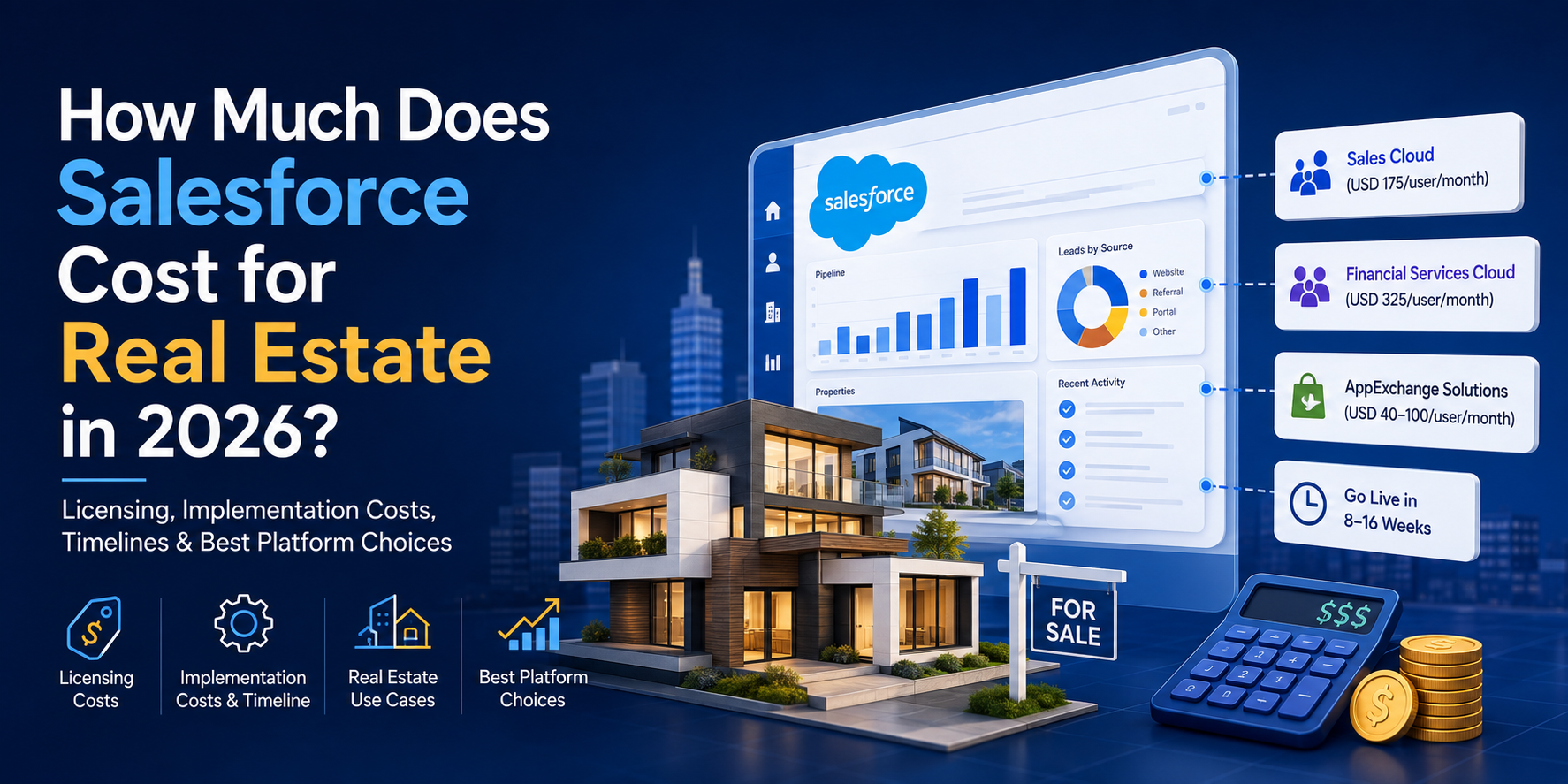
Salesforce for real estate typically costs USD 25–350 per user per month in licences, plus a one-off implementation of roughly USD 15,000–120,000 depending on scope. Most brokerages and developers go live in 8–16 weeks. There is no dedicated "Real Estate Cloud". Firms build on Sales Cloud, Financial Services Cloud, or an AppExchange package layered on the platform.
Which Salesforce product do real estate firms actually buy?
Salesforce does not sell a real estate product the way it sells Health Cloud or Financial Services Cloud. When a brokerage, developer or property manager tells you "we run on Salesforce", they mean one of three architectures.
- Sales Cloud with a custom real estate data model. Standard Account, Contact and Opportunity objects extended with custom objects for Property, Unit, Listing, Viewing, Offer, Tenancy and Commission. This is the most common route and the most flexible. Salesforce publishes an overview of the approach on its real estate CRM page.
- Financial Services Cloud (FSC). Mortgage brokers, lenders, REITs and real estate investment managers often start here because FSC ships with household and relationship modelling, financial goals and referral management already built. FSC list pricing starts at USD 325 per user per month for the Sales edition.
- An AppExchange package. Commercial brokerages frequently buy a managed package such as Rethink, Real Estate 360 or Power Broker rather than building the property model from scratch. Packages typically add USD 40–100 per user per month on top of the underlying Salesforce licence.
The choice is not cosmetic. A residential brokerage tracking viewings has very different data needs from a developer tracking units through construction, reservation, sale and handover, and the property model is hard to change once agents have three years of transactions on it. The rebuild is not a refactor, it is a second implementation with a migration attached.
Why most brokerages should not start on Financial Services Cloud
FSC is the option clients ask about most and buy least, once we have run the numbers with them.
The case for it is real. Household modelling, relationship groups and referral tracking arrive configured, and for lending or investment management those are the objects the process revolves around.
The case against is price. FSC for Sales is USD 325 per user per month against USD 175 for Sales Cloud Enterprise. On a 40-user brokerage that is USD 72,000 a year in extra licence spend, every year. Rebuilding the parts of the household model a sales brokerage actually uses on Enterprise takes a competent consultant a couple of weeks, once.
So the rule we apply is about where your revenue comes from, not what the software does. Commission on a transaction points to Sales Cloud Enterprise. A financial product with a term, a rate and a compliance obligation points to FSC, and lenders should also budget Digital Origination from USD 175,000 per org per year, an org-level rather than per-user commitment.
How much does Salesforce cost for a real estate business in 2026?
Licence cost is the part buyers can verify before talking to anyone. The figures below are Salesforce's published Sales Cloud list prices, billed annually, verified against the Salesforce sales pricing page in August 2026.
| Edition | List price (USD/user/month, billed annually) | Realistic fit in real estate |
|---|---|---|
| Free Suite | 0 | A solo agent testing the platform; hard limits on users and records |
| Starter Suite | 25 | 2–5 agent shop, simple pipeline, no custom objects worth speaking of |
| Pro Suite | 100 | Small brokerage wanting quoting and basic customisation; API only via a USD 25 add-on |
| Enterprise | 175 | The realistic starting point: record types, custom object headroom, API included |
| Unlimited | 350 | Large brokerages needing unlimited sandboxes and premier support |
| Agentforce 1 Sales | 550 | Includes 1M Flex Credits and 2.5M Data Cloud Credits per org per year |
For most real estate firms, Enterprise Edition at USD 175 per user per month is the honest floor, though not for the reason usually given. API access is not the gate: Pro Suite can talk to portals by buying the Web Services API add-on at USD 25 per user per month, and any partner who tells you otherwise is selling you an edition.
What Pro Suite caps is record types and custom object headroom, and a property model without record types cannot distinguish a residential resale from a new-build unit reservation. The arithmetic closes the gap anyway: Pro Suite at USD 100 plus the add-on is USD 125 against USD 175, so you are paying USD 50 for the customisation limits you came for. A 20-agent brokerage on Enterprise is looking at roughly USD 42,000 a year in licences before a day of implementation.
Financial Services Cloud sits above that, and its ladder has a rung the HTML pricing page does not show. Salesforce's own FSC pricing PDF lists Enterprise at USD 325 for Sales, USD 325 for Service and USD 350 for Sales and Service; Unlimited at USD 500, USD 500 and USD 525 respectively; and the Agentforce 1 editions at USD 750. Mid-size lenders usually land on an Unlimited rung rather than the USD 350 bundle, so budget from there rather than from the cheapest number on the page.
What does a real estate Salesforce implementation cost?
Implementation is a separate line from licensing and usually the larger first-year number.
One thing to be clear about before the table. The licence figures above are published list prices you can check yourself; nothing below is. These are our estimates from delivered projects, as are the integration and migration figures that follow. Use them as a planning baseline to test real quotes against, not as numbers for a procurement document.
| Firm profile | Users | Typical scope | Timeline | Implementation fee, USD (our estimate, not a list price) |
|---|---|---|---|---|
| Boutique brokerage | 5–15 | Custom property and listing objects, lead routing, portal lead capture, basic reporting | 6–10 weeks | 15,000–35,000 |
| Mid-size agency or developer | 20–75 | Full property lifecycle, commission calculation, document generation, 2–3 integrations | 10–16 weeks | 40,000–90,000 |
| Enterprise developer, REIT or property manager | 100+ | Multi-entity model, FSC, ERP and accounting integration, Experience Cloud portals, migration from legacy CRM | 4–8 months | 100,000–250,000+ |
Three cost drivers matter more than headcount does.
Integrations. Every connected system adds roughly USD 5,000–15,000 and one to three weeks: portal feeds, DocuSign, accounting, an ERP such as Yardi or MRI, WhatsApp or SMS. Clients consistently underestimate this line, because an integration reads as one item in a requirements document and turns out to be four.
Data migration. Ten years of listings, contacts and deals in a legacy system is rarely clean. Budget 15–25% of the implementation fee for extraction, deduplication and validation.
Commission logic. Splits across agents, teams and referrers are the most underestimated requirement in real estate projects. Our test is whether the rules fit on one page. If nobody can write them down without arguing, the argument is the real project and the automation will cost more than the estimate.
What Salesforce will not do for a real estate firm
None of this appears in a vendor demo, so it falls to the partner to say it.
Salesforce is not a listings marketing platform. It handles floor plans, virtual tours and photography libraries poorly, it has no native syndication to property portals, and every portal feed is a middleware build you own and maintain. It is also not a property accounting ledger. Rent rolls, service charge apportionment and trust accounting belong in Yardi, MRI or your finance system, and forcing them into custom objects produces something that fails an audit.
There is also a floor below which the platform is the wrong purchase. A three-agent shop on Enterprise pays USD 6,300 a year for a data model it will not use, and a specialist residential CRM serves it better for less. In our experience the crossover sits around ten to fifteen users.
How do you implement Salesforce for a real estate business, step by step?
- Define the property data model first. Decide whether Property, Unit and Listing are separate objects. For developers selling units they must be. For a residential resale brokerage, one Listing object may be enough.
- Map the transaction lifecycle. Every stage from enquiry to completion, who owns the record at each stage, and what triggers movement to the next.
- Pick the licence mix. Not everyone needs a full Sales Cloud seat. Back-office staff who only view records can often use cheaper platform or Experience Cloud licences.
- Build in a sandbox, in two-week increments. Show working functionality to real agents every fortnight. Requirements written six months before go-live are usually wrong by go-live.
- Migrate data in two passes. A dry run into a full sandbox, then production. The dry run is where you find that 30% of your contacts have no email address.
- Automate lead routing before anything else. Portal-to-agent response time has the clearest revenue link of any metric in residential real estate. Get it working in week two, not week twelve.
- Train by role, not by feature. Agents, sales managers and administrators need three different one-hour sessions, not one three-hour session.
- Run a hypercare period. Keep an admin available for 4–6 weeks after go-live. Adoption is won or lost here.
How do you calculate the ROI of Salesforce in real estate?
Real estate ROI models fail when they lean on vague productivity uplift claims. Use metrics your business already tracks.
- Lead response time. If your team answers portal enquiries in four hours today and automated routing gets that to eight minutes, model the conversion difference on your own historical data, not a vendor benchmark.
- Lead-to-viewing conversion rate. A one-percentage-point improvement on 5,000 annual leads at your average commission is a number your finance director can check.
- Agent administrative hours. Time re-keying data into spreadsheets and portals, multiplied by loaded hourly cost. Usually the largest and most defensible saving.
- Commission leakage. Firms calculating splits in spreadsheets routinely find 1–3% in errors when the logic moves into a system.
A workable first-year model for a 25-agent brokerage: USD 52,500 in Enterprise licences plus USD 60,000 implementation equals USD 112,500. Save each agent five hours a month, recover some commission leakage, and payback typically lands in months 9–14.
Treat anything promising payback under six months sceptically. We have not seen it on a project that also included a data migration, and the models claiming it count saved agent hours at full commission value, which assumes every recovered hour is spent selling.
Does Agentforce change the case for real estate?
It changes the ceiling, not the floor. Salesforce reported in its Q2 FY27 results on 26 August 2026 that Agentforce ARR passed USD 1.5 billion, up more than 240% year over year, with combined Agentforce and Data 360 ARR approaching USD 3.9 billion.
Read that growth rate with care. Salesforce widened the metric in the same quarter it reported the number: from Q2 FY27 the filing includes Slackbot and Headless 360 in Agentforce ARR, so the comparison is not like for like. The credible near-term uses in real estate are enquiry qualification, viewing scheduling and tenant service requests.
What Agentforce cannot fix is a bad data model or dirty property data. Add AI agents to an unstructured CRM and you get confident wrong answers faster than before. Sequence the platform work first. Our Salesforce consulting services are usually engaged on that ordering problem.
Frequently Asked Questions
Is there a Salesforce Real Estate Cloud?
No. Salesforce publishes no product called Real Estate Cloud. Firms build on Sales Cloud with custom objects, adopt Financial Services Cloud if their business is lending or investment management, or buy an AppExchange package such as Rethink or Real Estate 360. A vendor selling "Real Estate Cloud licences" is describing something else.
What is the minimum Salesforce edition for a real estate brokerage?
Enterprise Edition, at USD 175 per user per month billed annually, is the practical minimum for a brokerage needing record types and custom object headroom for a property model. API access is not the deciding factor, since Pro Suite can add the Web Services API for USD 25 per user per month. Pro Suite suits very small teams, but most firms outgrow its customisation limits within a year.
How long does a real estate Salesforce implementation take?
A boutique brokerage with 5–15 users goes live in 6–10 weeks. A mid-size agency or developer with a full property lifecycle and two or three integrations takes 10–16 weeks. Enterprise developers, REITs and property managers with ERP and portal requirements should plan four to eight months.
Can Salesforce integrate with property portals?
Yes, though not out of the box. Portal feeds run through the Salesforce REST and Bulk APIs, included from Enterprise Edition and available on Pro Suite through the Web Services API add-on at USD 25 per user per month. Most implementations build a middleware layer to push listings to portals and pull enquiries back, mapping each enquiry to a lead and routing it automatically.
Should a real estate firm buy an AppExchange package or build custom?
Buy a package if your process is standard commercial brokerage and you want speed. Build custom if your property lifecycle, commission structure or ownership model is unusual. Packages add USD 40–100 per user per month and constrain the data model. Custom builds cost more upfront but carry no package fee.
What is the biggest cause of failure in real estate CRM projects?
Low agent adoption, almost always caused by a system that adds data entry without giving anything back. If agents cannot see pipeline, commissions and next actions on one screen, they keep working from phones and spreadsheets. Design for the agent first and reporting follows.
The property object is the decision you cannot undo
The property, the object that matters most here, is not standard, and every firm defines it differently. Get it wrong and you are not tuning a system a year later, you are rebuilding it with three years of transactions in the way.
So before you sign a statement of work, ask your partner to show you the property data model on one page. Not in discovery afterwards, now. If they cannot, that is your answer. Aptivus Solutions runs that as a paid design session and you keep the model whether or not you build with us. Get in touch.
Have Questions or Need Assistance?
Our team of Salesforce experts is ready to help you implement the solutions discussed in this article.
Contact Us Today