Salesforce Industry Cloud Pricing: Verticals Compared
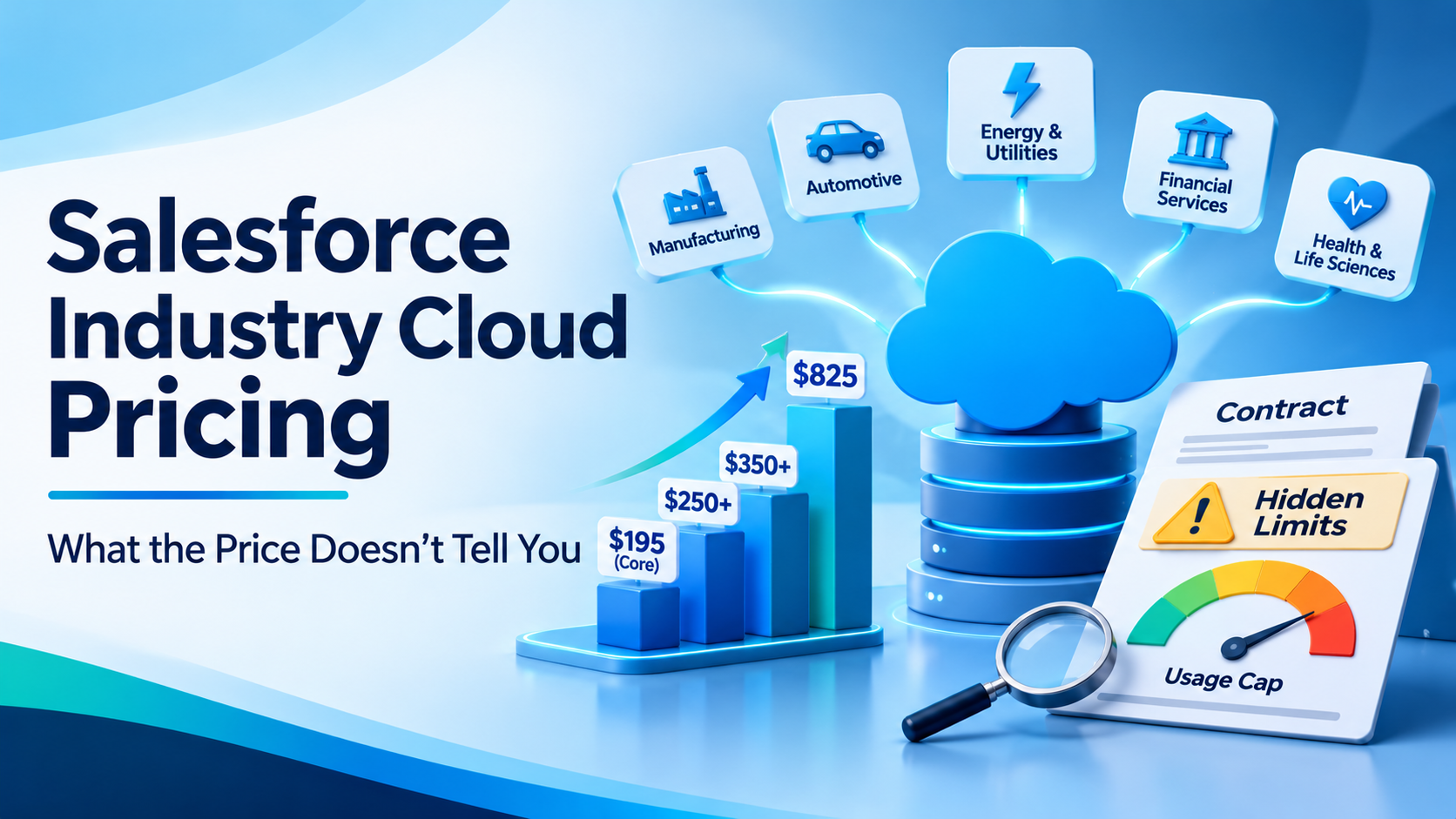
Salesforce's industry clouds start at $250 to $350 per user per month, against $195 for Sales Cloud Core. That is a premium of 28% to 79% for the entry tier, and the gap widens at the top: Communications Cloud Sales and Service Max is $825 per user per month, where Sales Cloud Max is $550. All figures on this page were read off Salesforce's own pricing pages on 9 November 2026.
What that premium buys is a prebuilt industry data model. What it does not buy, and this is the part that catches procurement teams, is a published entitlement ceiling. The volume caps that decide whether your licence actually covers your business live in a legal annexe, not on the pricing page, and nine of the verticals Salesforce prices do not publish one at all.
What does each Salesforce industry cloud cost per user per month?
Every figure below is a published list price, read directly from the named Salesforce pricing page on 9 November 2026. These are not estimates. They are also not what you will pay, because industry cloud deals are discounted, but they are the number your discount is calculated from.
| Product | Entry tier | Entry price (USD/user/month, billed annually) | Top tier | Top price | Premium over Sales Cloud Core |
|---|---|---|---|---|---|
| Sales Cloud (baseline) | Core | $195 | Max | $550 | baseline |
| Energy & Utilities Cloud | Service Core | $250 | Sales & Service Max | $700 | +28% |
| Public Sector | Service Core | $275 | Service Max | $650 | +41% |
| Manufacturing Cloud | Sales Core | $275 | Sales & Service Max | $700 | +41% |
| Consumer Goods Cloud | Sales Core | $275 | not priced on the US page | see below | +41% |
| Automotive Cloud | Sales & Service Core | $300 | Sales & Service Max | $725 | +54% |
| Communications Cloud | Growth | from $300 | Sales & Service Max | $825 | +54% |
| Financial Services Cloud | Sales & Service Core | $350 | Sales & Service Max | $725 | +79% |
| Health Cloud | Sales & Service Core | $350 | Sales & Service Max | $725 | +79% |
| Life Sciences Cloud | Core | $350 | Sales & Service Max | $725 | +79% |
Two products sit outside the per-user model entirely, and if you are budgeting for either, the per-seat arithmetic above is the wrong shape:
| Product | How it is priced | Published figure |
|---|---|---|
| Loyalty Management | per org per month | Starter $20,000, Growth $35,000, Advanced $45,000 |
| Net Zero Cloud | per org per year | Growth $210,000, including one full CRM licence |
Loyalty Management at the Advanced tier is $540,000 a year before a single CRM seat is counted. We have seen that figure stop a loyalty programme business case dead in a first meeting, which is a better outcome than discovering it in month four.
A note on the two verticals that look cheaper than Sales Cloud. Education Cloud and Nonprofit Cloud publish entry prices of $87 and $70 per user per month, well below Core. Both pages state that the cards reflect nonprofit pricing, and the Nonprofit page adds that for-profit institutions should contact an account executive. Do not quote either figure in a commercial business case.
Why three verticals have no Advanced tier, and what that gap costs
Sales Cloud has three rungs above the entry suites: Core at $195, Advanced at $395, Max at $550. Most industry clouds mirror that. Three do not.
Energy & Utilities Cloud goes Service Core at $250, Sales and Service Core at $325, then straight to Max at $650. Manufacturing Cloud goes Core at $275 then Max at $650. Consumer Goods Cloud prices only Core on its US page, with a footnote reading "Above pricing is for Core. Consumer Goods Cloud is also available in Advanced and Max."
The missing rung matters because of what sits on it. On Energy and Utilities, the Flex Credits allocation goes from 500,000 per org at Core to 2.75 million per org at Max. There is no 1 million tier in between, which is exactly where Sales Cloud Advanced sits. So an Energy and Utilities customer who needs more than 500,000 Flex Credits and does not need the rest of Max has nowhere to go but Max, at 2.6 times the Core price.
The Energy and Utilities page still carries traces of a tier that is not for sale. One feature row is labelled "Advanced Edition", and the Sales and Service Max description reads "Everything in advanced plus all full suite of Agentforce for Industries". A buyer reading that sentence reasonably asks what Advanced is. The answer is that on this product, nothing.
Why the tier name on your order form may not match the tier in the documentation
This is the single most common source of confusion we see in industry cloud scoping, and it is not the customer's fault. Salesforce has at least four naming generations live simultaneously across its own properties.
The pricing pages mostly use Core, Advanced and Max. The developer documentation mostly does not. The Manufacturing Cloud Developer Guide states that the product is "Available in: Enterprise, Unlimited, and Developer Editions." Those are not tiers you can buy on the Manufacturing pricing page, which sells Core and Max. The Automotive Cloud developer docs say the same thing. So does Financial Services Cloud, and FSC's admin guide adds a Professional tier that has no counterpart anywhere on the Core, Advanced and Max ladder at all.
Public Sector manages to put both generations inside one SKU name. Its pricing page sells "Public Sector Foundation - Advanced - Field Service Enterprise Edition" at $350 and "Public Sector Foundation - Advanced - Field Service Unlimited Edition" at $600, alongside Service Core, Service Advanced and Service Max. One product name containing both "Advanced" and "Enterprise" is a documentation artefact, but it is the name that ends up in the contract.
Manufacturing Cloud goes one step further and contradicts itself on the same page. Two footnotes under the Agentforce Manufacturing pricing read, in full:
"Above pricing of Agentforce Manufacturing for Sales and Agentforce Manufacturing for Service are for Enterprise Edition." "Unlimited Edition is available for Agentforce Manufacturing for Sales and Service for $425 USD/user/month and $425 USD/user/month respectively."
"Above pricing of Agentforce Manufacturing for Sales and Service is for Unlimited Edition." "Enterprise Edition is available for Agentforce Manufacturing for Sales and Service for $275 USD/user/month."
The first footnote says the printed price is Enterprise and Unlimited costs $425. The second says the printed price is Unlimited and Enterprise costs $275. The $425 figure appears nowhere in the pricing cards. Both footnotes also appear, in USD, on the UK page, whose cards are in pounds. We cannot tell you what Agentforce Manufacturing costs from Salesforce's own pricing page, and neither can your account executive without checking internally.
The practical fix is unglamorous and it works. Get the legacy subscription name and the entitlement table attached to the order form, not just the marketing tier name. If your order form says "Manufacturing Cloud Sales Core" and your developer documentation says Enterprise Edition, you want someone to have written down which features that maps to before you sign.
The USD list price for Net Zero Cloud exists only outside the United States
This one is worth checking yourself, because it sounds like a mistake and is not.
The US Net Zero Cloud pricing page publishes no numeric price anywhere. Every price cell reads "Contact us for pricing", for the Growth edition and for all five add-ons. The UK page publishes a full six-currency ladder for the same product, and the ladder includes a USD column: "$ 210,000" per org per year, "Billed annually; incl. 1 full CRM licence". The UK page also publishes five USD add-on prices the US page withholds, including Advanced Analytics and Forecasting at $165 per user per month and External Engagement Management at $60,000 per org per year.
Consumer Goods Cloud does the same thing in a smaller way. The US page prices only Core at $275. The EU page publishes Service Core at $275, Service Advanced at $450 and Service Max at $700, all in USD alongside five other currencies.
So the rule we now apply on every pricing exercise: when a US Salesforce page says contact us, check the UK and EU pages for the same product before you accept that no list price exists. We have now found a published USD figure on a non-US page twice, on Net Zero Cloud and Consumer Goods Cloud, and separately found the US and EU MuleSoft pages disagreeing on price, buying model and metering unit. It is not a loophole, it is inconsistent publishing, and it gives you an anchor you would otherwise walk into the negotiation without.
Where the entitlement ceilings are published, and it is not the pricing page
Here is the part that almost nobody writes down, and it is the most decision-relevant material on this page.
For six industry clouds, Salesforce publishes an "Additional Contractual Limitations" annexe on its customer agreements index. Those PDFs are the only place volume caps on industry functionality are published. Communications, Energy and Utilities, CME, Insurance, Health and Media and Entertainment each have one. Consumer Goods has an equivalent under a different title.
Three examples, quoted from the documents.
Energy and Utilities. The annexe, revision 04-2022, caps order management by volume: "B2B Order Management for Energy & Utilities Cloud (1,000 Orders/year)" and "B2C Order Management for Energy & Utilities Cloud (5,000 Orders/year)". Now look at Salesforce's add-ons PDF, which sells additional capacity at "$12,000/5,000 B2C orders annually" and "$12,000/1,000 B2B orders annually". The cap in the legal annexe and the overage price in the marketing PDF match exactly. Neither number is on the pricing page. A utility processing 30,000 B2C orders a year is looking at five increments of that add-on, or $60,000 annually, and will not find that out from anything a sales cycle normally produces.
Insurance. The Insurance annexe, revision 06-2021, caps functionality by gross written premium rather than by seats or records. It uses figures of "up to $1M GWP" and "up to $10M GWP", and explains the mechanism directly: "where a GWP amount is specified, a Quantity of 1 in the Order Form entitles Customer to use the applicable functionality in connection with up to the specified amount of GWP only." For any real insurer, a quantity of 1 at $1M of gross written premium is a rounding error. The document also says "Customer must order a sufficient quantity of each GWP-based subscription to cover the value of the business". That is a licensing model, published in a five-year-old PDF, that no insurance pricing page mentions.
Consumer Goods. The Retail Execution restrictions document lists four licences in this printed order: Contractor, Merchandiser, Field Sales, Strategic Sales. Its Custom Objects Limit row reads "10 10 20 100". So the Retail Execution Merchandiser licence, published at $100 per user per month, is capped at 10 custom objects. Salesforce's add-ons page then sells "Additional Custom Objects" at "$75/user/month". The ceiling is in a legal annexe, the remedy is on a marketing PDF, and neither is on the pricing page you were shown.
The nine priced verticals with no annexe of either kind are Automotive, Life Sciences, Financial Services Cloud as such, Manufacturing, Net Zero, Public Sector, Education, Nonprofit and Loyalty Management. That absence is not reassuring. It means the ceilings are wherever your order form says they are, which is a reason to ask for them in writing rather than a reason to assume there are none.
Is a vertical cloud better than building the data model on Sales Cloud Core?
This is the decision that actually matters, and the honest answer is that it depends on how much of the industry model you need.
Manufacturing Cloud is the clearest example because its surface area is public. The Manufacturing Cloud Developer Guide documents roughly 120 industry objects that do not exist in Sales Cloud. The commercially load-bearing ones are SalesAgreement, SalesAgreementProduct, SalesAgreementProductSchedule and SalesContractLine for long-term volume contracts, plus AccountForecast, AccountProductForecast and AdvAccountForecastFact for forecasting against those agreements rather than against pipeline. Sales Cloud's Opportunity object cannot model a three-year volume commitment with monthly schedules, and the usual workaround is a custom object tree that reimplements it badly.
We have built that custom tree for clients, before Manufacturing Cloud existed and twice since for reasons of budget. It works. What it costs is not the initial build, which is maybe six to ten weeks of configuration and Apex depending on how much forecasting you want. What it costs is everything after: every release, every new report requirement, every integration that expects a standard object and finds a custom one, and the fact that your forecasting logic is now your problem rather than Salesforce's. Our rule of thumb, and this is our estimate rather than a published figure, is that custom becomes the more expensive option somewhere around the second year for an org of more than 50 users.
So the vertical cloud wins when you need most of the model. It loses when you need two objects out of 120 and the premium over Core is $80 per user per month, because at 100 users that is $96,000 a year for two objects you could have built in a fortnight. Run that arithmetic with your own seat count before you accept that the industry cloud is obviously correct. The number of seats is what decides it, not the feature list.
What we check before signing an industry cloud order form
In this order, because each step makes the next one cheaper.
- Read the pricing page for your vertical, and then read the UK and EU versions of the same page. If the US page says contact us, a published USD figure may exist elsewhere. Record the date you checked, because these pages move.
- Check the pricing PDF as well as the HTML card. They diverge. The Health Cloud datasheet publishes three editions where the HTML page publishes five, omitting both $700 Max variants. Life Sciences has FY26 and FY27 datasheets live at the same path with different tier names and a top price that moved from $750 to $725. The FY26 document does not state its own fiscal year anywhere inside it, only in the filename, so ask for the datasheet by exact filename.
- Find the Additional Contractual Limitations annexe for your vertical on the customer agreements index. If one exists, read every numeric cap in it. If one does not exist, ask for the entitlement table to be attached to the order form.
- Cross-reference every cap you find against the add-ons PDF. Where a cap has a matching overage SKU, you can price the overage yourself before the conversation starts.
- Ask which legacy edition your tier maps to. If the developer documentation for your product says Enterprise or Unlimited and your order form says Core, get the mapping in writing.
- Count how many of the industry objects you will actually use. Then price the Core alternative at your real seat count. If the answer is close, the vertical cloud is still usually right for maintenance reasons, but you should know it was close.
- For any Agentforce industry add-on, ask for the release status in writing. See the next section.
If you want a second pair of eyes on an order form before it goes to signature, that is a short piece of work and we do it often. Get in touch.
What we could not verify, and what that means for your budget
Three honest gaps, because a post that pretends there are none is not much use.
The Agentforce industry SKUs publish a price but no status. Agentforce for Automotive Cloud, Life Sciences Cloud, Manufacturing Cloud, Consumer Goods Cloud and Communications Cloud all appear at $150 per user per month on their vertical add-ons pages. Not one of them carries a GA, beta or pilot designation anywhere on the page. The nearest thing to a status label is "Available for purchase", which is a commercial statement rather than a release stage. Agentforce for Automotive Cloud is simultaneously priced at $150 on the add-ons page and shown with no price and a "Contact us" link on the main Automotive pricing page. If you are budgeting for one of these, ask for the release status in writing before it goes in the plan.
Three annexes could not be read. The Health, Communications and Media and Entertainment annexes are robots-blocked to automated fetch on both of their published paths. We confirmed they exist and we confirmed their filenames from the legal index. We have not read their caps and we are not guessing at them. If you are buying Health Cloud or Communications Cloud, open those PDFs yourself.
We cannot price Agentforce Manufacturing. Because of the contradictory footnotes above, the published price is either $275 or $425 per user per month depending on which footnote you believe, and the figure in the pricing card belongs to an edition the page names twice, differently.
Frequently Asked Questions
Why do Salesforce industry clouds cost more than Sales Cloud?
The premium pays for a prebuilt industry data model. Manufacturing Cloud adds roughly 120 objects that Sales Cloud does not have, including sales agreements with product schedules and account-based forecasting. The entry premium runs from 28% on Energy and Utilities to 79% on Financial Services, Health and Life Sciences, measured against Sales Cloud Core at $195 per user per month as published on 9 November 2026.
Which Salesforce industry cloud is the most expensive?
By top published list price, Communications Cloud and Media Cloud, both at $825 per user per month for Sales and Service Max, verified 9 November 2026. Financial Services, Health, Life Sciences and Automotive all top out at $725. By total contract value the answer is different again: Loyalty Management is priced per org per month, at $20,000 to $45,000, which is $240,000 to $540,000 a year before CRM seats.
Can I negotiate Salesforce industry cloud pricing?
Published list prices are the starting point for a discount discussion, not the final number, and Salesforce states on every pricing page that the figures are for information only and subject to change. What is worth pushing on is not the headline rate. It is the entitlement ceilings, the overage rates on capped functionality, and a written mapping from your tier name to the legacy edition the documentation references.
Where does Salesforce publish the volume limits on an industry cloud licence?
In an "Additional Contractual Limitations" PDF on the customer agreements page, for the six verticals that have one. Those documents are the only published source for caps such as Energy and Utilities order management at 1,000 B2B and 5,000 B2C orders per year, or the Consumer Goods Retail Execution custom object limits. Nine other priced verticals publish no annexe at all.
Is Education Cloud really cheaper than Sales Cloud?
The published Education Cloud entry price of $87 per user per month is below Sales Cloud Core at $195, but the page states that the cards reflect nonprofit pricing. Nonprofit Cloud at $70 carries the same caveat plus a line directing for-profit institutions to an account executive. Neither figure is a commercial list price and neither should go into a for-profit business case.
Does the pricing PDF match the pricing page?
Not reliably. Health Cloud's datasheet publishes three editions where the HTML page publishes five. Financial Services Cloud's PDF carries an Agentforce 1 SKU at $750 that the HTML page does not sell, and two PDFs with the same filename on different regional paths carry entirely different figures. Read both, and ask for any datasheet by its exact filename, because some of them do not state their own fiscal year.
Industry cloud pricing is not hard to find. What is hard to find is the ceiling attached to the price, and on nine of the verticals Salesforce prices, it is not published anywhere. If you are in a scoping conversation now and nobody has shown you an entitlement table, that is the thing to ask for, and we are happy to go through an order form with you before it goes to signature. Our Salesforce advisory and implementation work starts with exactly this kind of read.
Have Questions or Need Assistance?
Our team of Salesforce experts is ready to help you implement the solutions discussed in this article.
Contact Us Today