Salesforce Life Sciences Cloud Pricing for Pharma
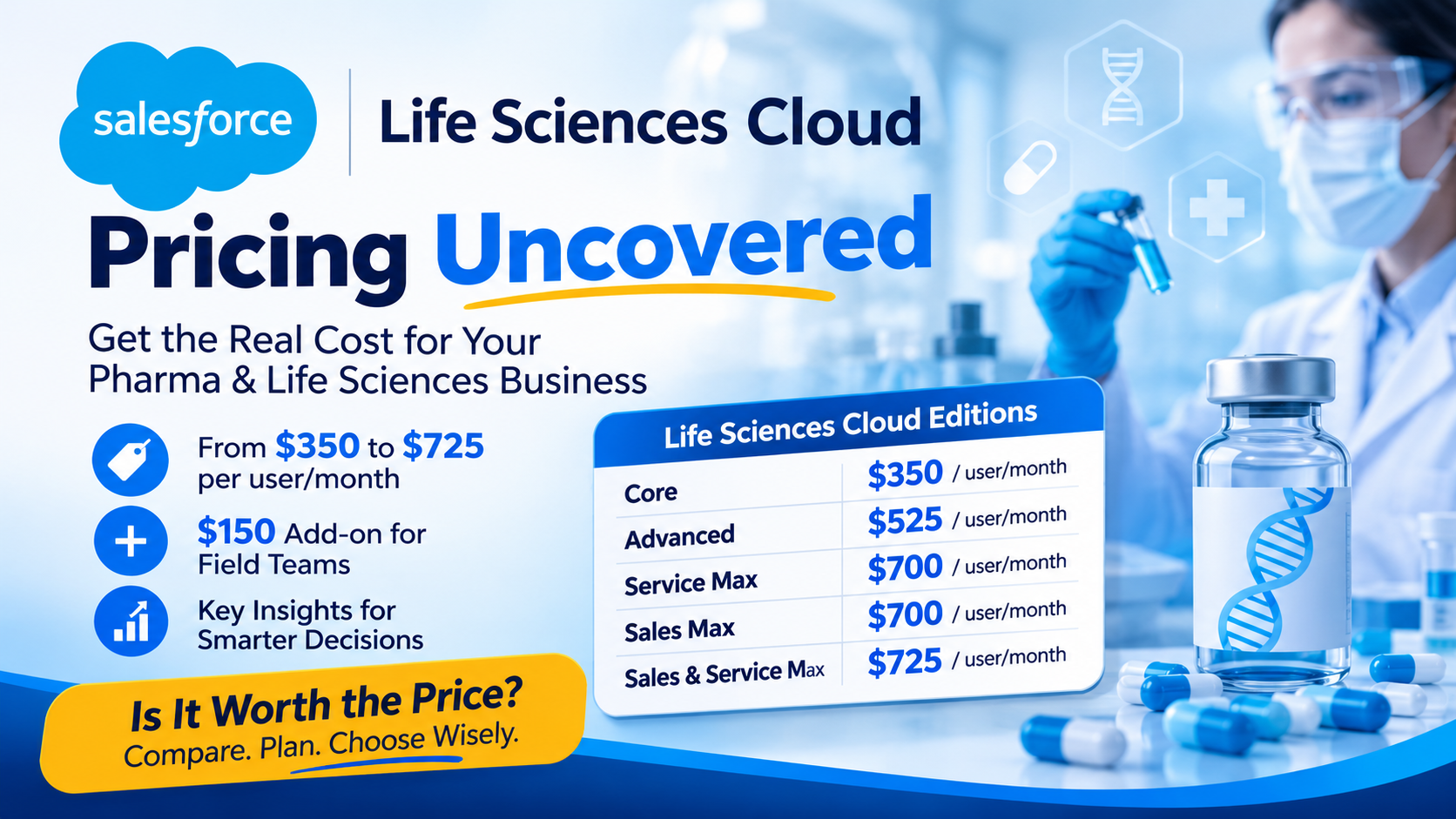
Salesforce Life Sciences Cloud list prices run from USD 350 per user per month for the Core edition to USD 725 for Sales & Service Max, billed annually. A field-facing seat usually needs the Life Sciences Cloud for Customer Engagement add-on at USD 150 per user per month on top, which puts a real rep or medical science liaison seat between USD 500 and USD 875 at list. Every figure here was verified on Salesforce's own pricing page on 2 November 2026.
That arithmetic is the first thing most pharma buyers get wrong, and it is not their fault. The pricing cards publish the platform price, and the offline-capable field application that a commercial team actually lives in is a separate SKU further down the same page.
What does Salesforce Life Sciences Cloud cost per user?
Five editions, all per user per month, all requiring an annual contract. These are published list prices, not our estimates.
| Edition | Published list price (USD/user/month, billed annually) | Flex Credits included | Data storage |
|---|---|---|---|
| Life Sciences Cloud Core | 350 | 500K per org per year | 20MB per user |
| Life Sciences Cloud Advanced | 525 | 1M per org per year | 1GB per user |
| Life Sciences Cloud Service Max | 700 | 2.75M per org per year | 1GB per user |
| Life Sciences Cloud Sales Max | 700 | 2.75M per org per year | 1GB per user |
| Life Sciences Cloud Sales & Service Max | 725 | 2.75M per org per year | 1GB per user |
Source: Salesforce Life Sciences Cloud pricing, verified 2 November 2026, and the FY27 Life Sciences Cloud pricing datasheet, which adds the sentence "Prices quoted require an annual contract."
Two things about this ladder are worth noticing before you model anything.
The first is that Salesforce prices life sciences near the top of its vertical range. Core at 350 sits 79% above the 195 that the general-purpose Core edition costs on the Sales Cloud pricing page, and above Automotive Cloud's 300, which was the most expensive vertical ladder Salesforce published until this one. If you are benchmarking against what a colleague in another industry pays for Salesforce, you will get an unpleasant surprise.
The second is that the regional pages agree, which is unusual. We checked the US, UK, EU, Australia, India and Canada variants on 2 November 2026 and found identical tier names and identical figures, with six currencies offered on all of them. The currency control is a list-price table rather than a live conversion: GBP sits at a flat 0.8 times USD, AUD at 1.4, JPY at 120, and EUR is set numerically equal to USD at every tier. Neither the Canadian page nor the Indian page offers its own local currency. If your procurement team is modelling in CAD or INR, there is no published number to model with.
Why a field seat costs USD 150 more than the pricing card says
The edition buys you the platform, the data model and the office-based user. The application a sales rep or MSL uses in a clinic with no signal is the Life Sciences Cloud for Customer Engagement add-on, published at USD 150 per user per month, which the FY27 datasheet describes as including an offline-ready iPad app.
That is the line clients consistently miss, and it changes the shape of the business case rather than just the total. Here is what it does to a typical commercial deployment.
| Published add-on | List price | Unit |
|---|---|---|
| Life Sciences Cloud for Customer Engagement | 150 | USD per user per month |
| Agentforce for Life Sciences Cloud | 150 | USD per user per month |
| Participant Recruitment and Enrollment | 10,000 | USD per org per year, in increments of 100 patients referred |
| Advanced Therapy Management | From 2,500 | USD, metered as "Other" on the page |
| Unified Health Scoring, powered by Data Cloud | From 10,000 | USD per org |
| Analytics for Health and Life Sciences | From 165 | USD per user per month |
| Customer Community Plus for Health Cloud | Starting at 15 | USD per login per month |
All figures from the same pricing page, verified 2 November 2026.
So a 200-seat field force on Core with Customer Engagement is 200 x 500 x 12, which is USD 1.2 million a year at list before a single hour of implementation. The same 200 seats on Sales Max with Customer Engagement is USD 2.04 million. Discounting on an annual contract of that size is normal, and a 200-seat commercial deal is not a list-price conversation, but the ratio between the two is what you should be arguing about, not the absolute.
There is one more structural point hidden in the footnotes. Two capabilities on the comparison table carry asterisks: Clinical Trial Candidate Matching requires the Participant Recruitment and Enrollment add-on SKU, and HCP Account Summarization requires the Customer Engagement add-on SKU. Neither asterisk appears on the pricing cards. If clinical trial matching is in your requirements document, the entry price is not 350, it is 350 plus 10,000 per org per year.
Which datasheet is your account executive quoting?
Salesforce has two Life Sciences Cloud pricing datasheets live on its own website at the same directory path, and they describe different products.
| Datasheet | Tier names | Top-of-ladder price |
|---|---|---|
| FY27 (current) | Core, Advanced, Service Max, Sales Max, Sales & Service Max | 700 and 725 |
| FY26 v3 (still live) | Enterprise, Unlimited, Agentforce 1 for Service, Agentforce 1 for Sales | 750 |
Both were fetched on 2 November 2026. The FY26 document contains no mention of Core, Advanced or Max; the FY27 document contains no mention of Enterprise or Unlimited.
The price points line up at 350 and 525, so Enterprise reads as Core renamed and Unlimited as Advanced renamed. We should be clear that this mapping is our inference from matching figures rather than something Salesforce states anywhere, and the top of the ladder genuinely moved: the FY26 Agentforce 1 tiers were 750, the FY27 Max tiers are 700 and 725. Flex Credits also moved from a paid add-on in FY26 to an included entitlement in FY27.
This matters in one specific and avoidable way. If a buyer searches for Life Sciences Cloud pricing and lands on the FY26 PDF, they will walk into a negotiation quoting tiers that no longer exist and a top price 50 dollars too high, which makes every subsequent sentence they say sound uninformed. Ask for the FY27 datasheet by name, and check the filename.
Does the data model actually know what a sample is?
Yes, and this is the part of Life Sciences Cloud that is stronger than most sceptics expect. It is not Health Cloud with a new badge.
The Life Sciences Cloud Developer Guide documents a large standard object set at Winter '27, API version 68.0. The objects that matter commercially are there as first-class objects rather than as custom fields someone bolted onto Account:
- Patient services and hub programmes: CareProgram, CareProgramEnrollee, CareProgramEligibilityRule, CareProgramAssistance, CareProgramEnrollmentCard, and the enrolment work order chain.
- HCP engagement and medical affairs: HealthcareProvider with NPI, specialty and taxonomy objects, MedicalInsight, Inquiry with question and answer children, EventPlan with budget, participant and territory children.
- Pharmacovigilance: eight dedicated adverse event objects, including AdverseEventEntry, AdverseEventCause, AdverseEventContribFactor and AdverseEventOutcome.
- Market access: Formulary, FormularyItem, CoverageBenefit, CarePreauth, CareBenefitVerifyRequest.
- Consent: CommSubscriptionConsent, ContactPointConsent, DataUsePurpose.
- Chain of custody and signature: DigitalSignature, DigitalSignatureRequest, CustodyChainEntry, CustodyItem.
Sample compliance is the test case, because this is where US pharma field teams decide whether a CRM is serious. The ProviderVisitRqstSample object represents "sample products requested to be shipped to the health care provider during a visit" and carries IsSignatureCaptured, IsTrackedForSmplTrxnLimit and a multipicklist ViolationType, along with distributor name, shipped quantity and delivery tracking. The object is available in API version 65.0 and later, which means Winter '26. So signature capture, transaction limit tracking and violation typing are in the shipped object model, not on a roadmap slide.
What Salesforce does not do is claim PDMA compliance. The Prescription Drug Marketing Act is not named on the pages we read, including Salesforce's own Trailhead module on capturing engagements, which documents licence checks, product restrictions, sample limits and per-attendee disbursement without using the term. That is the honest position: Salesforce ships the mechanics a PDMA programme needs and leaves the compliance claim to you and your legal team. Any partner who tells you Life Sciences Cloud is PDMA compliant out of the box is describing something no Salesforce page says.
One documentation detail worth having in front of you in a technical evaluation: the developer guide still gates Intelligent Sales with the line "Available in: Enterprise and Unlimited Editions", on the Intelligent Sales data model page. Those are the FY26 edition names. The documentation has not caught up with the commercial rename, which means you cannot read the docs to work out which FY27 tier gates which capability. Get the entitlement table attached to the order form rather than inferring it from a developer page.
Where Veeva's December 2029 date changes the decision
If you are running Veeva CRM today, your timeline is now shorter than you may think, and the change came from Veeva rather than from Salesforce.
Veeva's March 2026 announcement states that Veeva "has updated the end-of-support date for Veeva CRM from September 2030 to the end of December 2029". The same date appears in Veeva's FY2026 annual report as "Veeva CRM will be supported until December 31, 2029." That filing also says Veeva has "begun to migrate our CRM customers to our Vault CRM solutions" and that "the migration of our Veeva CRM customers will require time and expense, which may be significant."
So the decision is not whether to move. Veeva CRM, the product built on the Salesforce platform, has a published end of support three years and two months from now, and Veeva pulled it forward by nine months in a single announcement. The decision is whether you move to Vault CRM on Veeva's own platform or to Life Sciences Cloud on Salesforce's.
Two further facts from that same filing are relevant and come from the competitor rather than from Salesforce marketing, which makes them better evidence. Veeva's risk disclosure records that "certain large Veeva CRM customers have committed to purchasing" Salesforce's CRM solutions and that "a number of our customers have informed us of their intent to move to Salesforce as their CRM provider." The same filing notes that "IQVIA, which historically offered a competitive CRM solution, has licensed its CRM software to Salesforce." A three-horse commercial pharma CRM race is becoming a two-horse one.
The pricing asymmetry is stark and runs in Salesforce's favour on transparency alone. Salesforce publishes a five-tier ladder with figures, add-ons and footnotes. Veeva publishes no list price for Vault CRM anywhere we could find, on any of its own properties. For a finance-led buyer who has to build a 36-month model before the first vendor call, only one of those two vendors can be modelled.
Where Life Sciences Cloud is weaker than Veeva right now
This is the section a partner blog usually skips, and skipping it is why nobody trusts partner blogs.
Sample management documentation depth. Veeva's sample management platform matrix documents cold chain sampling, state distributor licence validation, package labels, lot activation and deactivation, inventory worksheets, returns and transfers, negative sample warning indicators, sample limit templates and audit support including unlocking submitted records. Salesforce documents a credible core. Veeva documents fifteen years of edge cases that US compliance teams have actually hit. If your sampling programme is complex, budget configuration time for the gap rather than assuming parity.
Validation is not Salesforce's. We found no first-party Salesforce page publishing GxP, 21 CFR Part 11, Annex 11 or computer system validation documentation for Life Sciences Cloud. What exists is an April 2025 announcement that the partner Sware "will deliver GxP computer systems validation of Salesforce Life Sciences Cloud". Note the tense. Salesforce is not stating that the platform ships validated, and neither should your project plan. 21 CFR Part 11 is not mentioned in that release at all.
Record locking is hedged. Salesforce's own training material says submitted visits are "normally locked to preserve compliance". For an auditor, "normally" is a question, not an answer. Get the locking behaviour demonstrated in your own sandbox with your own validation rules before you write it into an SOP.
Agentforce for Life Sciences Cloud has a price but no published status. It is listed at USD 150 per user per month with no generally-available, beta or pilot designation on any page we read. Priced and undated is an uncomfortable combination to build a business case on.
The HIPAA coverage detail that catches two bundled products
Life Sciences Cloud is a named HIPAA Covered Service on Salesforce's Business Associate Addendum, last updated 30 September 2026. The condition is explicit: "Customer and Salesforce must sign a BAA that includes the HIPAA Covered Service."
Two exclusions on that same page bite precisely because of what the editions now bundle.
Tableau is included in every Life Sciences Cloud tier, and the BAA says "Tableau Bridge, Tableau Data Connect, and Tableau Server are not covered by the BAA." Slack Business+ is included from Core upward, and the BAA restricts Slack so that it "may not be used to communicate with patients, plan members, or their families or employers."
Neither is a reason not to buy. Both are reasons to write a governance rule on day one rather than discovering it during an audit, and in our experience the Slack one is the harder of the two to enforce after the fact, because patient services teams find Slack genuinely useful and nobody told them.
How to evaluate Life Sciences Cloud in eight weeks
This is the sequence we use. It is designed to surface the expensive unknowns early rather than at contract.
- Week 1: fix the seat taxonomy. Count office seats, field seats and occasional seats separately. Field seats need the Customer Engagement add-on, so getting this count wrong by 30 people is a six-figure error over three years.
- Week 1: get the FY27 datasheet and the entitlement table. Ask for both by name. Check that the entitlement table uses the FY27 tier names and that it lists the two asterisked add-on dependencies explicitly.
- Week 2: run the storage arithmetic. Core gives 20MB of data storage per user. At 200 users that is 4GB for the whole org, and Salesforce publishes no list price for additional data storage anywhere, which we re-confirmed on the platform add-ons page. Growing out of Core on storage is a negotiation, not a purchase, so settle it while the contract is still unsigned.
- Week 3: test sample management against your three worst real scenarios. Not a demo script. A cold chain product, a state with a distributor licence requirement, and a rep who exceeded a transaction limit last quarter.
- Week 4: write the Lead and HCP identity model. HealthcareProvider, Account and Contact can all represent a prescriber. Decide which is authoritative before anyone builds anything, because this is the decision you cannot cheaply undo.
- Week 5: scope the validation work with your QA function, not with a vendor. Establish who signs the validation package and what evidence they need. If the answer involves a third party, get them in the room in week 5 rather than month 9.
- Week 6: model Flex Credit consumption for the agent use cases you actually want. Core includes 500K credits per org per year. Advanced includes 1M. Those are org-level pools, so a 500-seat org and a 50-seat org on Core get the same allowance.
- Weeks 7 and 8: price both paths side by side. Life Sciences Cloud at list against a Vault CRM quote. Only one side has a published list price, so insist on a written Veeva figure early or the comparison will arrive too late to use.
What we would budget for implementation
These are our estimates, not published figures, and they exist to be tested against real quotes rather than quoted as fact.
| Scope | Our estimate, not a Salesforce figure | What drives the variance |
|---|---|---|
| HCP 360, territory model, call reporting, offline field app | 16–24 weeks | Quality of the HCP master data and the number of source systems feeding it |
| Add sample management with signature capture and transaction limits | a further 8–14 weeks | Number of states, cold chain products, and how custom your limit rules are |
| Add patient services hub with care programme enrolment | a further 12–20 weeks | Consent model complexity and payer integration |
| Add GxP validation package | a further 6–12 weeks, run in parallel | Whether your QA function accepts a partner's validation evidence |
Treat these as a planning baseline. We publish them because a range you can argue with is more useful than a number with no provenance, and because every consultancy that refuses to give one is still carrying one internally.
The variance driver that dominates all of these is the HCP data, exactly as the DMS interface dominates automotive estimates. If your prescriber data lives in three systems with three different identifiers and no agreed survivorship rules, that work happens before the CRM work and it is rarely in anyone's first budget.
Frequently Asked Questions
How much does Salesforce Life Sciences Cloud cost per user?
List prices are USD 350 per user per month for Core, 525 for Advanced, 700 for Service Max and Sales Max, and 725 for Sales & Service Max, all billed annually. A field-facing seat usually also needs the Customer Engagement add-on at USD 150 per user per month, making a real field seat USD 500 to 875 at list. Verified 2 November 2026.
Is Salesforce Life Sciences Cloud the same thing as Health Cloud?
No, though they share lineage and some Health Cloud objects appear in the Life Sciences data model. Life Sciences Cloud adds objects the pharma commercial and medical affairs functions need, including eight adverse event objects, care programme enrolment, formulary and coverage objects, and sample request objects with signature capture and transaction limit tracking. Health Cloud is priced and sold separately.
When does Veeva CRM stop being supported?
31 December 2029. Veeva moved the date forward from September 2030 in its March 2026 announcement and restated it in its FY2026 annual report. Veeva CRM is the product built on the Salesforce platform; Vault CRM runs on Veeva's own Vault platform and is where Veeva is migrating customers. That date is the planning constraint for any pharma still on Veeva CRM.
Does Life Sciences Cloud come validated for GxP?
No Salesforce page we found publishes GxP, 21 CFR Part 11 or computer system validation documentation for Life Sciences Cloud. A 2025 announcement names the partner Sware as the party that will deliver GxP validation, phrased in the future tense. Plan validation as project scope with your own QA function, and do not assume the platform arrives with a signed package.
Can we migrate from Veeva CRM to Life Sciences Cloud without rebuilding?
Records migrate; configuration does not. Veeva CRM's call reporting, sampling rules, territory alignment and content distribution are Veeva constructs with no one-to-one Salesforce equivalent, so each becomes a design decision rather than a mapping exercise. In our experience the territory and alignment model is the single largest piece of rebuild work, and it is usually underestimated because it looks like data.
Which Life Sciences Cloud edition do we need?
Core covers the platform, the data model, Revenue Cloud Advanced and Tableau Next. Advanced adds a full sandbox, Data Detect and Security Center, which most regulated commercial deployments want. The Max tiers add Agentforce access, contract management and Salesforce Maps Advanced. If a full sandbox matters to your validation approach, that requirement alone pushes you from Core to Advanced.
A pharma commercial team evaluating Life Sciences Cloud against Vault CRM on a December 2029 clock has two hard problems that have nothing to do with features: working out what a field seat really costs once the Customer Engagement add-on is in, and getting the HCP identity model right before the build starts. We do both as a fixed-scope piece of work, and the output is a costed seat model plus a written data model decision your QA and commercial teams have both signed. If that is where you are, talk to us, or read how we scope Salesforce implementation work before committing to a platform.
Have Questions or Need Assistance?
Our team of Salesforce experts is ready to help you implement the solutions discussed in this article.
Contact Us Today