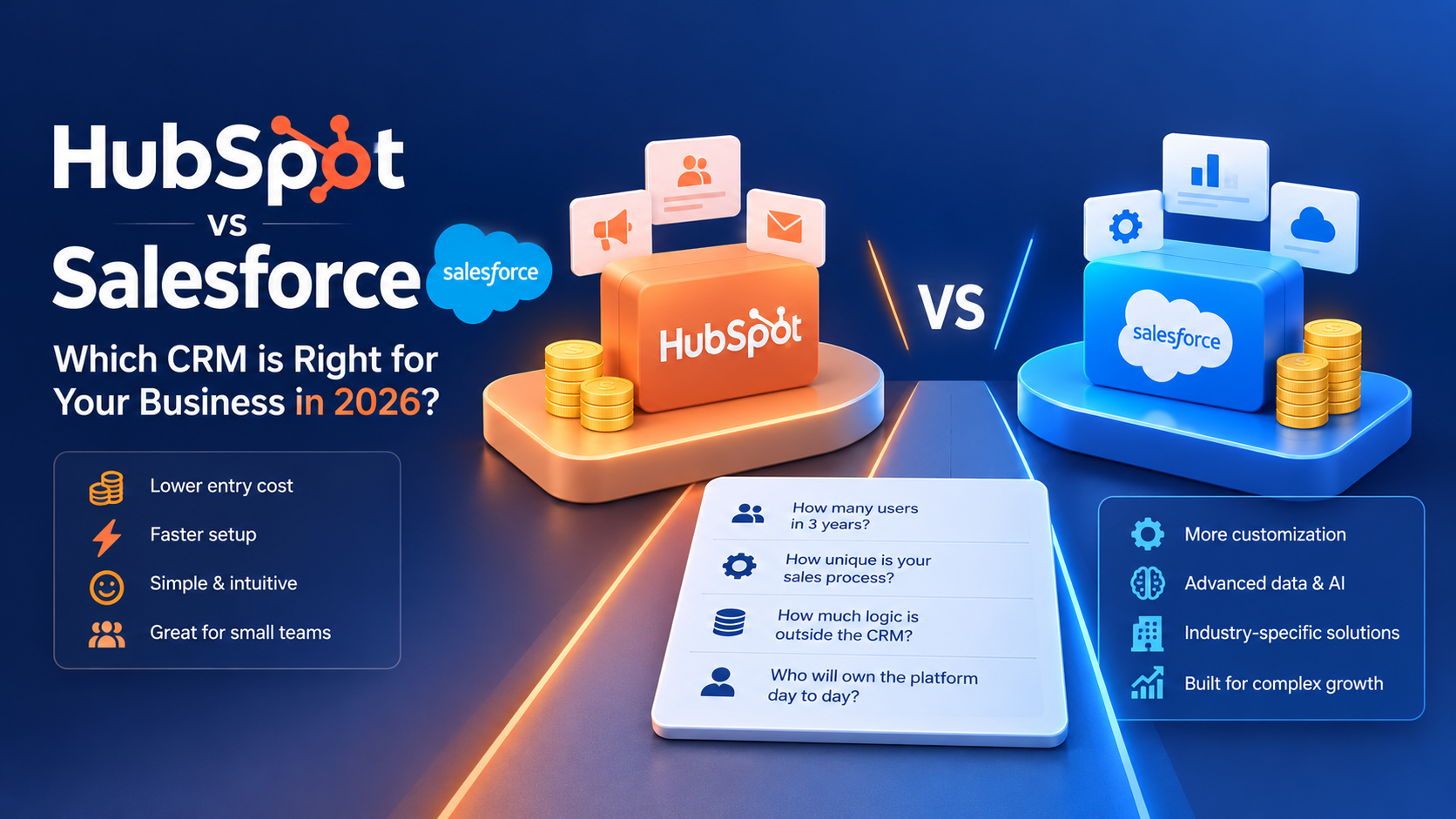
Salesforce vs HubSpot in 2026: Pricing and Fit
HubSpot is cheaper at entry, with Sales Hub Professional at USD 90 per seat per month on annual billing against Salesforce Enterprise at USD 175. The gap narrows sharply above about 50 users and closes once you need multi-object customisation, industry data models or governed AI. Choose HubSpot for speed and simplicity, Salesforce for depth and complex process.
That is the short answer. The longer one turns on four questions: how many seats you will have in three years, how unusual your sales process genuinely is, how much of your business logic lives outside the CRM, and whether anyone will own the platform day to day.
We implement Salesforce for a living, so read the sections below with that in mind. We have also told clients to buy HubSpot, and the section on when we do that is the most useful part of this comparison.
Current Salesforce and HubSpot list prices in 2026
Both vendors changed their line-ups recently, so figures from 2024 comparison guides are misleading. Salesforce rebranded Sales Cloud to Agentforce Sales at Dreamforce '25, though the edition names and the underlying product are unchanged. HubSpot continues to price per seat, with separate contact-tier costs on its marketing products.
Salesforce (Sales Cloud / Agentforce Sales), USD per user per month, from the official Salesforce pricing page:
| Edition | Price | Billing |
|---|---|---|
| Free Suite | $0 | Monthly or annually |
| Starter Suite | $25 | Monthly or annually |
| Pro Suite | $100 | Annually |
| Enterprise | $175 | Annually |
| Unlimited | $350 | Annually |
| Agentforce 1 Sales | $550 | Annually, includes 1M Flex Credits and 2.5M Data Cloud Credits per org per year |
HubSpot Sales Hub, USD per seat per month, from HubSpot's own pricing guide:
| Plan | Annual billing | Monthly billing | One-off onboarding |
|---|---|---|---|
| Free Tools | $0 (up to 2 seats) | $0 | None |
| Starter | $9 | $15 | None |
| Professional | $90 | $100 | $1,500 |
| Enterprise | $150 | $150 | $3,500 |
Two details are easy to miss. HubSpot's Enterprise tier at USD 150 undercuts Salesforce Enterprise at USD 175, so the price advantage runs the whole length of the range rather than just at entry.
HubSpot also charges mandatory onboarding fees on paid tiers. Salesforce charges no platform onboarding fee, which reads well on a quote and means very little, because a Salesforce Enterprise rollout effectively requires implementation services costing considerably more than USD 3,500.
Where the cost difference actually shows up
Licence list price is the least interesting number in a CRM comparison. Four other lines move total cost of ownership more.
Implementation. A HubSpot Professional rollout for a 25-person sales team is commonly a two to four week exercise. The equivalent Salesforce Enterprise implementation is six to twelve weeks and typically costs USD 25,000 to USD 75,000 in services. That gap is real and it favours HubSpot whenever the process is straightforward.
Administration. HubSpot is designed to be administered by a marketing or revenue operations generalist. Salesforce above Pro Suite realistically needs a dedicated admin, full-time above roughly 100 users. Budget for that person or for a managed service. Orgs without an owner degrade within a year, and the cleanup costs more than the salary would have.
Scale economics. HubSpot's per-seat pricing stays largely flat as you grow. Salesforce discounts materially at volume, and the 6 per cent list price rise applied to Enterprise and Unlimited editions from 1 August 2025 is routinely negotiated away on multi-year deals of any size. By 100 seats and above, the effective gap is much smaller than list prices suggest.
Add-ons. This is where Salesforce deals inflate. CPQ, Field Service, Data Cloud, Shield, extra sandboxes and Agentforce credits are separate lines. HubSpot bundles more into each tier but caps what the tier can do, so you upgrade the whole tier rather than buying one module.
Where HubSpot is the better choice
- Under 50 seats with a conventional sales process. If your pipeline is leads, deals and a handful of stages, HubSpot does it faster and cheaper.
- Marketing and sales in one team. HubSpot's marketing-to-sales handoff is genuinely more integrated out of the box than Salesforce plus Marketing Cloud.
- No dedicated admin. HubSpot is the more forgiving platform when nobody owns configuration full-time.
- Speed matters more than fit. Live in three weeks with 80 per cent of what you wanted beats live in three months with 95 per cent, for a lot of growing companies.
- Content and inbound are core. The CMS, email and reporting stack is a coherent whole rather than an assembly of separate clouds.
Where Salesforce is the better choice
- Non-standard data models. If your business runs on objects that are not leads, contacts, accounts and deals, such as policies, claims, patients, shipments or assets, Salesforce models them natively and HubSpot does not.
- Industry clouds. Health Cloud, Financial Services Cloud, Manufacturing Cloud and the rest ship with data models and compliance features that would be custom builds elsewhere.
- Complex quoting and revenue processes. Multi-tier approvals, CPQ, subscription revenue recognition.
- Serious integration requirements. MuleSoft, a mature API surface, and an app ecosystem an order of magnitude larger than HubSpot's marketplace.
- Governed AI on your own data. Agentforce agents run as a Salesforce user and inherit that user's sharing and field-level security, which is a materially different governance story from an AI assistant bolted onto a CRM.
- 500 or more users, or global operations needing territory management, multi-currency and regional data residency.
How the AI capabilities compare
Both vendors put AI at the centre of their 2026 positioning, and both charge for it.
Agentforce is metered through Flex Credits at USD 500 per 100,000 credits, with a standard action consuming 20 credits and a voice action 30. The alternative model is USD 2 per conversation. Agentforce 1 editions bundle 1 million Flex Credits per org per year. The distinguishing feature is not model quality but grounding: agents are built from subagents and actions that read and write real CRM records under a running user's permissions.
HubSpot's Breeze AI is bundled more generously into tiers with credit allowances, which makes it cheaper to experiment with and harder to predict at scale.
For teams doing summarisation, drafting and basic routing, the practical difference between the two is small, and we would not pick a CRM on it. For teams wanting agents that execute multi-step processes against a governed data model, Salesforce is ahead.
The commercial signal is worth noting. Salesforce reported Agentforce annual recurring revenue of USD 1.2 billion in Q1 FY27, up 205 per cent year on year, with Agentforce and Data 360 combined at nearly USD 3.4 billion. That is adoption at scale rather than marketing.
A worked three-year comparison at 40 seats
Assume 40 sales users, annual billing, no negotiated discount, and a moderately complex process.
| Line item | HubSpot Sales Hub Professional | Salesforce Enterprise |
|---|---|---|
| Licences, 40 seats, 3 years | $129,600 | $252,000 |
| Onboarding / implementation | $1,500 | ~$45,000 |
| Admin resource, 3 years | ~$60,000 (0.3 FTE) | ~$180,000 (0.75 FTE or managed service) |
| Integrations and add-ons | ~~$15,000 | $40,000 |
| ~~~~Approximate three-year total~~~~ | **$206,000** | **~~$517,000** |
Salesforce is roughly 2.5 times the cost at this size. That is the honest number, and it is why HubSpot wins a great many mid-market deals.
The counter-argument is equally honest. If 20 per cent of your process cannot be modelled in HubSpot and ends up in spreadsheets or a second system, the two columns are no longer measuring the same thing, and the spreadsheets have a cost that never appears on anyone's quote. Work out which situation you are in before you compare totals.
When we tell clients to buy HubSpot instead
A 30-seat B2B services firm came to us last year wanting Salesforce, mostly because their board expected it. Their process was leads, opportunities, four stages, one approval step and a quoting spreadsheet they wanted to retire.
We scoped both options. Salesforce Enterprise would have given them a data model with room to grow, an approval process that matched their governance on paper, and an upgrade path into CPQ later. It lost anyway, on two grounds. They had nobody to run it, and their process did not need it. HubSpot Professional covered the same work for roughly a third of the three-year cost, and their operations manager could administer it without a partner on retainer.
What they gave up is worth stating, because it was not nothing. Two custom objects they wanted for supplier relationships had to be handled as workarounds. Their reporting is less flexible than it would have been. If they acquire a business with a different sales motion, the migration conversation restarts.
Our test in these situations is simple: if the platform decision is driven by ambition rather than by current process complexity, and there is no admin, the cheaper platform is usually correct. Buying Salesforce for the company you hope to be in five years is the most expensive optimism in this market.
Where this comparison stops being reliable
Cost models like the one above are directionally useful and precisely wrong. Two things break them.
Discounting is the first. Salesforce list prices are a starting position, and a negotiated multi-year deal at 100 seats can move the licence line by a meaningful percentage that no public comparison can predict for you. Every table on the internet, this one included, compares undiscounted prices against a vendor that rarely charges them.
Second, the admin line is an estimate of your own hiring market, not a product cost. A 0.75 FTE assumption is reasonable in some cities and badly wrong in others.
Can you migrate between them?
Yes, in both directions, and neither migration is trivial. Exporting contacts, companies, deals and activities and mapping them to the target schema is the easy part. The hard parts are consistent across every migration we have run.
- Custom fields and objects rarely map one to one. Decide what to carry over and what to retire before the export, not during it.
- Automation must be rebuilt, not migrated. HubSpot workflows and Salesforce Flows are different enough that reimplementation is the only sensible approach.
- Historical activity data is bulky and is usually what blows the timeline. Agree a cut-off, because most organisations do not need eight years of email logs.
- Integrations need to be re-pointed and retested individually.
- Reporting has to be rebuilt and reconciled, because leadership will compare old and new numbers on day one.
Budget six to twelve weeks for a mid-market migration in either direction, and run both systems in parallel for at least two weeks.
Frequently Asked Questions
Is HubSpot cheaper than Salesforce?
Yes at list price and at small scale. HubSpot Sales Hub Professional is USD 90 per seat per month on annual billing against USD 175 for Salesforce Enterprise, and HubSpot implementations cost far less. The advantage narrows above roughly 100 seats, where Salesforce discounts materially and HubSpot's per-seat pricing stays largely flat.
Has Sales Cloud been renamed?
Yes. Salesforce rebranded Sales Cloud to Agentforce Sales at Dreamforce '25, as part of the wider Agentforce 360 naming. The edition names, being Starter Suite, Pro Suite, Enterprise, Unlimited and Agentforce 1 Sales, are unchanged, as is the product itself.
Can HubSpot handle custom objects?
HubSpot Enterprise supports custom objects, but with tighter limits and less relational depth than Salesforce. If your business model depends on several interrelated custom objects with their own layouts, sharing rules and automation, Salesforce is the safer choice. For one or two supplementary objects, HubSpot Enterprise is usually sufficient.
Which is better for a company scaling to 200 or more users?
Salesforce, in most cases. Beyond roughly 150 to 200 users the governance features, meaning territory management, granular sharing, sandboxes, release management and deployment tooling, stop being optional. Salesforce's volume discounting also reduces the licence gap that made HubSpot attractive at 30 seats.
Do you need a consultant to implement either platform?
HubSpot Professional can be implemented in-house by a capable operations person. Salesforce Enterprise realistically cannot, unless someone on staff has done it before. The cost of a poor Salesforce implementation, meaning bad data model decisions and ungoverned customisation, usually exceeds the consultant's fee several times over.
Before you compare the two quotes
The mistake that costs the most here is buying for the process you expect in five years rather than the one you run today, then paying three years of licences and admin salary for capability nobody uses. Write down the parts of your current process that genuinely cannot be modelled as leads, deals and stages. If that list is short, the cheaper platform is probably right.
If it is not short, contact us, or see what we do first.
Have Questions or Need Assistance?
Our team of Salesforce experts is ready to help you implement the solutions discussed in this article.
Contact Us Today