Salesforce vs Zoho CRM: Pricing and Fit in 2026
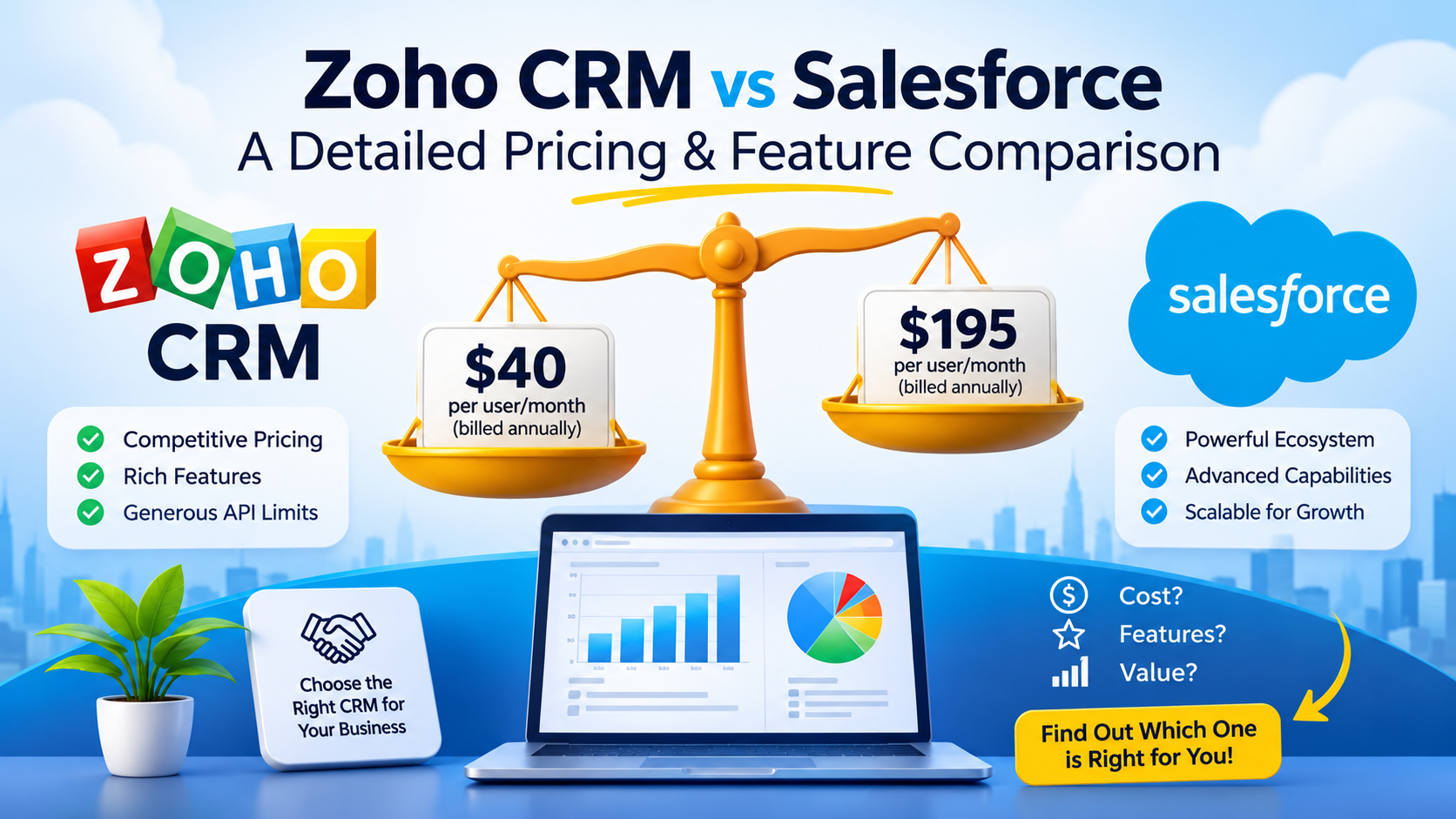
Zoho CRM Enterprise lists at USD 40 per user per month billed annually. Salesforce Core lists at USD 195. At 50 seats that is roughly USD 24,000 a year against USD 117,000, a gap of about 4.9 times on list price. Both figures are the vendors' own published prices and both require an annual commitment, so the comparison is fair as far as it goes.
What it does not tell you is what the extra 155 dollars buys, and whether your business needs it. We are a Salesforce partner, so you can discount the conclusion if you like. What you should not have to discount are the numbers, which is why every price below carries the page it came from and the date we checked it, and why the section where Zoho is plainly ahead is as long as the one where Salesforce is.
What does each one cost at 10 to 100 seats?
All figures verified directly on the vendors' own pricing pages on 26 October 2026. These are published list prices, not estimates.
| Edition | Published list price, USD per user per month, billed annually | Billed monthly |
|---|---|---|
| Zoho CRM Standard | 14 | 20 |
| Zoho CRM Professional | 23 | 35 |
| Zoho CRM Enterprise | 40 | 50 |
| Zoho CRM Ultimate | 52 | 65 |
| Salesforce Starter Suite | 25 | 25 (billed monthly or annually) |
| Salesforce Pro Suite | 100 | Not offered |
| Salesforce Core | 195 | Not offered |
| Salesforce Advanced | 395 | Not offered |
| Salesforce Max | 550 | Not offered |
Sources: Zoho CRM edition comparison and Salesforce Sales Cloud pricing, both fetched 26 October 2026. Zoho adds "Local taxes (VAT, GST, etc.) will be charged in addition to the prices mentioned."
Three observations before anyone builds a spreadsheet.
Zoho's month-to-month pricing is substantially more expensive than its headline. Professional costs 52% more billed monthly than billed annually. Zoho's published range of 14 to 52 dollars is an annual-commitment range, and the monthly option is a convenience you pay for. Salesforce simply does not offer monthly billing above Starter Suite, so both vendors effectively want an annual commitment for their real price.
Regional pricing is not a conversion on either side. Salesforce prices EUR 1:1 with USD and GBP at 0.80 of USD across every tier. Zoho's India ladder has a different shape entirely, not just a different level: in USD, Ultimate costs 30% more than Enterprise, while in INR the equivalent step is around 8%. A multinational standardising on one edition will find the upgrade decision has a different answer in Chennai than in Chicago.
Zoho's own comparison page served us a mix of currencies in a single table, with one tier in rupees and the rest in dollars, which is worth knowing if you are quoting from it. Salesforce's pages were consistent.
Where the edition wall sits on each ladder
Headline price comparisons fall apart because the two ladders gate different things, but the gates are closer together than either vendor's marketing suggests.
| Capability | Zoho Standard (14) | Zoho Professional (23) | Zoho Enterprise (40) | Salesforce Pro Suite (100) | Salesforce Core (195) |
|---|---|---|---|---|---|
| Custom modules or objects | 10 | 25 | 200 | 50 | 200 |
| Custom fields per module or object | 10 | 155 | 300 | 100 | 500 |
| Active automation | 15 active workflow rules per module | 40 active per module | 75 active per module | 5 active flows in total | No low cap documented |
| Custom code in automation | Not offered | Not offered | Workflow Functions | Not offered | Apex |
| Sandboxes | None | None | 3 configuration, 2 configuration and data | None | 25 developer, 1 partial copy |
Zoho figures from the Zoho CRM specifications page and the feature availability table; Salesforce figures from the Pro Suite and Enterprise edition allocation pages. Verified 26 October 2026.
A caution on Zoho's own documentation, offered in the same spirit as the ones we apply to Salesforce. Zoho's comparison page states that custom modules are not offered at Standard and Professional and caps Enterprise at 100. Its feature availability table and its help centre specifications page both say 10, 25, 200 and 500, and a Zoho community announcement confirms custom modules were extended to Standard and Professional with expanded limits. The comparison page is stale. We have used the higher figures because two Zoho sources agree on them.
The practical point is that both vendors put custom code behind the same wall. Zoho's Workflow Functions require Enterprise. Salesforce's Apex requires Core. Neither Zoho Standard at 14 nor Salesforce Pro Suite at 100 will run a line of custom logic, and neither gives you a sandbox to test in. If your requirement list contains the words "when X happens, call the warehouse system and then do Y", you are shopping at Zoho Enterprise and Salesforce Core, which narrows the gap from 14 against 195 to 40 against 195.
The gap is still 4.9 times. It is simply a smaller claim than the one usually made.
The API: included on Zoho, a line item on Salesforce
This is the clearest structural win on the Zoho side and it is rarely mentioned.
Zoho meters API usage in credits per org per 24 hours, with a formula published on its API limits page:
| Zoho edition | Daily credit allowance | Daily maximum |
|---|---|---|
| Free | 5,000 | 5,000 |
| Standard | 50,000 + (user licences x 250) + add-ons | 100,000 |
| Professional | 50,000 + (user licences x 500) + add-ons | 3,000,000 |
| Enterprise and Zoho One | 50,000 + (user licences x 1,000) + add-ons | 5,000,000 |
| Ultimate and CRM Plus | 50,000 + (user licences x 2,000) + add-ons | Unlimited |
A 25-seat Zoho Standard org therefore gets 56,250 credits a day, included. The 50,000 base is granted regardless of seat count, which favours small orgs disproportionately.
On Salesforce, API access below Enterprise is a purchase. The Web Services API add-on is USD 25 per user per month and is included in Enterprise and Unlimited licences, and additional API calls are USD 25 per month per 10,000 daily calls. For a 25-seat business with three integrations, that is a real recurring line on one side of the comparison and zero on the other.
One thing Zoho does not document: what happens when the daily credit limit is fully consumed. The page documents the concurrency error, TOO_MANY_REQUESTS, and a remaining-credits response header that appears at 50% usage, and says nothing about credit exhaustion. We would ask before building anything latency-sensitive against it.
AI: one vendor publishes a rate, the other publishes an allowance
Both vendors now sell AI agents. They have made opposite choices about what to tell you.
Salesforce publishes rates you can model before you sign. Flex Credits are USD 500 per 100,000 credits, which is USD 0.005 per credit by simple division. A standard Agentforce action costs 20 credits, so ten cents. Conversations are priced at USD 2 each. Salesforce also publishes its overage position: "There is no overage penalty. If you exceed your entitlement, your rate is your contracted rate billed monthly in arrears", alongside "Unused Flex Credits do not roll over into subsequent subscription terms."
Zoho publishes an allowance and withholds the rate. Its Zia Agents pricing page states "You pay only for LLM usage; Zia Agents are free", converts tokens to credits at 1 credit per 1,000 tokens on the standard tier and 3 credits per 1,000 on the pro tier, and includes 30 million standard-tier tokens and 20 million pro-tier tokens per month, resetting on the first of each month. The over-limit row on that table exists and the figure is blank. There is no published per-million-token price, and the page uses neither "generally available" nor "beta".
The fair reading of that is not that one vendor is hiding something. It is that they suit different buyers.
If you will stay inside 30 million tokens a month, Zoho's AI costs nothing and Salesforce's costs whatever you committed to, whether or not you use it. If you are building something whose usage you need to forecast over 24 months and defend to a finance director, Salesforce gives you a unit rate, an overage policy and a published rate card, and Zoho currently does not. Both of those are real positions and you know which one describes you.
Zoho built a migration path from Salesforce. Salesforce has not built one back.
We would rather say this ourselves than have you notice we left it out.
Zoho names Salesforce explicitly in its data migration documentation and provides a "custom-made setup to migrate from Salesforce". It handles module and field mapping including creating missing custom modules, carries file and image upload fields, picklist history, multi-select lookups and subforms, and maps record ownership provided you migrate users first. File limits are published: CSV only, 5GB per file, 200 files at once, 25GB total.
Salesforce publishes no Zoho-specific migration tool. The documented routes are the generic Data Import Wizard and Data Loader. Every Zoho-to-Salesforce migration offering we found is a consultancy's, including ours.
Two things are worth saying precisely, because the usual version of this section overstates both sides.
Zoho's tooling is a data migration tool. Its documentation describes record-level CSV transfer with field mapping. It makes no claim to carry Salesforce workflows, validation rules, formula fields, Apex, approval processes, page layouts, sharing rules or field history, and it does not discuss them either way. Anyone telling you Zoho's docs say configuration does not migrate is inventing a sentence. The accurate warning is more useful anyway: the documentation covers records and is silent on configuration, so assume configuration is rebuilt by hand and get that confirmed in writing before you commit to a date.
And an inbound tool is not a measure of product quality. It is a measure of where a vendor thinks its growth comes from. Zoho has invested in making itself easy to switch to. That is a commercial decision that benefits buyers, and it would be churlish to pretend otherwise.
Where Zoho genuinely wins
Seat cost at 10 to 100 seats. Enterprise at 40 against Core at 195. At 50 seats that is about USD 93,000 a year of difference on list, which at the smaller end of this range is a headcount.
API cost at low volume. Included on Zoho from Standard upward, a per-user or per-call purchase on Salesforce below Enterprise.
Suite breadth per dollar. Zoho One is published as bundling 50 or more business applications per user. Zoho's pricing pages render those figures inconsistently, and the only complete numbers we could get were a flexible-user figure of US$90 and a small-teams page showing Zoho One starting at $37 per user per month, with the all-employee figure not rendering at all. Treat those as partial. Even so, there is no Salesforce product at any price that bundles accounting, HR, email, projects and CRM, and for a small business consolidating six subscriptions that is not a CRM comparison at all.
AI is free up to a real allowance. Building and deploying Zia Agents carries no fee, and 20 to 30 million tokens a month is a meaningful amount of usage for an SMB.
Field headroom arrives earlier. Zoho Professional at 23 dollars allows 155 custom fields per module. Salesforce Pro Suite at 100 dollars allows 100 custom fields per object. Published as shown, and yes, 155 is an odd enough number that we double-checked it.
There is third-party ROI evidence, and it is not nothing. Nucleus Research published "Zoho delivers a 439 percent ROI and reduces TCO by 47 percent" on 6 February 2025, reporting a return of $4.39 per dollar invested, a 68% TCO reduction specifically for customers switching from Salesforce, and payback in under four months for most users. The caveats belong alongside it: the page states no sample size, describes its basis only as "recent Nucleus case studies", states nothing about sponsorship, and Zoho promotes it widely. Cite it with those and it stands up. Cite it bare and it reads as marketing.
One claim we checked and will not repeat: Zoho's telephony is not free. It is built in, which saves you a third-party vendor, but Zoho's own documentation prices it in credits where "1 Credit equals $1 US", debited for both incoming and outgoing calls, with 1,000 minutes of free recording storage per org. That is still a win, just a smaller and truer one.
Where Salesforce genuinely wins
The talent market, and this is the evidentiary asymmetry of the whole comparison. Salesforce publishes that "70% of Salesforce implementations are led by one of 132,000 credentialed Salesforce experts". We searched for an equivalent Zoho figure, on Zoho's partner pages and across its properties, and found none published at all. Zoho's partner programme offers a searchable directory and references certifications without quantifying either.
That matters to a 40-person business more than to a 4,000-person one, and not for the reason usually given. The risk is not finding the first administrator. It is finding the second one, in your city, at short notice, when the first leaves. The market for that person is observably deeper on one side.
Ecosystem depth. Salesforce publishes roughly 7,000 AppExchange listings, though note that the number bundles applications and consulting organisations together, and around 10 million installs. Zoho publishes "over 2,500 ready-to-use extensions" on its Marketplace page, with no install figure. Zoho's own page contradicts itself here too, its meta description saying 1,000 or more while the body says 2,500, which is the sort of thing we flag on Salesforce's pages and should flag on Zoho's.
Sandbox depth. Salesforce Enterprise gives 25 developer sandboxes and one partial copy. Zoho Enterprise gives three configuration and two configuration-and-data sandboxes. Both vendors withhold sandboxes below their mid-tier; above it, Salesforce's provision is roughly five times deeper. If you run a release process with more than one stream of change, that difference turns into calendar time.
Analyst position, stated precisely. Gartner's current report in this category is the Magic Quadrant for CRM Sales Platforms, renamed from the Magic Quadrant for Sales Force Automation Platforms. Trade press reporting on the 2026 edition places Salesforce and Microsoft as Leaders and Zoho as a Challenger. Zoho's own page confirms it was "recognized as a Visionary for the fourth time" in the 21 July 2025 Sales Force Automation Platforms report. Read plainly, Zoho moved up a quadrant between the two editions, which is a point in Zoho's favour and the kind of thing a Salesforce partner should say out loud. Gartner does not endorse any vendor depicted in its research.
A documented upgrade path. Starter 25, Pro Suite 100, Core 195, Advanced 395, Max 550, all on one page with per-edition allocation documentation behind each. Zoho's equivalent path runs CRM to CRM Plus to Zoho One, and Zoho does not render complete prices for the latter two on its own pages.
Three things we would normally claim for Salesforce and will not, because we could not source them today: the depth of the data and sharing model under complexity, governance and compliance tooling, and industry clouds. They are probably true. They are adjectives until someone puts a number on them.
What this means at 10, 50 and 100 seats
- Under 20 seats, with standard sales processes. Zoho, almost certainly. At Standard or Professional you will spend between USD 3,400 and USD 5,500 a year for ten users against USD 12,000 for Salesforce Pro Suite, the API is included, and neither platform gives you custom code at that price anyway.
- 20 to 50 seats, with two or three integrations and some custom logic. The honest answer is Zoho Enterprise unless something specific pushes you the other way. At 40 against 195 you need a concrete reason, and "we might scale" is not one on its own.
- 50 to 100 seats, with a complex sharing model, regulated data, or an industry-specific data model. This is where Salesforce starts earning the difference. Vertical products, the depth of the record access model and the availability of people who have built the thing you are building before are worth real money at this size.
- Any size, where the CRM is the smallest part of the problem. If you are also buying accounting, HR, projects and a help desk, price Zoho One against the sum of what you are replacing rather than against Salesforce.
- Any size, where AI agent usage is central and must be forecast. Salesforce publishes a unit rate and an overage policy. Zoho publishes an allowance and a blank over-limit cell. Pick the one whose uncertainty you can live with.
The decision we see go wrong most often is not choosing Zoho when Salesforce was right, or the reverse. It is choosing either platform on a seat price and then discovering the integration work costs more than three years of licences on either side. That cost is roughly the same whichever you pick, and it is the number nobody puts in the comparison table.
Frequently Asked Questions
Is Zoho CRM really cheaper than Salesforce?
On list price, substantially. Zoho CRM Enterprise is USD 40 per user per month billed annually against Salesforce Core at USD 195, a gap of about 4.9 times. The gap narrows once implementation and integration costs enter, because those are driven by your process complexity rather than by the platform, and both vendors put custom code behind their mid-tier edition anyway.
Can you migrate from Salesforce to Zoho CRM?
Zoho publishes a named migration path for Salesforce using CSV files, with automatic module and field mapping, limits of 5GB per file and 25GB in total, and a documented requirement to migrate users before records. Its documentation covers record data and is silent on configuration, so assume workflows, validation rules, formula fields and Apex are rebuilt by hand and get that confirmed in writing.
Does Zoho CRM include an API?
Yes, from Standard upward, metered in credits per org per 24 hours. The formula is 50,000 credits plus 250 to 2,000 per user licence depending on edition, plus any add-on credits. Salesforce includes API access in Enterprise and Unlimited licences and charges USD 25 per user per month for the Web Services API add-on below that, which makes the API a line item at the lower editions.
What does Zoho's AI cost compared with Agentforce?
Zoho states that Zia Agents are free to build and deploy, charging only for LLM usage, with 30 million standard-tier tokens included monthly and no published price beyond the allowance. Salesforce publishes Flex Credits at USD 500 per 100,000 credits, 20 credits per standard agent action, and no overage penalty beyond your entitlement. One is cheaper if you stay inside the allowance; the other is forecastable.
When is Salesforce worth five times the price?
When your sharing and record access model is genuinely complex, when you need an industry-specific data model, when compliance tooling is a requirement rather than a preference, or when the depth of the hiring market matters because the platform will outlast the person who built it. Below roughly 50 seats with standard processes, that case is hard to make honestly.
Does Zoho publish how many certified partners it has?
Not that we could find. Zoho's partner pages offer a searchable directory and reference training and certifications without giving a number. Salesforce publishes 132,000 credentialed experts. That asymmetry is about published evidence rather than a measured comparison, but for a business that will need to replace its administrator at some point, it is the right thing to worry about.
Where to start
If you are weighing these two, the question that settles it is not the seat price. It is whether your sharing model, your integrations and your industry data model are complex enough to need what the extra 155 dollars a user pays for. That is answerable in a workshop rather than a procurement cycle, and we will tell you if the answer is Zoho. We would rather do that than win an implementation that should have cost a quarter as much. Talk to us about the fit, or see how we scope implementations.
Have Questions or Need Assistance?
Our team of Salesforce experts is ready to help you implement the solutions discussed in this article.
Contact Us Today