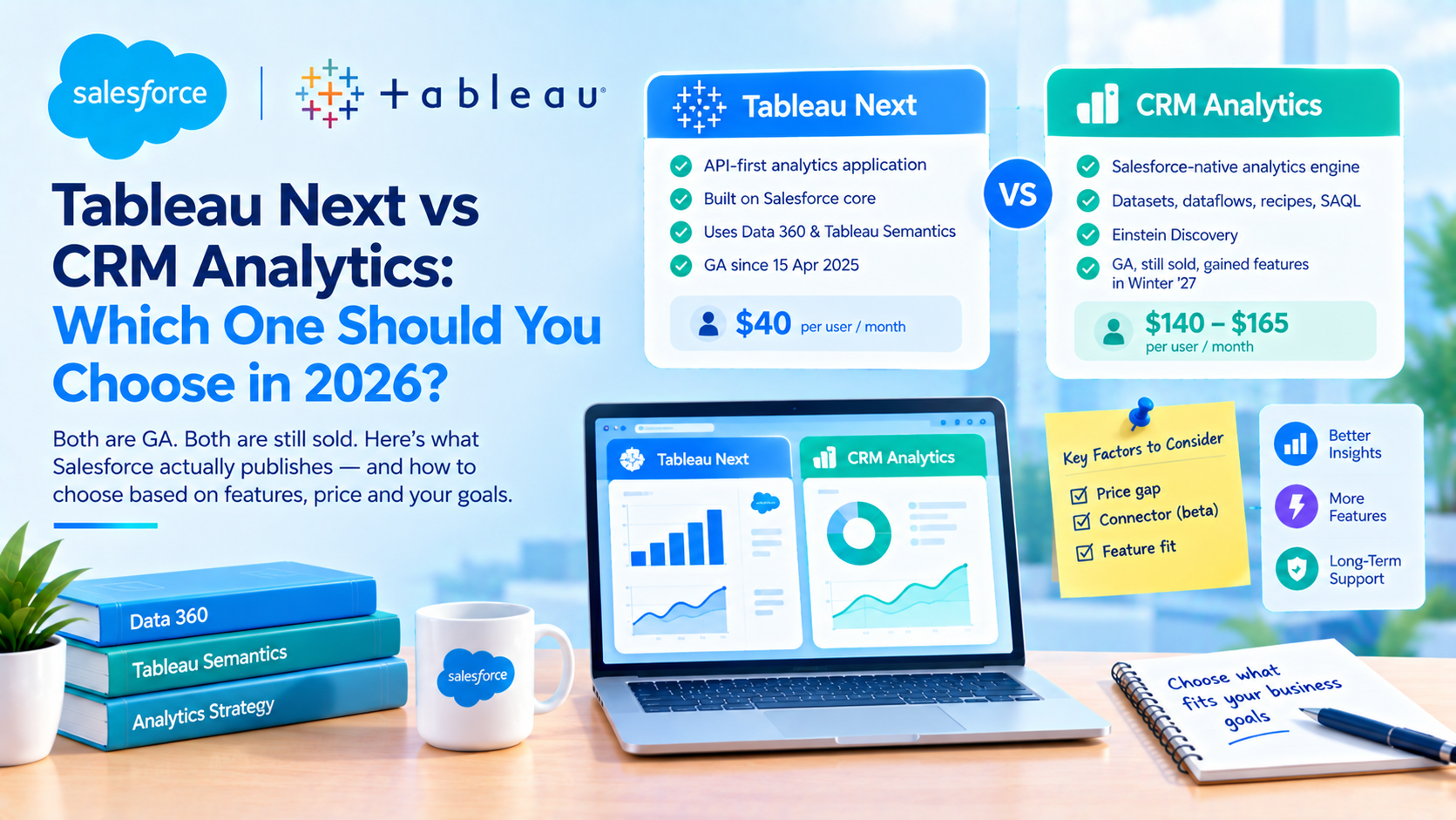
Tableau Next vs CRM Analytics: Which to Build On
Tableau Next and CRM Analytics are both generally available, both still sold, and both still getting features. Tableau Next lists at USD 40 per user per month, CRM Analytics Growth at USD 140 and Plus at USD 165. Salesforce has published no end-of-sale or end-of-life notice for CRM Analytics, and Winter '27 shipped a brand-new CRM Analytics MCP server. So choose on feature fit, not on a retirement rumour, because the rumour is not sourced to Salesforce.
That is the answer most of the posts on this question get wrong, in both directions. One camp says CRM Analytics is dead and you must move now. The other says Tableau Next is immature and you should ignore it. Neither survives a look at what Salesforce actually publishes, and the real decision turns on three things: a price gap that is not what it appears, a connector that is still in beta, and one feature with no destination at all.
What Tableau Next is, and how it differs from the other things called Tableau
The naming is the reader's real problem, so start here. There are five distinct products in this space and they are not versions of each other.
| Name | What it actually is | Where it runs | Status |
|---|---|---|---|
| Tableau Desktop, Server, Cloud | Classic Tableau. VizQL, workbooks, extracts, Tableau Prep, Tableau Bridge. Its own release train, 2026.1, 2026.2 and so on | Tableau-hosted or customer-hosted, Desktop is a client | GA, actively released |
| Tableau Pulse | Metric monitoring and insight digests inside classic Tableau Cloud and Server | Tableau Cloud or Server | GA, included in all Tableau Cloud editions |
| Tableau Semantics | A governed semantic layer that lives inside Salesforce Data 360 | Data 360 | GA since 15 April 2025 |
| Tableau Next | An API-first analytics application on the Salesforce core platform, built on Data 360 and Tableau Semantics. Its own asset types: workspaces, semantic models, metrics, visualisations, dashboards | Salesforce org plus a Data 360 instance | GA since 15 April 2025, several sub-features still beta |
| CRM Analytics (was Einstein Analytics, then Tableau CRM) | The Salesforce-native analytics engine: datasets, dataflows, recipes, lenses, SAQL, Einstein Discovery | Salesforce org | GA, still sold, gained features in Winter '27 |
Two corrections to the assumptions we hear most often. Tableau Next is not Tableau Cloud with a new name, and classic Tableau is not being folded into it. They share a release train on tableau.com, so features for both appear on the same 2026.2 release pages, but they are architecturally separate. And Tableau Semantics is not part of Tableau Next, it is part of Data 360. Salesforce's own semantic layer documentation describes it as providing "business context and a single source of truth for data in Salesforce Data 360".
Tableau Next is a real product rather than a brand, which is worth establishing because Salesforce has shipped umbrella names that were not. It has a REST API, a hosted MCP server with a documented tool list, semantic models as first-class Salesforce metadata, and its own permission set licences.
One naming oddity to be ready for. "Concierge" and "Data Pro", both announced for GA in June 2025, no longer appear as named components on the current Tableau Next product page. Concierge survives as a prerequisite toggle in the MCP documentation, where the analyze_data tool requires that "Concierge is enabled in your Salesforce Org". The current vocabulary is Tableau Agent, Tableau Semantics and Tableau Knowledge. Salesforce never announced the rename, so if you have a 2025 architecture document naming Concierge and Data Pro, it is not wrong, it is just using words the product pages have dropped.
Is CRM Analytics being retired? What Salesforce actually says
No, and the evidence runs the other way.
Salesforce's Active Product and Feature Retirements list, last modified 16 September 2026, contains no entry for CRM Analytics, Tableau CRM, Einstein Analytics, Einstein Discovery or Tableau. The analytics-adjacent entries on it are Einstein Prediction Builder and the Einstein Vision and Language APIs, both carrying an order end date, and Einstein Relationship Insights with a date of 1 April 2027.
What Salesforce does say, on the Tableau Next product page, is this: "While Tableau Next is the next generation of our analytics portfolio and will be the pathway to the latest generative AI and agentic capabilities for analytics, CRM Analytics will continue to exist for customers who are not ready for that journey."
That is a direction statement with an explicit commitment to continuity. It is not a retirement notice, and the difference matters when you are deciding whether to spend a quarter on a migration.
The strongest counter-signal is what shipped last month. Salesforce's Winter '27 CRM Analytics release notes list a new CRM Analytics MCP server ("Query Your Analytics Data in Natural Language with CRM Analytics MCP Server"), alongside Gantt chart visualisations, a dedicated CRM Analytics recycle bin, 18-digit measure precision, increased dashboard page limits, and live Data 360 widget subscriptions. Vendors do not build a new MCP server for a product they are winding down. If anything, that release note is the clearest evidence available that CRM Analytics has a roadmap.
We have seen this exact pattern before, with Salesforce CPQ: end of sale is not end of life, and the circulating end-of-life date is analyst inference rather than vendor announcement. CRM Analytics has not even reached end of sale. Its pricing page carries live list prices today.
The nearest thing to a Salesforce human saying otherwise is Tableau CEO Ryan Aytay, in an interview from October 2024, saying that feeding Tableau analytics into Salesforce UI means "over time, this will become the new CRMA". That is a two-year-old statement of direction from before the Tableau Next name existed. It is not a date, and nobody should be planning a migration around it.
What the two actually cost, and why the 71% gap is not a saving
Every figure here is a published list price, fetched on 5 October 2026, with the source linked.
| Product or tier | Published list price, per user per month | Billing term as published |
|---|---|---|
| Tableau Next, standalone | USD 40 | Billed annually |
| Tableau+ bundle (Tableau Next plus Tableau Cloud+) | Contact Sales | n/a |
| CRM Analytics Growth | USD 140 | Billed annually |
| CRM Analytics Plus | USD 165 | Billed annually |
| Revenue Intelligence, Service Intelligence, Industry Cloud Intelligence | USD 220 each | Billed annually |
| Tableau Cloud Standard: Creator / Explorer / Viewer | USD 75 / 42 / 15 | Billed annually |
| Tableau Cloud Enterprise: Creator / Explorer / Viewer | USD 115 / 70 / 35 | Billed annually |
| Tableau Pulse | No separate price, included in all Tableau Cloud editions | n/a |
| Tableau Semantics | No separate price, included with Tableau Next | n/a |
| Einstein Discovery | No separate price, requires CRM Analytics Plus or an Einstein Predictions licence | n/a |
USD 40 against USD 140 is a 71% gap on the seat, and it is the most quotable number in this topic. It is also the most misleading, and here is why.
CRM Analytics' USD 140 is all-in on the Salesforce org you already have. Tableau Next's USD 40 is not. Salesforce states on the pricing page that "Every customer that purchases Tableau Next will receive an org on the Salesforce platform as well as a Data 360 instance." The Data 360 instance is not optional and Trailhead corroborates the architecture, describing Tableau Next as built with "Data 360 as its hyperscale data layer".
The pricing wording on that page deserves quoting in full, because the second sentence qualifies the first substantially: "Tableau Next pricing is now Role-based, eliminating consumption-based pricing (like Flex credits) for data queries, data transforms, and agentic analytics. Data Services Credits and/or Flex Credits costs may still apply."
So consumption pricing has been removed for the named analytics operations, and consumption costs may still apply for everything else. Salesforce's billing considerations for Tableau Next sets out three billable categories: Data 360 usage, Data 360 storage usage above allocation, and Agentforce and generative AI usage.
Where that lands in credits is worth knowing, because it tells you which activity to watch. Salesforce's Flex Credits rate card dated 31 August 2026 has no Tableau, Tableau Next, analytics, dashboard or semantic usage type on it at all. Tableau Next consumption bills entirely through Data 360 usage types. At the base tier, Data 360 Queries cost 3 credits per million rows processed, and Data 360 Prep costs 40 credits per million rows. Prep is 13 times the cost of Queries. So the bill does not land where people expect it. Dashboard viewing is cheap. The transformation job that feeds the dashboard is where the consumption goes, which is exactly where a CRM Analytics recipe would have been doing the same work for no incremental charge.
The rate card publishes multipliers and no credit-to-dollar rate. Credit price is contractual. That means the seat comparison is knowable at 40 against 140, and the total comparison is not computable from published prices at all. Any cost model that puts a total next to those two numbers is estimating, and should say so.
Is Tableau Next included in Core, Advanced and Max? Salesforce gives two answers
We checked both pages ourselves on 5 October 2026 because the answer is worth several hundred dollars a seat, and they disagree.
The Tableau Next pricing page states: "Tableau Next with Tableau Agent is included in Core, Advanced, and Max editions for Sales, Service, and Industry Clouds".
The Service Cloud pricing page shows the Tableau Next row as "Available for purchase" at Starter Suite, Pro Suite, Core (USD 195) and Advanced (USD 395), and included only at Max (USD 550), where the edition's feature list reads "Tableau Next, Slack Enterprise+" with 2.75M Flex Credits per org per year.
Both pages are live Salesforce pricing pages. Both were modified within the last fortnight. We cannot resolve it from published sources, and we are not going to pretend otherwise.
The practical consequence is simple and it is the single most useful thing in this post for anyone mid-negotiation. Tableau Next is reliably included at Max. At Core and Advanced, get the inclusion written into the order form. Do not let a pricing-page screenshot stand in for a contractual entitlement, because the other pricing page says you are buying it.
What CRM Analytics still does that Tableau Next does not
This section is why some clients cannot move yet whatever the seat price says.
- SAQL. Salesforce Analytics Query Language is a CRM Analytics construct, used behind the scenes in lenses, dashboards and explorer. It appears nowhere in Tableau Next's documentation. Tableau Next's equivalent is the Semantic Query API and Metric Query API against a semantic model, which is a different model, not a different syntax. Every SAQL step, every custom binding and every compare table is a rebuild.
- Dataflows and recipes. These are CRM Analytics objects with their own published limits. Tableau Next has no dataflow or recipe equivalent. Its data preparation is Data 360 Prep plus Tableau Agent's semantic-modelling assistance, and that assistance is beta.
- Einstein Discovery. CRM Analytics only, requiring CRM Analytics Plus or an Einstein Predictions licence. No Tableau Next equivalent is published. More on this below, because it is the hardest blocker in the topic.
- Change-set asset migration. CRM Analytics assets move between orgs via change sets. We found no equivalent change-set path for Tableau Next assets.
- A published limits table. CRM Analytics has one. Tableau Next does not. For a regulated client, that absence is itself a finding.
And the one that decides it for most Salesforce-centric reporting workloads: Tableau Next's native Salesforce Connector is in beta. That is the status on tableau.com's own release pages as of the August 2026 and 2026.2 releases. CRM Analytics' Salesforce connector has been GA for years. If the job is reporting on Salesforce CRM data, the newer product's route to that data is not yet generally available, and no price gap compensates for that on a production reporting platform.
Also in beta on Tableau Next: Auto Semantic Model Creation, Q&A Calibration, Pace to Threshold Insights, Tableau Agent's data connection and semantic modelling capabilities, the MCP authoring tools, and the Inspector proactive-insights alerts. Semantic Search is pilot. These are real features and several will be excellent. They are not features to put in a go-live plan this quarter.
What Tableau Next does that CRM Analytics cannot
Fair is fair, and the GA list is substantial. All of the following are GA per tableau.com's release pages, which are the most status-precise source available since the Salesforce help release-notes pages do not render reliably:
- Tableau Semantics as a governed semantic layer with composability overrides, letting an extended model customise inherited business logic. CRM Analytics has no semantic layer in this sense at all, and this is the genuine architectural advance.
- Tableau Agent for conversational analytics, described by Salesforce as "a collection of pre-built agentic capabilities that enable conversational analytics, deliver proactive insights, and automate data prep and semantic modeling".
- Semantic Model Builder and Smart Canvas, plus a Tableau Semantics DX extension for programmatic semantic model management.
- Composable Tableau views and Tableau Pulse metrics as Lightning web components, with Winter '27 adding embedded dashboards on tablets and an embedding SDK.
- Radial layout charts, Actions (filter, parameter, multi-select), CSV export, and alerts inside Agentforce health monitoring.
- Semantic models as first-class Salesforce metadata, which is what makes governance and deployment tractable in a way CRM Analytics dataflows never were.
The MCP server used to be a clean Tableau Next differentiator. As of Winter '27 it is not, because CRM Analytics has one too.
Limits: one product publishes them and one does not
CRM Analytics' published limits, verified 5 October 2026:
| Limit | Value |
|---|---|
| Dataset row allocation, CRM Analytics Growth | 100 million |
| Dataset row allocation, CRM Analytics Plus | 10 billion |
| Rows per dataset | 2 billion |
| Fields per dataset | 5,000, including up to 1,000 date fields |
| Dataflow and recipe runs per rolling 24 hours | 60, with runs under two minutes not counted |
| Concurrent recipe runs | 3, with concurrency sharing enabled |
| Concurrent dataflow runs | 2 on production Plus, 1 on Growth and sandbox |
| API calls per user per hour | 10,000 |
| Concurrent queries | 50 per platform org-wide, 10 per user |
| Query timeout | 2 minutes |
| Default maximum rows returned | 25,000 |
| Dashboard JSON size | 4 MB |
| Components per dashboard | 20 |
The 60 runs per rolling 24 hours is the one that bites in practice, and the carve-out matters: runs completing in under two minutes do not count against it. Even so, a client wanting hourly refresh across more than two substantial pipelines is already close to the ceiling, and that is an org-wide cap rather than a per-dataflow one.
Tableau Next has no published limits table that we could locate. Salesforce's own workspaces documentation cross-references an article titled "Tableau Next Considerations, Guidelines, and Limits" at analytics.tua_limits_and_guidelines.htm, and that URL does not resolve to that article. It served an unrelated connector beta page instead. Repeated site-scoped searches failed to surface the limits article anywhere.
A single third-party blog post circulates figures including a 200-asset-per-workspace hard limit. It cites no Salesforce source, we could not confirm any of it against Salesforce documentation, and we are therefore not putting those numbers in a table next to verified ones. If you need a Tableau Next limit for a design decision, the honest answer today is to get it from your account team in writing.
What is knowable is that Tableau Next's effective data limits are Data 360's limits, and its effective consumption ceiling is the Data Services or Flex Credit entitlement rather than a row count.
What migrating from CRM Analytics actually involves
There is no Salesforce-provided migration tool from CRM Analytics to Tableau Next. We searched help, Trailhead, architect and developer documentation. There is no Trailhead migration module, and the 15-item Tableau Next trail contains nothing on migration. There is no architect decision guide for choosing between the two products.
That absence is informative rather than accidental, because Salesforce does build this material when it wants to: a Tableau Server to Tableau Cloud migration module exists on Trailhead today.
What exists instead is a data and semantics bridge. The CRM Analytics Data Prep output node supports Data 360 as a target, letting you save prepared data as a Data 360 data lake object, and Salesforce says recipes can be turned into semantic models. Read that carefully. Turning a recipe into a semantic model means re-expressing the transformation logic in a different system. The data moves. The logic is rewritten.
| CRM Analytics asset | Published path to Tableau Next |
|---|---|
| Dataset | Can be written to Data 360 as a data lake object. The data moves, the dataset object does not |
| Recipe | Output node can target Data 360. The transformation logic is re-expressed, not lifted |
| Dataflow | No path published. Manual |
| Dashboard or lens | No converter. Manual rebuild |
| SAQL steps, bindings, compare tables | No converter and no SAQL in Tableau Next. Full manual rebuild |
| Einstein Discovery model | No path published, and no equivalent feature |
On coexistence, the news is good and it is worth stating because the equivalent is not true elsewhere in the Salesforce portfolio. Both products can be provisioned in one org, the licences and permission sets are separate and independent, and Salesforce's own recommended bridge requires both to be live simultaneously. Tableau Next licences require Data 360 licences, Data Cloud Architect or Data Cloud User, and do not touch CRM Analytics licensing. We found no statement that enabling one restricts the other. That is an absence of a documented restriction rather than a documented guarantee, which is a meaningful difference if you are writing a contract, but it is a far better position than the Revenue Cloud and CPQ situation where billing is disabled while both are provisioned.
Einstein Discovery is the blocker nobody has solved
Einstein Discovery is still GA, still licensed, still absent from the retirements list, and has no published migration path and no Tableau Next equivalent. That is the whole answer, and the absence is the story.
Salesforce's documentation describes it as augmenting business intelligence "with statistical modeling and supervised machine learning", requiring CRM Analytics Plus or an Einstein Predictions licence. Its published capacities are specific: training datasets from 400 rows up to 20 million, up to 50 columns, 100 models per org per day and 500 per month, unlimited active prediction definitions with CRM Analytics Plus against 10 with an Einstein Predictions licence, and automated prediction writeback of 500,000 records per rolling 24 hours or 5 million with high-volume writeback.
Tableau Next's nearest published capabilities are beta: Pace to Threshold Insights and the Inspector alerts. Neither is a supervised learning model writing scored predictions back to Salesforce records.
So a client with production Einstein Discovery prediction definitions driving a sales process has no documented destination in Tableau Next today. That is the reason some organisations cannot move whatever the price difference, and it is worth saying plainly because the migration posts never mention it.
One adjacent signal, with the caveat it needs. Einstein Prediction Builder carries an order end date on the retirements list, as do the Einstein Vision and Language APIs. Prediction Builder is the lightweight sibling that shares the Einstein Predictions licence with Einstein Discovery. End of sale for the sibling is not end of life for Einstein Discovery and should not be presented as one, but it is the only directional evidence in existence.
What we would actually recommend, and where we would not
We specify Tableau Next where the analytics requirement is new, the data already lives in or is heading into Data 360, the consumers want conversational and embedded insight rather than authored dashboards, and nobody is depending on SAQL or Einstein Discovery. The semantic layer is a genuine architectural improvement over CRM Analytics dataflows, and semantic models as first-class metadata make governance tractable.
We keep clients on CRM Analytics where there is an existing estate of dashboards and recipes, where Einstein Discovery is in production, or where the reporting is predominantly over Salesforce CRM objects. That last one is the decisive case and it is about status rather than capability: with the native Salesforce Connector still in beta, moving a Salesforce reporting workload to Tableau Next means putting a beta component on the critical path.
The option we have stopped recommending is the phased dashboard-by-dashboard migration. It sounds prudent and it is the default proposal, so it is worth saying why it loses. Because there is no converter, each dashboard is a rebuild, and because there is no SAQL in Tableau Next, the rebuild is a redesign rather than a port. Running both platforms for eighteen months means paying both seat costs, maintaining two semantic definitions of the same metric, and fielding "which number is right" questions from the business every week. Where a client has decided to move, we now scope a single cutover of a defined reporting domain, finance or service or pipeline, complete with its own semantic model, and leave the rest on CRM Analytics untouched until that domain is live and trusted.
One more thing worth noticing, since the whole topic is thick with urgency that nobody is sourcing. Salesforce held Dreamforce in September 2026 and announced nothing about Tableau. The Tableau newsroom's most recent item is dated 5 May 2026, and the Dreamforce announcements blog of 28 September 2026 does not mention Tableau, Tableau Next or Tableau Semantics anywhere. The Tableau announcements the market attributes to Dreamforce came from Tableau Conference in May 2026. A vendor that said nothing about its next-generation analytics product at its largest event of the year, while shipping a new MCP server for the product it supposedly supersedes, is not running a migration deadline.
Frequently Asked Questions
Is CRM Analytics being discontinued?
No. CRM Analytics does not appear on Salesforce's Active Product and Feature Retirements list as of its 16 September 2026 update, it still carries published list prices of USD 140 for Growth and USD 165 for Plus, and Winter '27 added new features including a CRM Analytics MCP server, Gantt charts and a dedicated recycle bin. Salesforce states that CRM Analytics "will continue to exist for customers who are not ready" for Tableau Next.
How much does Tableau Next cost compared with CRM Analytics?
Tableau Next lists at USD 40 per user per month billed annually, against CRM Analytics Growth at USD 140 and Plus at USD 165. The seat gap is 71%, but it is not a like-for-like total: Tableau Next requires a Data 360 instance and may incur Data Services or Flex Credit costs, and Salesforce publishes no credit-to-dollar rate. The total cost of Tableau Next cannot be calculated from published prices.
Is Tableau Next included in Salesforce Core, Advanced and Max editions?
Salesforce gives two answers. The Tableau Next pricing page says it is included in Core, Advanced and Max for Sales, Service and Industry Clouds. The Service Cloud pricing page shows it as "Available for purchase" at Core and Advanced, and included only at Max. Both pages were live on 5 October 2026. Treat inclusion as reliable at Max only, and get it written into the order form at Core or Advanced.
Can CRM Analytics dashboards be migrated to Tableau Next automatically?
No. There is no Salesforce-provided migration tool, no Trailhead migration module and no architect decision guide. CRM Analytics datasets can be written to Data 360 as data lake objects, and recipe logic can be re-expressed as semantic models, but dashboards, lenses and all SAQL require a full manual rebuild because Tableau Next does not support SAQL at all.
What happens to Einstein Discovery if we move to Tableau Next?
Nothing is published. Einstein Discovery remains GA, still requires CRM Analytics Plus or an Einstein Predictions licence, and is not on the retirements list, but Salesforce has published no migration path and no Tableau Next equivalent. The nearest Tableau Next capabilities, Pace to Threshold Insights and Inspector alerts, are beta and are not supervised learning models writing predictions back to records.
Can we run Tableau Next and CRM Analytics in the same org?
Yes. The licences and permission sets are separate and independent, Tableau Next requires Data 360 licences that do not affect CRM Analytics licensing, and Salesforce's own recommended bridge from CRM Analytics recipes into Data 360 requires both to be live at once. We found no published statement that enabling one restricts the other, though that is an absence of a documented restriction rather than a stated guarantee.
The decision that actually needs making
The question we get asked is "should we move to Tableau Next". The question that determines the answer is narrower: does anything in your current reporting estate depend on SAQL, on an Einstein Discovery prediction definition, or on the Salesforce connector being generally available. If the answer to all three is no, the seat price is a real saving and the semantic layer is a real improvement. If the answer to any one of them is yes, the migration has a blocker that no amount of project management removes.
Our Salesforce consulting services cover both platforms, and we have no incentive to push you at the newer one.
Working out which of those three applies to a given org takes an inventory rather than a workshop: a count of dashboards with SAQL steps, a list of active prediction definitions, and the source objects behind your top twenty dashboards. We do that as a fixed-scope assessment and the output tells you whether this is a cutover you can plan this year or one that waits for Salesforce to ship a connector. Send us the dashboard inventory and we will tell you which it is.
Have Questions or Need Assistance?
Our team of Salesforce experts is ready to help you implement the solutions discussed in this article.
Contact Us Today