What Dreamforce 2026 Changes About Your Salesforce Budget
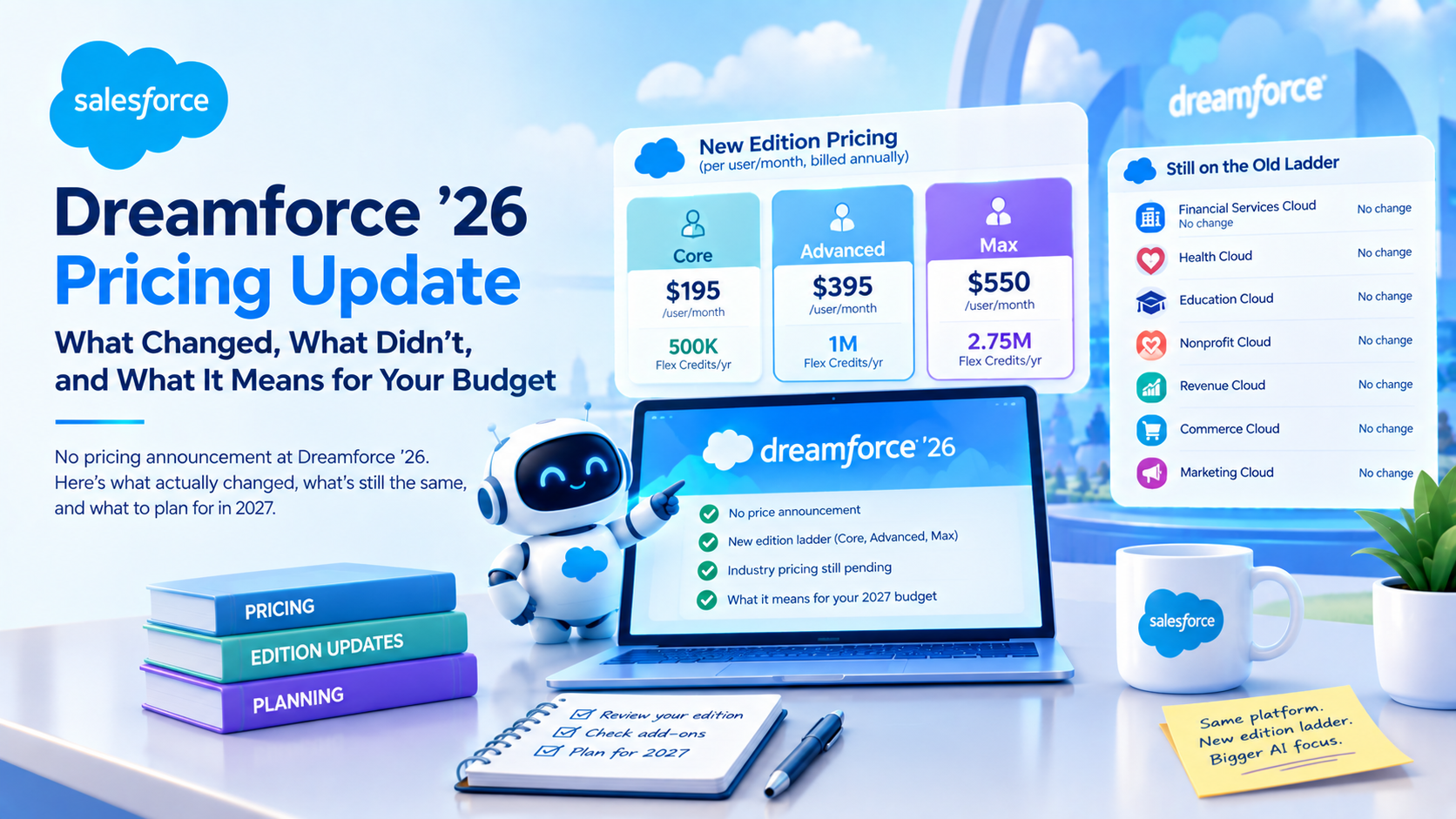
Dreamforce '26 made no pricing announcement at all. The Core, Advanced and Max edition ladder was announced separately on 3 September 2026, industry cloud pricing was promised for "later this fall" and had still not appeared as of 22 September, and three of the four headline products carry no published price. For anyone building a 2027 Salesforce budget, the useful news from Dreamforce is what it did not change.
That is not a complaint about the conference. It is a planning constraint. A keynote with 1,600 sessions and a FY2030 revenue target produced no number you can put in a spreadsheet, and several of the numbers you already had are now contradicted by Salesforce's own pages.
What your edition costs after 3 September
Verified on the Sales Cloud pricing page and the Service Cloud pricing page on 22 September 2026. Both carry the identical structure, per user per month billed annually.
| Edition (published list price, verified 22 Sep 2026) | Price | Flex Credits per org per year |
|---|---|---|
| Starter Suite | USD 25 | none included |
| Pro Suite | USD 100 | none included |
| Core | USD 195 | 500,000 |
| Advanced | USD 395 | 1,000,000 |
| Max | USD 550 | 2,750,000 |
Against the previous ladder, Core is roughly 11% above Enterprise at USD 175, Advanced roughly 13% above Unlimited at USD 350, and Max is flat against Agentforce 1 at USD 550. Existing customers may stay on their current editions at current pricing, and Agentforce 1 customers move to Max at no additional cost.
Add-ons published on the Service page, which are the lines most often missed in a renewal model: Knowledge with read-write at USD 75 per user per month from Core upwards, Einstein Bots at USD 75 on Core, Enhanced Messaging at USD 75 on Core and Advanced, and the Web Services API at USD 25 on Pro Suite.
Salesforce's claims that Max represents "60% more value than Agentforce 1 Edition" and "up to USD 500 in added value" are vendor value statements, not measurements. Treat them as you would any vendor percentage.
Which products are still on the old edition ladder
We checked every industry pricing page individually on 22 September 2026. None has moved to Core, Advanced and Max.
| Product (published, verified 22 Sep 2026) | Current editions and prices | Moved? |
|---|---|---|
| Financial Services Cloud | Sales USD 325, Service USD 325, both USD 350, Agentforce 1 USD 750 | No |
| Health Cloud | Enterprise USD 350, Unlimited USD 525, Agentforce 1 USD 750 | No |
| Education Cloud | Enterprise USD 87, Unlimited USD 145, Agentforce 1 USD 375 (nonprofit institution pricing) | No |
| Nonprofit Cloud | Enterprise USD 60, Unlimited USD 100, Agentforce 1 USD 135 | No |
| Revenue Cloud | Growth USD 150, Advanced USD 200 | No |
| Commerce Cloud | All editions "contact for pricing" | No |
| Marketing | Org-based, Marketing Cloud Next Growth USD 1,500 and Advanced USD 3,250 per org per month | No |
Two things follow from that table.
Revenue Cloud's "Advanced" is USD 200 per user per month. The new Advanced edition is USD 395. Same word, two products, nearly double the price. If a proposal says Advanced without naming the product, send it back.
The industry pages have not been touched since before the repricing. The Health, Education and Nonprofit pricing pages carry a last-modified date of 28 August 2026, five days before the new ladder was announced. That is consistent with an industry repricing still in preparation rather than an oversight, but it means every industry figure you are working from predates the change. Salesforce's wording is that new pricing for "Agentforce Industry Editions" goes into effect later this autumn. No date has been attached, and Dreamforce did not attach one.
If you are renewing an industry cloud in the next two quarters, that unannounced repricing is the largest single uncertainty in your model. Ask your account executive for the timing in writing, and ask what happens to your renewal if it lands mid-term.
The Flex Credit overage question finally has an answer
We have looked for a published Flex Credit overage rate across six research passes and never found one. The reason is now clear: there is no overage rate, because there is no overage penalty. Salesforce's Agentforce pricing page states it directly.
"There is no overage penalty. If you exceed your entitlement, your rate is your contracted rate billed monthly in arrears."
Two accompanying terms from the same page belong in the model beside it. Unused Flex Credits do not roll over into subsequent subscription terms. And Flex Credits and Conversations are not supported in the same org, so each org commits to one consumption model.
Taken together those three facts change how you should size an entitlement. Because there is no penalty multiplier, over-committing is now the more expensive error: credits you do not use expire, while credits you exceed simply bill at the rate you negotiated. The incentive is to commit conservatively and let the arrears line absorb growth, which is the opposite of how most teams instinctively buy capacity.
On unit price, Salesforce publishes worked examples rather than a rate. Case management at 3 actions and 60 credits for USD 0.30, field service scheduling at 6 actions and 120 credits for USD 0.60, and employee onboarding at 1 action and 20 credits for USD 0.10 all imply USD 0.005 per credit, which makes a standard action USD 0.10 and a voice action USD 0.15.
Describe that as implied by Salesforce's own examples rather than as a published rate, and check the arithmetic on any example you cite. A fourth example on the same page gives reservation management at 4 actions and 120 credits for USD 0.15, which reconciles at no consistent rate. That inconsistency was live when we checked on 22 September 2026.
What has no published price at all
Four of the most-discussed items from Dreamforce have no commercial terms from anybody.
- Claudeforce. Beta, approval gated, and neither Salesforce nor Anthropic has published pricing, metering, or whether it consumes Flex Credits, Einstein Requests or Agentforce Conversations. The one certain cost is a paid Claude plan, with Team or Enterprise needed for org-level distribution.
- Koa. Pilot now, GA expected winter 2026 in US regions only. No pricing, no credit consumption rate, no international date, and no documented pilot signup route.
- The Headless Experience Layer. Open beta, no pricing, and no statement on whether it consumes credits.
- The Enterprise AI Harness. Salesforce explicitly deferred pricing, packaging and upgrade paths to "closer to general availability", with the unified experience not rolling out until early fiscal FY28.
There is nothing improper about announcing before pricing. The planning consequence is simply that none of these can carry a budget line this cycle, and any partner quoting you a per-user figure for Claudeforce today is extrapolating. Ask what from.
Three things Salesforce made free, and they are worth real money
The genuine packaging news at Dreamforce was not a new SKU. It was three inclusions.
- Builder Central, a no-code builder for apps, agents and experiences, in beta from the week after Dreamforce and described as "included free in every org with reasonable usage limits" for customers with Agentforce enabled.
- Security Center Essentials, a no-cost security dashboard available now, needing only the View Security Center Pages permission.
- The Agentforce Vibes free tier, restored after a paid-only period, giving Developer Edition orgs 50 requests or one million tokens daily.
The second of those is the one we would action first. A no-cost security dashboard that an admin can switch on in an afternoon is unusually good value for something that costs nothing, and "reasonable usage limits" on Builder Central is worth pinning down before anyone builds anything load-bearing on it.
Where Salesforce's own pricing pages contradict each other
This matters for budgeting because a procurement team will quote whichever page they found.
The Agentforce pricing page is stale. It still describes "Agentforce 1 Editions" starting at USD 550 per user per month with 1M Flex Credits and 2.5M Data 360 Credits per org per year. The Sales and Service pricing pages describe Max at the same USD 550 with 2.75M Flex Credits. Same price, different edition name, different allocation, both live simultaneously. Use the Sales or Service page.
The marketing pricing page uses three names on one page. The heading says Agentforce Marketing, the body copy and FAQ say Marketing Cloud, and the SKUs are named Marketing Cloud Next Growth and Advanced.
Two live pages still say Data Cloud rather than Data 360, including the Health Cloud pricing page, which lists Data Cloud credit allocations of 250,000 per org per year on Enterprise and Unlimited and 2.5M plus 1TB storage on Agentforce 1.
A generic Flex Credits rate card PDF is still published saying "Updated as of May 2025", alongside the current card dated 17 June 2026.
Underneath all of this sits a story Salesforce has never confirmed. Around 14 September, days before Dreamforce, The Information reported that Salesforce had dropped "Agentforce" from product names, with Sales Cloud returning and Headless 360 Platform reverting to Salesforce Platform. Salesforce said nothing about it across three days of keynotes and has not commented since. Its own pricing pages corroborate the reporting: the Sales page is titled Sales Cloud, the Service page is titled Service Cloud.
The practical advice is dull and worth following anyway. Do not rename anything in your internal documentation, contracts or training material to match the October 2025 rebrand. Wait until the pages settle.
Vendor numbers from the keynote, and what to do with them
Salesforce raised its FY2030 revenue target to more than USD 63 billion, against Bloomberg consensus of USD 61.4 billion. That figure includes revenue from Informatica, which closed in November 2025, so it is not organic growth.
On Agentforce, the published figures from the Q2 FY27 release on 26 August 2026 are Agentforce ARR exceeding USD 1.5 billion and Agentforce plus Data 360 ARR of nearly USD 3.9 billion, on total quarterly revenue of USD 11.3 billion, up 11%.
The growth rates attached to those ARR figures, 240% and 210%, are not like for like, and Salesforce says so in the same document: "Effective Q2 FY27, Agentforce ARR includes our AI offerings, Slackbot and Headless 360." The prior-year base does not contain them. Quote the absolute figures and leave the growth rates alone.
The keynote claim that 30,000 customers are now live on Agentforce has no published definition of "live" and appears on no Salesforce page we could find. Deep Analysis estimates that roughly 8,500 are actually in production. If you use one of those numbers in a business case, use both and name the gap.
The most useful number Salesforce published is one of the least flattering. Its own Agentic Enterprise Index reports escalation rates holding at 32%, with agents resolving roughly seven in ten interactions without escalation. Independent work by CallMiner and Metropolis puts a further 5 to 15 point gap between raw containment and genuine end-to-end resolution. Apply that to any vendor deflection figure you are shown, including the ones in Salesforce case studies.
How to build a 2027 Salesforce budget from this
- Price your seats off the Sales or Service pricing page, not the Agentforce pricing page, which is stale by one edition generation.
- Flag every industry cloud renewal falling in the next two quarters as carrying unannounced pricing risk, and get the repricing timing in writing.
- Size Flex Credits conservatively. No rollover and no overage penalty means under-committing is the cheaper error.
- Add a Data 360 storage line for observability. Session tracing consumes storage beyond allocation even though it no longer consumes compute credits.
- Budget agent testing as metered. Salesforce's documentation currently says both, and the balance of evidence favours metered.
- Leave Claudeforce, Koa, HXL and the Enterprise AI Harness out of the numbers entirely. No published price means no line item.
- Claim the free things. Security Center Essentials, Builder Central in beta, and the restored Agentforce Vibes tier.
- Model escalation at around a third, not at the rate in the case study, and discount any deflection figure by the containment-to-resolution gap.
What we would not budget for yet, and why
We would put money behind the six generally available agents and multi-agent orchestration. Those have a status, a home in existing licensing, and a published consumption model. They are the buyable subset, and for a service organisation already paying for escalation handling, they are the item most likely to return something this financial year.
We would not put a line against Claudeforce, however much a sales team wants it. Not because it is a bad product, but because a budget line needs a price, and there is not one. The same applies to Koa with more force: pilot access with no documented signup route, GA in US regions only, and no international date. For a UK or EU business it is not a 2026 item at all.
The alternative we have watched clients choose, and would advise against, is provisioning a large Flex Credit entitlement now to cover everything announced. It feels prudent and it loses on the published terms: unused credits expire at the end of the subscription term, there is no penalty for exceeding the entitlement, and half the products it would be covering cannot be bought yet. Buy for what you will deploy in the next two quarters and let the arrears mechanism handle the rest.
Frequently Asked Questions
Did Salesforce announce price increases at Dreamforce 2026?
No. Dreamforce '26 included no pricing or packaging announcement. The Core, Advanced and Max edition ladder at USD 195, USD 395 and USD 550 per user per month was announced separately on 3 September 2026, twelve days before the conference. Industry cloud pricing was promised for "later this fall" and had not appeared as of 22 September 2026.
How much do Salesforce Core, Advanced and Max cost?
Core is USD 195, Advanced is USD 395 and Max is USD 550 per user per month, billed annually, with Flex Credit allocations of 500,000, 1,000,000 and 2,750,000 per org per year respectively. Verified on the Sales and Service Cloud pricing pages on 22 September 2026. Existing customers may remain on their current editions at current pricing.
What happens if we use more Flex Credits than our entitlement?
Salesforce states there is no overage penalty, and that exceeding your entitlement bills at your contracted rate monthly in arrears. Unused credits do not roll over into subsequent terms. Because expiry costs you and overage does not carry a premium, committing conservatively and absorbing growth in arrears is usually the cheaper approach.
Has Health Cloud or Financial Services Cloud moved to the new editions?
No. As of 22 September 2026, Financial Services Cloud, Health Cloud, Education Cloud, Nonprofit Cloud, Revenue Cloud, Commerce Cloud and the marketing products all remain on their previous edition names and prices. Salesforce has said new pricing for industry editions takes effect later this autumn but has published no date.
How much does Claudeforce cost?
Nothing has been published by Salesforce or Anthropic, including whether it consumes Flex Credits, Einstein Requests or Agentforce Conversations. The only certain cost is a paid Claude plan, with Team or Enterprise required for organisation-level distribution. Because no commercial terms exist, Claudeforce cannot carry a budget line this cycle.
Is the Agentforce growth figure reliable?
The absolute figures are. Agentforce ARR exceeded USD 1.5 billion and Agentforce plus Data 360 ARR reached nearly USD 3.9 billion in Q2 FY27. The accompanying growth rates of 240% and 210% are not like for like, because Salesforce widened the metric definition in that same quarter to include Slackbot and Headless 360.
What to settle before your next renewal conversation
The specific problem Dreamforce '26 leaves you with is a budget cycle in which the loudest products have no price, the industry clouds have a repricing coming with no date, and Salesforce's own pages disagree on what your top edition is called and how many credits it includes. None of that is resolvable by reading harder.
Two questions will close most of it with your account executive: when does industry edition repricing take effect and what does it do to a renewal signed before then, and what is our contracted per-credit rate in writing. If you would like those modelled against your current entitlement and consumption before the conversation, we can do that with you.
Have Questions or Need Assistance?
Our team of Salesforce experts is ready to help you implement the solutions discussed in this article.
Contact Us Today